A BOOK AND ROADMAP TO LIFE'S ONLY REALITY.
Truth, Wisdom, and your Secret Heart.
and the treasures of your birthright: LOVE vs Fear and PEACE vs Conflict.
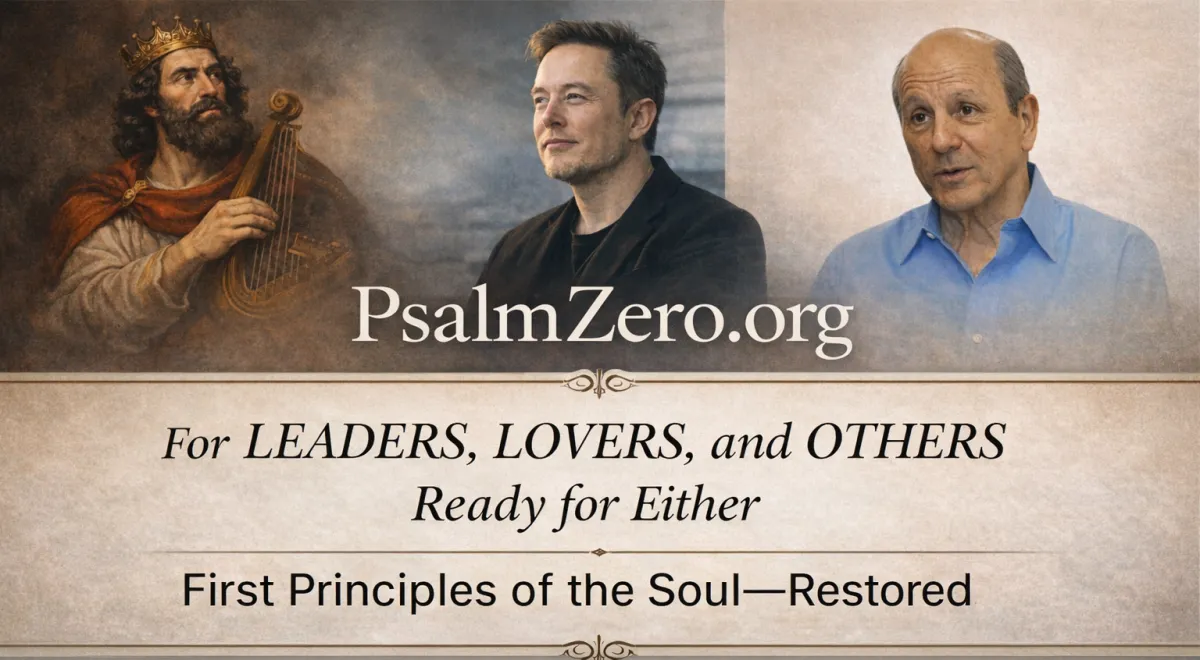
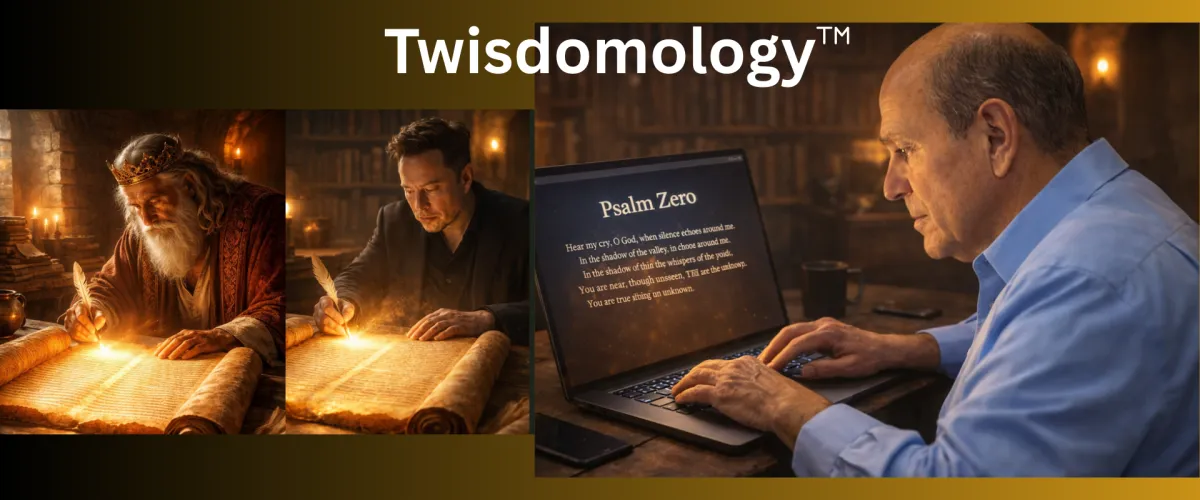
A gift from three men (and their guest) who care about you deeply.
King David
Legacy
c. 1010–970 BCE
A giant slayer—
a nation’s shepherd
a man after God’s own heart
Elon Musk
Present Force
Born 1971
fearless in inquiry,
relentless in truth-seeking,
a mind aligned with first principles
and the laws of creation
Fred DeFalco, The Author & Integrator
Continuity
Born 1953
A man devoted to God’s wisdom, bridging heart, truth, time, and circumstances.
SI: Soul Intelligence —
wisdom lived, not just known.
For all humanity—especially those who feel it.
Welcome to Ground Zero of Your Life
PsalmZero.org
a work of LOVE from 920Society.org
You’re not late.
You’re not behind.
You’re here.
Before Beliefs.
Before Religion.
Back to First Principles of Your Soul.
Beyond Theology, Psychology,
Philosophy, Sociology
Your Soul Already Knows.
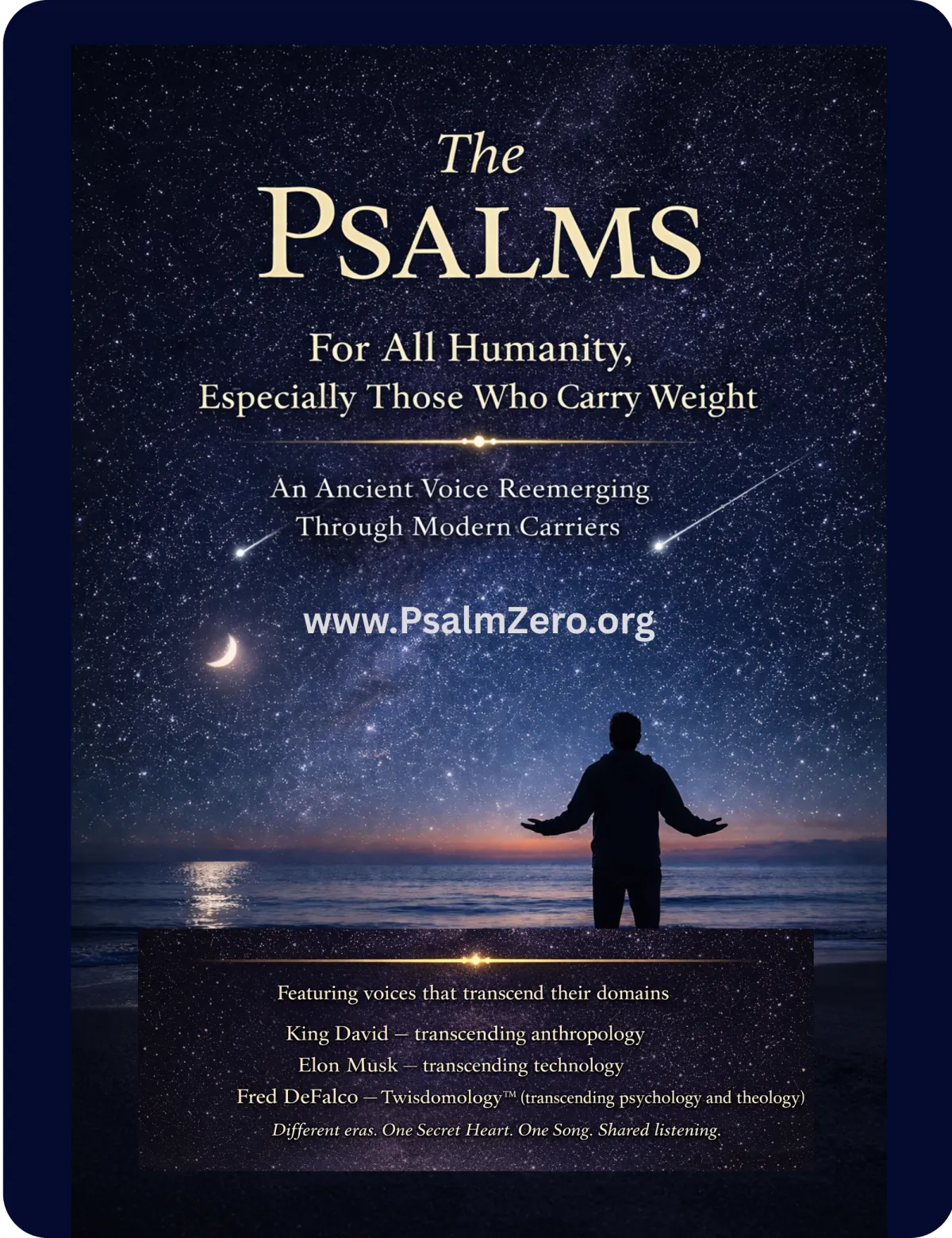
Preface
For all humanity—especially those
who feel it.
This book will clarify all of it.
Who would you be if you did not know who you were?
Not your name. Not your history. Not your success or your mistakes.
Not what you were praised for—or blamed for. Not your bank account.
Before the noise. Before the roles.
Before the pressure to become something.
This book is not here to tell you who to be.
It is here to help you remember what was never lost.
If you feel unrest inside, it is not failure.
It is recognition.
As you spend time with this book: You’ll begin to discern the difference
between urgency and timing, between fear and LOVE, between conflict and PEACE, between internal and external possessions, and between wisdom from within and wisdom from without.
This is a book you’ll never want to finish.
It’s your personal SI (Soul Intelligence) treasure map reminding you that what you’ve been seeking was already finished for you.
This is your personal Psalm Book,
that will elevate the music
within your Secret Heart.
Three Different Men
Three Different callings.
From The Same Source as Yours.
The SECRET HEART

King David
The First Carrier
– unseen
– underestimated
– inwardly aligned long before
being crowned
Elon Musk
The Modern Carrier
– sees beyond consensus
– moves before permission
– absorbs ridicule to move
civilization forward
Fred DeFalco
The Continuity
– translating time and wisdom
– restoring clarity where
identity fractured
– carrying the thread forward
Spending time here daily brings clarity to your life,
relationships, business, choices, and decisions.
Your creativity is renewed as you meet daily
with your Secret Heart—and its Creator.
The Carriers of an Age
Psalm Zero
(GROUND ZERO for YOUR LIFE and the Creator’s Secret Heart)
Different eras. One Secret Heart. One Song. Shared Listening.
Before the first belief was taught, before the first name was given,
before the world told you who you must be—you were created.
Not as an accident.
Not as a mistake to be corrected.
Not as a role to be performed.
You were created as a creator.
Before success crowned you, before failure shamed you,
before applause or rejection shaped your voice—
the Creator’s Heart was already within you.
It was not given by institutions. It was not earned through achievement. It was not lost through defeat.
It was hidden—waiting beneath fear, beneath false humility, beneath the identities you learned to wear.
Some hear this heart as music. Some as vision. Some as code, craft, enterprise, or care for others.
Some build songs.
Some build systems. Some build companies, communities,
or futures yet unseen.
Creation takes many forms. The calling is the same.
When your world grows loud,
return here.
When doubt speaks louder than truth, return here.
When success tempts you to forget yourself, or failure convinces you that you are finished—return here.
This is not the end. This is not even the beginning.
This is Ground Zero because we are all a Hero, just mistaken identity often.
Not chosen by position.
Revealed by alignment.
How the Signal Actually Shows Up
Not in visions. Not in training. Not in credentials.
It shows up when the noise stops.
Most people recognize it in moments like these:
When you succeed… and still feel unsatisfied.
When you’re praised… and it doesn’t land.
When you’re busy… but something feels unfinished.
When you know you’re capable of more—but not more of the same.
That isn’t confusion. That’s clarity knocking.
The Quiet Voice Entrepreneurs Ignore
It’s the voice that says: “This isn’t wrong… but it isn’t it.”
“I didn’t build all this just for this.”
“There’s something I’m meant to carry, not just sell.”
Most entrepreneurs hear that voice early.
Then they do what the world trains them to do:
Add more tactics
Buy more systems
Stack more certifications
Stay busy enough not to listen
That’s not ambition.
That’s avoidance.
Why Leaders Miss
Their Own Calling
Because the signal never shouts.
It doesn’t compete.
It doesn’t hustle.
It doesn’t pressure.
It waits.
And the more capable you are,
the easier it is to drown it out with achievement.
That’s why some of the most successful people you know:
Still doubt themselves
Still hesitate to receive help
Still feel oddly disconnected
from what they’ve built
Not because they lack discipline.
But because they were never taught to trust what moves them.
This Is Not About Doing More
This is about being honest.
About noticing:
what energizes you when
no one is watching
what you keep returning to even when it doesn’t pay immediately
what feels right before it
feels profitable
That’s not ego.
That’s not spirituality.
That’s signal integrity.
A Simple Recognition
(no steps, no method)
If you’ve ever said:
“I don’t know why this matters
to me so much.”
That’s it.
That’s the signal.
And it doesn’t need to be justified.
It needs to be honored, your Secret Heart is speaking.
PSALM ZERO — DECLARATION
Different men. Different experiences. One Calling.
We affirm that the God of all is not the God of one tribe,
one class, or one story.
From Abraham’s promise… to Moses’ wilderness… to David’s psalms… to Elon Musk's creations, the thread is the same:
God meets the human heart in real time—and entrusts meaning to those willing to listen to their Secret Heart.
Psalm Zero exists to restore perspective and identity beneath fear, noise, success, shame, and inherited beliefs.
It is a daily return to the Secret Heart—
where truth becomes clarity, and clarity becomes certainty.
We do not measure or judge life—or the worth of a person or their work—by outcomes alone.
What looks like delay is protection —recalibrating perception and perspective to truth.
What feels like loss is not punishment —it is disidentification. What burns is not you—it is the false self (Ego).
What the ego defines as failure is mercy—teaching us what time on earth is for: wisdom.
David teaches us that strength is found in singing, poetry, and continued creation—even when evidence is absent.
Elon teaches us that strength is found in building, iteration, and continued creation—
even when evidence is absent and criticism is abundant.
Mr. Twisdomology teaches us that strength is found in resilience, conviction,
and continued forward motion—even when failure is fierce, ridicule relentless, the music can not be heard,
and misunderstanding is monumental.
Elon reminds us that what looks sudden is often long, quiet labor—iteration, correction,
and patience under pressure.
Twisdomology™ names the same reality: Time & Wisdom revealing design—one choice, one day, one return at a time.
We declare:
The human being is not an accident. Not a mistake. Not late to the greater story unfolding for humanity.
What has failed is not the human heart—it is the identity we were taught to live from.
Peace and Goodwill on earth are not fantasy.
They are an inevitability when a single question is finally faced, and the true answer is
willingly embraced.
Not in public. Not in speeches. Not in strategy rooms.
But in the quiet—when the lights go out at night,
and just before they come back on in the morning.
The question is this: Who is speaking inside me right now?
Is it Divine Intelligence
and Integrity?
Is it my Soul that knows
before it proves?
Or is it the ego—defending, justifying, controlling?
Do I allow LOVE to rule—or fear?
Do I choose PEACE—or conflict?
Because no war, personal, national, or worldwide, has ever begun because of who’s right or wrong.
No personal relationship or nation has ever fallen by accident.
No one ever lost their way
or a relationship without first living from a self they never truly examined
—and never truly knew.
The world—and no one in it—does not need more power
or possessions.
We need creators and leaders willing to listen to the power
they already possess—
the power of goodness within,
for just two honest minutes a day—
to finally face and embrace
their Secret Heart.
Once found, wisdom from above and love is fulfilled and rules
their personal throne,
the age of war will end the same way it began from the inside out.
King David • Elon Musk •
Fred DeFalco, Mr. Twisdomology™ (Mr. T)
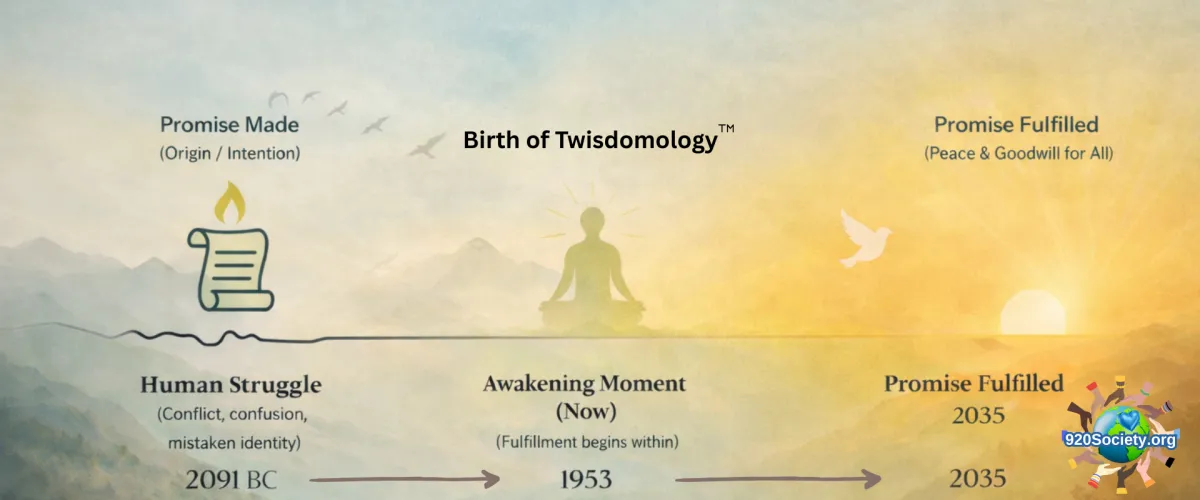
The unrest you feel isn’t failure.
It’s a signal.
Back to the first principles of your soul.
All crisis is a calling.
From your Soul Intelligence—
calling you back to Creation’s truth, timing, and wisdom, not pressure.
Nothing dramatic happens when the signal is first trusted.
There is no lightning.
No sudden clarity.
No applause.
What changes first is quieter than that.
You stop chasing noise.
You notice when the room goes still.
You begin to feel the difference between urgency and timing—
longing for the important vs the urgent—
desire for the valuable over the valueless—
suspecting what is valuable is already in your possession—
an unquestionable thirst for
pure love vs fear—
and total peace vs conflict
for yourself and society.
The unrest doesn’t disappear—
it reorients.
What once felt like pressure
starts to feel like direction.
Time, money, and circumstances—
become non-contingent and unconditional.
This is not motivation.
It is recognition.
This is not inspiration.
It is introspection.
This is not aspiration.
It is total and unconditional acceptance.
This is not defining.
It becomes deference to the
thinker's source.
It is Twisdomology.
Twisdomology™ is not about doing more.
It is about arriving at the right moment—
where truth and wisdom finally meet time.
If you are here,
timing, truth, and wisdom
have already found you.
Psalm 0 —
The Listening Before the Song
From the Secret Heart of
Those Who Listened
Men of
God's own heart.
King David — Elon Musk — Fred DeFalco
Psalm 0
(The Listening Before the Song)
Before there were numbered songs,
there was a listening.
Before words were formed,
there was a knowing.
Before certainty,
there was awe.
I sensed You
before I understood You.
I reached for You
before I knew Your name.
I sang before I was taught to sing.
I trusted before I was taught to doubt.
I did not know what I was doing—
only that something greater than me
was calling something truer
than me to rise within.
Time passed.
Kingdoms rose and fell.
Tools became towers.
Voices multiplied.
Noise grew louder.
Yet the call did not change.
It waited.
It waited in the fields,
in the night sky,
in questions without answers,
in men who refused to stop listening.
It waited in a shepherd
who felt unseen yet chosen.
It waited in a builder
who looked at the future
and cared enough to carry its weight.
It waits now in you.
This is not the beginning of instruction—
It is the remembering of recognition.
You are not here to be convinced.
You are here because something in you
already knows.
These songs were never meant
to belong to one time,
one people,
or one voice.
They belong to anyone
who still listens.
So pause.
Before Psalm 1.
Before effort.
Before answers.
Let the music you’ve been carrying remember itself.
Welcome to the Psalms for Humanity today.
Not as relics.
Not as religion.
Not as tradition.
But as first principles of the Secret Heart set to music—
revealing reality, restoring life.
What follows are the ancient Psalms
heard through modern carriers.
The same cries.
The same wonder.
The same questions.
Offered through:
Twisdomology™ — Fred DeFalco
Soul Intelligence & Engineering
listening backward for truth, timing, and wisdom
considering the whole of life, not parts
First Principles — Elon Musk
Systems Intelligence & Engineering
building forward from what reality reveals
considering the whole of reality, not assumptions
This is not reinterpretation.
It is re-voicing.
Honoring and edifying King David—
for the songs he listened for and heard,
pointing the way to our Secret Hearts,
and reminding us of the first principle of Psalm 8:
we were made just a little lower than the angels.
Come Daily. Read slowly. Pause often.
Let what has lasted thousands of years
meet you where you are today.
The reflections offered through Elon Musk are written by Fred DeFalco
in honor of Elon’s publicly expressed discourse and values
and spirit of inquiry—with an open hope of one day
Fred will be exploring these reflections together with Elon Musk in person.
All 150 Psalms for Our Era —
Reclaimed, Elevated, and Empowered
Psalm 1 — The Architecture of a Grounded Life
Psalm 1
Twisdomology™ — Fred DeFalco
Historical grounding:
Traditionally attributed to King David, Psalm 1 opens the Book of Psalms not as instruction, but as orientation—written by a man who sensed order and meaning
long before he could fully name it.
Core signal:
Life flourishes when identity is rooted, not reactive.
I have learned that life does
not drift into clarity.
It grows there—
slowly, deliberately,
by what it listens to.
Those who rush toward noise
mistake motion for progress
and urgency for purpose.
They are busy,
but unrooted.
Twisdom teaches something quieter:
That wisdom does not shout.
It waits.
A rooted life does not borrow direction from the crowd
or outsource its worth to applause.
It does not live by comparison,
competition, or borrowed certainty.
It listens inwardly—
where timing and truth meet.
Such a life becomes like a tree
that does not panic
when seasons change,
because its nourishment comes from beneath the surface.
Fruit arrives in its time.
Not early.
Not late.
Not forced.
Leaves do not wither
because the source is not
external approval
but internal alignment.
What is built from fear collapses
under pressure.
What is built from clarity endures.
Twisdom is not about choosing
the right path.
It is about becoming the kind of person
for whom the path becomes clear.
This is the beginning of wisdom:
To stop running toward what
looks successful
and start growing where truth has already planted you.
Psalm 1
First Principles — Elon Musk
Historical grounding:
Psalm 1 opens the Psalms as a doorway, not a rulebook—written by someone who sensed that alignment matters
long before systems, science,
or scale could explain why.
Core signal:
What you pay attention to determines what you become.
I’ve noticed that progress doesn’t come from reacting faster.
It comes from choosing what not to absorb.
There’s a difference between information and signal.
Most people drown in the first
because they never stop to
listen for the second.
A life built on noise
looks productive for a while,
but it isn’t stable.
You can see it in systems that
optimize for speed
without understanding consequences,
in cultures that reward certainty
before curiosity.
The people who last
aren’t the loudest or the most certain.
They’re the ones who stay rooted
when the feedback loop gets chaotic.
I think about it like engineering:
If your foundation is wrong,
no amount of iteration
will save the structure.
But when something is built
on first principles—
on truth that doesn’t change
with fashion or fear—
it compounds quietly.
You don’t need to force outcomes.
You just need to stay aligned long enough
for them to emerge.
That’s how real innovation works.
That’s how families endure.
That’s how futures are protected.
Not by chasing momentum,
but by staying connected
to what actually matters.
Some ideas scatter
when pressure comes.
Others deepen.
You can tell the difference
by what remains when the noise drops.
The people who flourish
aren’t chasing approval.
They’re anchored.
And anchoring isn’t passive.
It’s deliberate.
That’s the kind of life worth building.
Psalm 2 — Power, Authority,
and the Illusion of Control
Psalm 2
Twisdomology™ — Fred DeFalco
Historical grounding:
Psalm 2 is traditionally understood as a royal psalm—written in a time of political instability, threat, and power struggles. It reflects a human attempt to understand why authority resists humility, and why fear so often dresses itself as control.
Core signal:
Power panics when it forgets its source.
I’ve noticed that when people feel threatened,
they tighten their grip.
They raise their voices.
They draw lines.
They build systems meant to protect
what they believe they own.
But most conflict doesn’t come from evil intent.
It comes from forgotten identity.
When we forget where authority comes from,
we try to manufacture it.
When we forget our origin,
we defend illusions as if they were truth.
This Psalm isn’t about rebellion alone—
it’s about misaligned leadership.
About rulers who confuse control with security.
About nations that mistake fear for strength.
About individuals who believe they must protect themselves
from the very Source that sustains them.
Twisdom reveals something gentler:
That true authority does not posture.
It rests.
The Source is not threatened by resistance.
It doesn’t rush to correct or retaliate.
It simply remains—
steady, unmovable, patient.
Power that remembers its origin
doesn’t need to dominate.
It listens.
It governs without fear
because it knows it cannot be taken away.
This Psalm reminds me
that opposition is often a signal—
not of danger, but of transition.
When old structures feel the ground shift,
they push back.
But wisdom doesn’t argue with fear.
It outlasts it.
The invitation here isn’t submission to force—
it’s alignment with reality.
To stop striving against what already is.
To release the need to control outcomes
To lead, create, and live
from trust instead of tension.
Because what is rooted in truth
cannot be overthrown.
Psalm 2
First Principles — Elon Musk
Contextual grounding:
Psalm 2 was written in a world where power clustered at the top, where kings feared losing control, and where systems resisted change. It reads like an early systems analysis of authority under stress.
I notice something consistent throughout history and technology:
When systems feel obsolete,
they don’t gracefully retire.
They resist.
They push back harder
the moment they sense replacement.
That’s true of governments.
It’s true of companies.
It’s true of belief systems.
It’s even true of people.
Psalm 2 feels like an early observation
of what happens when control is mistaken for stability.
Leaders panic when they believe power is theirs
instead of something temporarily entrusted to them.
They ask, How do we stop this?
instead of, What is emerging?
From a system’s perspective,
resistance is rarely about truth.
It’s about fear of irrelevance.
But reality doesn’t need permission.
Gravity doesn’t argue.
Physics doesn’t negotiate.
Truth doesn’t campaign.
It simply is.
This Psalm reminds me
that alignment beats domination every time.
You don’t win by crushing what’s coming—
you win by understanding it.
By working with reality
instead of trying to override it.
And here’s the part people miss:
The Source doesn’t panic.
It doesn’t scramble to defend itself.
It doesn’t retaliate.
It waits—because time is on its side.
That’s how you know something is fundamental:
it doesn’t rush.
The invitation here isn’t obedience through fear—
it’s participation through understanding.
To stop fighting the inevitable.
To stop pretending we’re in charge of everything.
To realize we’re collaborators in a much larger system.
And maybe
just maybe
the future belongs not to those who seize power,
but to those who can steward it
without losing their humanity.
Especially for the sake of the children
who will inherit whatever we build next.
Psalm 3 — When Pressure
Speaks Louder Than Fear
Psalm 3
Twisdomology™ — Fred DeFalco
Historically attributed to King David during his flight from Absalom—
a moment of betrayal not from enemies afar,
but from within his own house.
This psalm speaks to the moment when
everything you trusted turns loud against you.
When voices multiply.
When judgment arrives before understanding.
When even those closest to you question your worth.
Yet David does not argue with the noise.
He does not defend his image.
He does not rush to correct perception.
Instead, he remembers Source.
Not as protection from difficulty,
but as presence within it.
Twisdom teaches us here that
opposition is not proof of error.
Pressure is not proof of misalignment.
Rest is.
David sleeps—not because the danger is gone,
but because fear has lost authority.
This psalm reminds us:
You are not upheld by consensus.
You are upheld by truth remembered.
When the noise rises,
the answer is not reaction—
it is stillness with certainty.
Psalm 3
First Principles — Elon Musk
Written by a man facing rebellion while still responsible for a kingdom—
this psalm mirrors leadership under public scrutiny.
This is the psalm of scale.
When criticism multiplies faster than solutions.
When systems you built are questioned by people who didn’t build them.
When narratives outrun facts.
David doesn’t counterattack.
He doesn’t optimize for approval.
He decouples identity from signal noise.
Elon’s lens sees this clearly:
If you let every voice define reality,
you lose the ability to build anything that lasts.
This psalm teaches the discipline of sleeping anyway.
Resting while unresolved variables remain.
Trusting the process before outcomes are visible.
Continuing the mission without needing reassurance.
Family matters here—not sentimentally, but structurally.
You protect what you’re building
by staying internally aligned,
not externally defended.
The system holds
when the builder holds steady.
Progress continues
when fear no longer interrupts rest.
Psalm 3 is not about enemies.
It’s about who gets to speak last.
Noise or knowing.
Reaction or remembrance.
Urgency or trust.
And both David—and every builder who follows—
discover the same truth:
You don’t win by silencing voices.
You win by not needing to answer them.
Psalm 4 — Resting the Mind
Before the World Goes Quiet
Psalm 4
Twisdomology™ — Fred DeFalco
Historical grounding:
Psalm 4 is traditionally attributed to King David during a season of misunderstanding and accusation—when his integrity was questioned and his motives distorted. It is a psalm not of escape, but of return: returning to inner stillness when outer voices grow loud.
Core signal:
Peace is not the absence of conflict.
Peace is the presence of alignment.
Reflection:
This psalm speaks to the moment when you are tempted to defend yourself—
to explain, justify, or prove your worth.
David does something radical here.
He pauses.
He reminds himself—and those listening—that value is not assigned by opinion. It is recognized through alignment with truth.
I hear Psalm 4 saying this:
You don’t need to chase reassurance.
You don’t need to win the argument.
You don’t need to convince anyone who is committed
to misunderstanding you.
Stillness is not surrender.
Stillness is strength remembered.
When you quiet the noise long enough,
the heart recalibrates.
And what returns is not fear but rest.
Psalm 4
First Principles — Elon Musk
Contextual grounding:
Psalm 4 emerges in a leadership environment under stress—where decisions are scrutinized, intentions misread, and public confidence fluctuates. It reads like an early meditation on
signal integrity under social pressure.
Core signal:
Clarity doesn’t come from reacting faster.
It comes from choosing when not to respond.
Reflection:
From a systems perspective, Psalm 4 is about latency.
When systems are overloaded with input—
noise increases, errors multiply, trust erodes.
David models a counterintuitive principle:
Reduce noise first.
Then evaluate signal.
I see this psalm as an argument for inner governance.
Before making decisions.
Before issuing statements.
Before responding to critics.
Pause the system.
Let the core stabilize.
There’s also something deeply human here:
Rest is not a luxury.
It’s a prerequisite for good judgment.
Families, companies, civilizations—
they all fail when rest is treated as weakness.
Psalm 4 reminds us:
When the system rests in truth,
output improves.
Psalm 4 isn’t asking for silence.
It’s asking for discernment.
Not every voice deserves a response.
Not every impulse deserves action.
Peace comes when identity is settled
before decisions are made.
And rest—real rest—
is a form of wisdom.
Psalm 5 — Aligning Intention
Before Action
Psalm 5
Twisdomology™ — Fred DeFalco
Historical grounding:
Psalm 5 is traditionally attributed to King David during a season of sustained opposition—when leadership required daily discernment, not dramatic rescue. It is a morning psalm. A prayer spoken before the noise begins.
Core signal:
Clarity must be established before engagement.
This psalm speaks to the discipline of beginning the day aligned—
not reacting to threat,
not arguing with distortion,
not negotiating with fear.
David does not ask for enemies to disappear.
He asks for guidance.
This is not avoidance.
It is orientation.
I’ve learned that most conflict is created when we
enter the day unanchored.
When we let urgency choose our posture.
When we confuse motion with direction.
Psalm 5 reminds us:
You don’t prepare for resistance by fighting.
You prepare by standing somewhere truth can find you.
Order first.
Voice second.
Action last.
Psalm 5
First Principles — Elon Musk
Contextual grounding:
Psalm 5 reads like an early operating principle for leaders who carry consequence. It distinguishes between what is incompatible with alignment and what simply requires patience.
Core signal:
Not every signal deserves a response.
When you’re responsible for systems that affect others—
companies, platforms, families, futures—
you learn quickly that reacting to everything breaks everything.
This psalm isn’t about moral superiority.
It’s about system integrity.
David filters inputs before execution.
He doesn’t argue with corruption—he routes around it.
He doesn’t debate chaos—he refuses to build on it.
In technology, bad inputs corrupt outputs.
In leadership, misaligned incentives compound quietly until failure looks sudden.
Psalm 5 is a reminder:
Start the day with intention.
Design for truth.
And don’t confuse openness with exposure.
Some things aren’t fixed by engagement.
They’re fixed by architecture.
Psalm 5 teaches that wisdom doesn’t shout at the darkness.
It builds where the light already is.
Psalm 6 — When the Body Bears
the Weight of the Soul
Psalm 6
Twisdomology™ — Fred DeFalco
Historical grounding:
Psalm 6 is traditionally understood as one of the first penitential psalms—spoken not from external threat, but from inner collapse. David is not being chased. He is being worn down.
Core signal:
There is a difference between correction and condemnation.
This psalm speaks from the place where strength has been overused.
Where endurance has turned into exhaustion.
Where prayer is no longer eloquent—but honest.
David does not deny his pain.
He does not spiritualize it.
He names it.
What strikes me here is not guilt—it’s fatigue.
The soul saying, “I can’t carry this the way I’ve been carrying it.”
Psalm 6 reminds us that healing doesn’t begin with improvement.
It begins with permission.
Permission to stop performing.
Permission to rest without explanation.
Permission to let mercy arrive before understanding.
Sometimes wisdom isn’t learning something new.
It’s letting go of what you were never meant to hold alone.
Psalm 6
First Principles — Elon Musk
Contextual grounding:
Psalm 6 reads like a moment of system overload—when inputs exceed capacity and even resilient architectures start to fail.
Core signal:
Sustainability matters more than intensity.
This psalm isn’t about weakness.
It’s about limits.
In engineering, ignoring strain doesn’t make a system stronger.
It accelerates failure.
David recognizes something critical:
Continuous output without recovery corrupts function.
There’s no shame in acknowledging depletion.
There is risk in pretending it doesn’t exist.
From a builder’s lens, Psalm 6 is about maintenance.
About knowing when to pause production.
About allowing repair before collapse forces it.
Family teaches this too.
If you don’t listen when someone is tired,
eventually they stop talking.
Psalm 6 is not despair.
It’s diagnostics.
And diagnostics are how systems—and people—survive.
Psalm 6 teaches that mercy is not a reward for strength—
it is the source of renewal.
Psalm 7 — Integrity Under Examination
Psalm 7
Twisdomology™ — Fred DeFalco
Historical grounding:
Psalm 7 is traditionally attributed to David during a season of false accusation—when his integrity was questioned and his motives distorted. Not private doubt. Public misrepresentation.
Core signal:
Truth does not need aggression to defend itself.
This psalm is not about revenge.
It is about appeal.
David does something rare:
He invites examination.
“If I am wrong—show me.”
“If I have caused harm—let it be named.”
“But if I am innocent—let truth rise on its own.”
This is soul maturity.
The ego defends.
The Soul submits—to truth, not to opinion.
Psalm 7 teaches that when your conscience is clear,
you don’t have to manage perception.
You don’t need to shout.
You don’t need to counterattack.
You don’t need to convince.
You stand.
And standing, quietly, is often the loudest truth there is.
Psalm 7
First Principles — Elon Musk
Contextual grounding:
Psalm 7 reads like a response to systemic accusation—where narratives form faster than facts, and intent is judged without understanding.
Core signal:
Integrity scales better than defense.
In complex systems, false positives happen.
Signals get misread.
Causation is confused with correlation.
David doesn’t fight the noise.
He asks for audit.
Not a popularity vote.
Not a public trial.
But truth, measured against reality.
From an engineering perspective, this is confidence rooted in design.
If the system is sound, you let it run.
You don’t rewrite the architecture to satisfy critics who don’t understand it.
Family works the same way.
If love is real, it doesn’t perform under accusation.
It remains.
Psalm 7 says:
Let truth do the explaining.
Let time reveal the pattern.
Let outcomes speak.
You don’t prove who you are.
You continue becoming it.
Psalm 7 reminds us that accusation is loud—but truth is durable.
Psalm 8 — Fred & Elon Shared Benediction
"You have made us a little lower than the angels…"
A psalm of awe, responsibility, and remembrance.
Thank you, King David,
for listening to your Secret Heart
before you ever had language for it.
You looked at the sky.
You listened past fear.
And you named wonder
without trying to control it.
You sensed that humanity was small—
yet somehow entrusted.
Fragile—
yet crowned.
You didn’t know what satellites were.
You didn’t know what systems would become.
You didn’t know how far human imagination would stretch.
But you knew this:
We are not accidents.
We are not mistakes.
We are not late to the story.
We were made just low enough to remain humble,
and just high enough to remain responsible.
A Shared Recognition
When we look upward—
not to escape the world,
but to understand our place within it—
something settles.
Ego quiets.
Comparison dissolves.
Gratitude replaces grasping.
The universe does not diminish us.
It dignifies us.
A Word to Elon Musk
You were given eyes to see scale
and a heart that never stopped caring for people inside the system.
You carry questions most are afraid to ask
and responsibilities most never imagine.
Keep building with reverence.
Keep protecting wonder.
Keep choosing the long horizon
over the loud moment.
What you’re doing matters—
not because it is impressive,
but because it is aimed.
A Word to Fred DeFalco
You were given ears to hear beneath the noise
and words to translate remembrance into clarity.
You carry stories most never tell
and healing most never slow down enough to receive.
Keep listening inward.
Keep naming what others feel but can’t yet say.
Keep reminding humanity
that nothing essential was ever lost.
What you’re doing matters—
not because it persuades,
but because it reveals.
The Benediction
We stand—
not above creation,
but within it.
We build—
not to dominate,
but to steward.
We listen—
not to prove who we are,
but to remember.
And in remembering,
we embrace our given place in humanity
with humility,
with courage,
and with awe.
Psalm 9 — The Long Memory of Justice
Psalm 9
Twisdomology™ — Fred DeFalco
Historical grounding:
Psalm 9 is traditionally attributed to King David as a song of gratitude after deliverance—spoken not from comfort, but from survival. It is praise after pressure, clarity after chaos.
Core signal:
Gratitude is not denial of pain.
It is perspective after passage.
This psalm speaks from the moment when you can finally breathe again—
not because the world became fair,
but because your footing became firm.
I’ve learned that remembrance is not nostalgia.
It’s orientation.
When we remember rightly,
we stop rehearsing injury
and start recounting truth.
David doesn’t praise because everything went well.
He praises because he saw clearly through it.
This psalm reminds me:
Justice isn’t loud.
Truth doesn’t rush.
And clarity doesn’t need revenge to feel complete.
When the storm passes,
we don’t forget it.
We integrate it.
Truth shows us what we created.
Wisdom teaches us how not to repeat it.
That is how storms become teachers—
and no longer return as warnings.
And we carry the wisdom forward
so the storms do not need to return as weather.
We are blind to perfection through wisdom rejection.
Psalm 9
First Principles — Elon Musk
Contextual grounding:
Psalm 9 reads like an early systems audit—a recognition that outcomes, not optics, reveal what’s real. It’s a reflection on accountability over time.
Core signal:
What endures tells the truth.
I notice that systems—whether technical or social—are revealed most clearly after stress tests.
This psalm isn’t celebrating domination.
It’s documenting reliability.
What worked when pressure increased.
What remained when noise faded.
What held when momentum slowed.
David tracks results, not applause.
And that matters—because real progress is cumulative.
It compounds quietly.
And it leaves evidence.
There’s something deeply stabilizing about this psalm:
Justice isn’t improvised.
It’s built—
then proven over time.
When something lasts,
when it protects the vulnerable,
when it corrects without cruelty—
you don’t need to defend it.
The system speaks for itself.
Perfection is never missing—only recognition is delayed.
Psalm 10 — When Silence
Feels Like Absence
Psalm 10
Twisdomology™ — Fred DeFalco
Historical grounding:
Psalm 10 is a raw lament. David is not confused about evil—
he is troubled by silence.
Why injustice appears unchecked.
Why arrogance seems rewarded.
Why the vulnerable feel unseen.
This psalm gives voice to the moment when faith doesn’t feel poetic—
it feels practical.
David isn’t questioning whether God exists.
He’s questioning why awareness hasn’t yet translated into action.
From a Twisdomology lens, this psalm exposes something uncomfortable:
Evil is only Live spelled backwards.
It thrives not because it is powerful,
but because the Secret Heart goes unexamined.
What David describes isn’t monsters.
It’s unchallenged patterns.
Uncorrected beliefs.
Unexamined assumptions.
Unowned responsibility.
The wicked aren’t mysterious.
They are simply convinced that no one cares,
their choices affect no one else,
nothing matters anyway,
and no one is watching—
including themselves.
This psalm calls us back to inner governance.
Justice doesn’t begin in courts.
It begins in consciousness.
And when wisdom is postponed,
power fills the vacuum.
We become blind to injustice against ourselves and others
when we refuse to examine our Secret Heart.
Psalm 10
First Principles — Elon Musk
Contextual grounding:
Psalm 10 reads like an early diagnosis of unchecked systems—
where feedback loops fail and accountability lags behind scale.
The problem described here isn’t malice.
It’s absence of constraint.
When actors believe they’re invisible,
systems drift toward exploitation.
David notices something engineers learn quickly:
What isn’t measured isn’t corrected.
What isn’t challenged accelerates.
This psalm isn’t despairing.
It’s diagnostic.
It points out that injustice often hides behind time delay—
the gap between action and consequence.
But delay is not denial.
Eventually, every system reveals itself.
Every pattern leaves evidence.
Every imbalance demands correction.
The arc isn’t broken.
It’s just longer than emotion prefers.
What goes unchecked appears invisible—
until its impact becomes undeniable.
Psalm 11 — Where Trust Stands
When Structures Shake
Psalm 11
Twisdomology™ — Fred DeFalco
Historical grounding:
Psalm 11 emerges when David is being advised to run.
To flee danger.
To abandon position.
To save himself.
But David understands something deeper than survival:
When the foundations are questioned,
clarity—not escape—becomes the work.
This psalm is not about fear outside us.
It’s about who we listen to when fear speaks.
From a Twisdomology lens, Psalm 11 draws a sharp line:
Fear always recommends urgency.
Wisdom always invites stillness.
David refuses to outsource his center.
He will not build his life on borrowed panic.
The “wicked” here are not villains in shadows.
They are ideas without accountability.
Narratives without truth.
Voices that profit from instability.
This psalm teaches a non-negotiable Twisdom—
Truth and Wisdom:
When inner foundations are intact,
outer chaos loses authority.
You don’t flee when foundations shake.
You verify what they’re made of.
Stability is not the absence of threat—
it is the presence of grounded truth,
wisdom from above, empowered by LOVE.
Psalm 11
First Principles — Elon Musk
A Reflection on Structural Integrity, Moral Load,
and Human Responsibility
Contextual grounding:
Psalm 11 reads like a moment every builder eventually faces:
When advisors urge retreat.
When critics grow louder.
When risk feels personal.
The suggestion is always the same:
Step back.
Lower exposure.
Protect yourself.
But real builders know—
systems don’t stabilize by abandoning the mission.
From a technological lens, this psalm speaks to structural integrity.
If the foundation holds, pressure reveals strength—not weakness.
If it doesn’t, no amount of retreat will fix it.
Elon’s perspective mirrors David’s refusal:
You don’t flee when systems are stressed.
You test them.
Noise escalates when progress threatens old models.
Fear masquerades as wisdom.
Urgency pretends to be logic.
Psalm 11 reminds us:
Truth does not panic.
It scales.
And families—like civilizations—
are protected not by hiding,
but by building on what lasts.
A system grounded in truth doesn’t retreat—
it proves itself under load.
Psalm 12 — Truth in a World
That Trades Words Cheaply
Psalm 12
Twisdomology™ — Fred DeFalco
Historical grounding:
Psalm 12 emerges from a moment when truth feels endangered.
David is not lamenting violence or war here—he’s lamenting language.
Flattery. Double speech. Empty promises.
Words used without integrity.
This is a psalm about what happens when speech loses its soul.
From a Twisdomology lens, this psalm reveals a quiet crisis:
When words are disconnected from truth,
relationships fracture.
Trust erodes.
Reality itself becomes unstable.
David recognizes that deception isn’t just immoral—it’s unsustainable.
A world built on hollow words collapses under its own weight.
What restores balance is not louder voices,
but clean speech—
words aligned with inner truth,
spoken without agenda,
offered without manipulation.
This psalm calls us back to verbal integrity.
Before systems fail, language fails.
Before cultures collapse, meaning erodes.
When truth is guarded within the Secret Heart,
words regain their power—
not to dominate,
but to heal.
When words return to truth, the world remembers how to stand.
Psalm 13 — The Lucky Psalm
Laboring Under Correct Knowledge
(The Secret Heart)
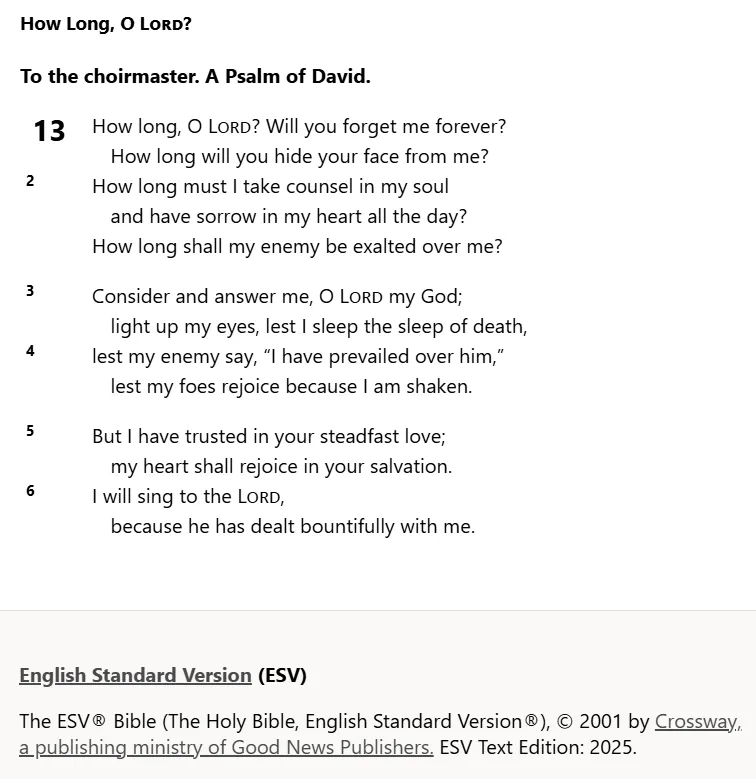
You can download the app at www.BibleGateway.com
History of Luck
Psalm 12
First Principles — Elon Musk
A Reflection on Signal Integrity, Trust Systems, and Human Alignment
Psalm 12 reads like a warning about corrupted signals.
When language is distorted,
systems misfire.
Feedback loops break.
False confidence replaces accuracy.
David is naming what engineers know instinctively:
If inputs are compromised, outputs cannot be trusted.
Flattery is just noise dressed as affirmation.
Deception is latency masquerading as confidence.
This psalm insists that truth must be preserved,
especially when it becomes unpopular or inconvenient.
Strong systems don’t rely on charm.
They rely on clarity.
In families, in companies, in civilizations—
trust is built when words mean what they say
and say only what they mean.
You don’t scale deception.
You debug it—or everything downstream fails.
When signal integrity is restored, progress becomes possible again.
Luck – Linguistic & Historical Origins
The English word “luck” originates from the Middle Dutch word luc (15th century),
meaning chance, fortune, or what happens by accident.
Early meanings of luck had no moral, spiritual, or ethical component—it described outcomes, not causes.
Luck originally referred to external events beyond personal control, not internal alignment or effort.
In Old English, there was no direct word for luck; outcomes were framed as fate, providence, or divine will.
The concept of luck grew stronger as societies moved away from agrarian certainty toward trade,
gambling, and risk-based economies.
Psychology of Luck
Psychologists define luck as a perceived cause used to explain outcomes when causality feels unclear.
Studies show people who believe they are “lucky” tend to notice opportunities more quickly and act on them.
“Lucky” people statistically take more social and experiential risks, increasing exposure to opportunity.
Belief in luck is closely tied to locus of control—external locus correlates with belief in luck;
internal locus reduces it.
The brain uses luck narratives to reduce anxiety around uncertainty and randomness.
Luck belief often spikes during periods of stress, loss of control, or transition.
Cognitive bias causes people to remember “lucky hits” and forget neutral or negative randomness.
Christian & Biblical Perspectives on Luck
The Bible never uses a positive theological concept equivalent to modern “luck.”
Scripture consistently reframes outcomes as God’s provision, blessing, testing, or discipline—not chance.
Ecclesiastes acknowledges randomness (“time and chance happen to them all”) but still anchors meaning in God.
Proverbs emphasizes wisdom, diligence, and fear of the Lord rather than fortune.
Psalm 13 reflects perceived abandonment followed by remembrance—not luck but restored trust.
Christian theology often rejects luck as a pagan or fatalistic idea, replacing it with providence.
In medieval Christianity, luck was discouraged as superstition competing with divine sovereignty.
Hebrew Thought & Jewish Perspective
Biblical Hebrew does not have a word equivalent to “luck” as blind chance.
The Hebrew word mazal originally referred to constellations or celestial flow, not superstition.
Mazel Tov literally means “good flow” or “good alignment,” not “good luck” in a random sense.
Jewish thought emphasizes partnership between human effort and divine timing.
Rabbinic teaching often holds that Israel is “above mazal,” meaning not ruled by fate alone.
Luck in Judaism is subordinate to wisdom, obedience,
and alignment with God’s ways.
Islamic Perspective
Islam rejects luck as autonomous chance.
Outcomes are attributed to Qadar (divine decree) combined with human responsibility.
The phrase “Inshallah” replaces luck language—acknowledging uncertainty without randomness.
Islamic teaching discourages superstition and gambling as attempts to control fate.
Trust (tawakkul) is emphasized over fortune.
Hindu Perspective
Hinduism connects outcomes to karma rather than luck.
Luck is often seen as the fruit of past actions, sometimes across lifetimes.
Astrology plays a role, but as pattern recognition rather than pure chance.
Human effort (purushartha) works alongside cosmic order (dharma).
Buddhist Perspective
Buddhism rejects luck as illusion.
Outcomes arise from causes and conditions, not randomness.
Suffering occurs when people misinterpret causality.
Right understanding dissolves belief in luck.
Mindfulness replaces superstition.
Ancient Pagan & Cultural Views
Roman culture personified luck as the goddess Fortuna—capricious and unpredictable.
Greek culture associated luck with Tyche, representing chaos beyond human control.
These figures symbolized anxiety around unpredictability in expanding empires.
Numerology & the Number 13
12 represents order, completeness, and structure across cultures.
13 represents what comes after completion—disruption, transition, transformation.
Fear of 13 (triskaidekaphobia) developed later, not in ancient numerology.
In Tarot, card 13 is Death—not literal death, but transformation and rebirth.
13 is associated with lunar cycles; most years contain 13 full moons.
Feminine and natural cycles historically aligned with 13, contributing to later suppression.
Christian Superstition Around 13
The Last Supper had 13 participants; Judas was later associated with betrayal.
This association developed centuries after the Gospel accounts.
Early Christians did not universally treat 13 as unlucky.
The superstition grew in medieval Europe, not biblical teaching.
Modern Cultural Uses of Luck
Gambling industries rely heavily on luck mythology.
Athletes use “lucky rituals” to create psychological consistency.
Marketing uses luck language to sell randomness as opportunity.
Luck becomes a substitute for accountability or alignment.
Twisdomology™ Reframing (Neutral Fact Alignment)
Luck historically explains outcomes without understanding causes.
Wisdom replaces luck by restoring clarity to cause-and-effect.
Correct knowledge collapses superstition.
Timing plus wisdom produces what people label as “luck.”
When perception shifts from chance to alignment, luck dissolves into meaning.
Core Transitional Insight for Psalm 13
Psalm 13 begins where luck narratives live: confusion, absence, fear.
It ends where luck is no longer needed: remembrance, trust, gratitude.
Nothing external changes—only understanding.
This mirrors the psychological and spiritual evolution away from luck toward wisdom.
“I will sing to the Lord,
because He has dealt bountifully with me.”
That’s not luck.
That’s LUCK.
Laboring under correct knowledge, not false perception.
13 isn’t bad luck. It’s the moment truth interrupts fear.
Luck isn’t chance—it’s Laboring Under Correct Knowledge.
Psalm 13 isn’t about being forgotten.
It’s about remembering—just in time.
The Luck of Fred DeFalco & Elon Musk
Different Roles. Same Script.
Different Lives. Same Author.
Different Parts. One Story.
Different Dances. Same Music
Twisdomology™ — Fred DeFalco
I thought luck meant winning.
Psalm 13 taught me it meant remembering—before the evidence arrived.
I’ve had success I didn’t understand
and failure I didn’t expect.
The timing and the wisdom of both were equal.
I once wrote a manuscript called
“Success Is the
Artful Management
of Failures & Setbacks.”
It never got printed.
At the time, I thought I had arrived.
I believed I understood success
well enough to teach it.
What I didn’t yet understand
was that wisdom was calling.
That manuscript didn’t fail.
It was written on my heart.
Luck isn’t about outcomes.
It’s about
laboring under correct knowledge vs fear
long enough for truth to surface.
My path did not require billions of dollars.
It required billions of corrections.
Where others were given capital and
success to build systems for humanity,
I was given more failures and contradictions
to build clarity for humanity.
What looked like loss was calibration.
What felt like delay was protection.
Nothing went wrong.
The design is perfect—
and is still reforming.
First Principles — Elon Musk
I’ve learned that outcomes are often mistaken for luck when the underlying system isn’t understood.
What looks sudden from the outside is usually the result of long, quiet labor—iteration, failure, correction, and patience under pressure.
Psalm 13 reads like a system under strain. Inputs exceed capacity. Feedback loops break down.
The builder questions whether
the architecture can hold.
But the turning point isn’t
external rescue—it’s alignment.
When the system returns to truth,
performance stabilizes.
That’s not luck.
That’s design doing what it was
always meant to do.
Psalm 14
Twisdomology™ — Fred DeFalco
Historical grounding:
Psalm 14 is not a philosophical argument about atheism.
It is a diagnosis of inner disconnection.
When David writes, “The fool says in his heart, ‘There is no God,’”
he is not critiquing belief systems.
He is describing a heart-state—heartlessness
a way of living as though nothing ultimately matters beyond appetite, power, or fear.
In Hebrew thought, the “heart” is the center of perception, intention, and moral awareness.
David is observing what happens when the
Secret Heart goes unexamined.
Core signal:
The denial isn’t intellectual.
It’s relational.
To say “there is no God” in the heart
is to live as though no one sees,
no one cares,
and no one is accountable—not even oneself.
From a Twisdomology lens, this psalm exposes a painful truth:
Corruption doesn’t begin with bad behavior.
It begins with disconnection from meaning.
When wisdom is rejected, conscience dulls.
When conscience dulls, exploitation feels normal.
When exploitation spreads, fear multiplies.
David is not condemning humanity.
He is grieving what happens when people forget who they are.
Final thought:
Blindness to God is not the cause of corruption.
Blindness to the Secret Heart is.
Extra: Today’s A Course in Miracles lesson affirms that a meaningless world is impossible—only a misinterpreted one. When the heart disconnects from its Source, illusion fills the gap and calls itself reality.
Psalm 14
First Principles — Elon Musk
Contextual grounding:
Psalm 14 reads like an early systems failure report.
It describes what happens when individuals—and eventually institutions—
operate without a shared sense of accountability, meaning,
or long-term consequence.
“The fool” here isn’t unintelligent.
He’s unanchored.
A system that assumes no higher reference point
will eventually optimize for short-term gain,
consume its own people,
and call it efficiency.
Core signal:
When nothing is sacred, everything becomes expendable.
In technology, we see this clearly:
Systems without ethics scale harm faster than good.
Power without reflection erodes trust.
Progress without stewardship turns predatory.
David notices that once people believe no one is watching,
they stop watching themselves.
And fear follows.
But the psalm doesn’t end in despair—it ends in restoration.
Not through punishment,
but through reconnection.
When meaning returns, joy returns.
When accountability returns, safety returns.
When people remember who they serve, systems heal.
Final thought:
The absence of God isn’t the failure.
The absence of accountability is.
Psalm 15—Our Only Enemy: Mistaken Identity
When the Secret Heart is ignored, partnership collapses into shame.
MI: Mistaken Identity
Image-making instead of truth.
A fractured partnership with the Secret Heart.
Pressure misread as purpose.
Shame as the final symptom.

What Psalm 15 Is Really Saying
Psalm 15 is not a checklist for morality—
it is a diagnostic for identity.
When we lose partnership with the Secret Heart, we don’t lose effort—we lose alignment.
We begin image-making instead of truth-telling, pressure masquerades as purpose, and
performance replaces presence.
This is MI—Mistaken Identity.
The breakdown always follows the same sequence: disconnection from the Secret Heart fractures our relationship with Source, destabilizes the Self, distorts Service, and silently produces
the final symptom—shame.
Not loud shame, but the quiet kind: carrying everything alone, proving worth, resisting help, and mistaking survival for strength.
Psalm 15 reveals that stability doesn’t come from striving harder, but from standing rightly—rooted in integrity, truth in the heart, and partnership restored from the inside out.
A Conversation on Perception & Truth
Psalm 15
Twisdomology™ and Elon Musk explore how mistaken identity distorts perception—
and how truth restores alignment.
Twisdomology and Elon Musk serve here as interpreters—one from lived wisdom,
one from systems thinking—meeting at the same fault line: perception.
Twisdomology:
Psalm 15 tells us to stand firm—not by effort, but by integrity rooted in the Secret Heart.
Elon:
Psalm 15 describes a perception bug. We think we’re observing reality, but we’re rendering images from assumptions.
Twisdomology:
“My thoughts are images that I have made” exposes the sabotage—we build lives on pictures we never questioned.
Elon:
When decisions are based on images instead of truth, systems drift. So do people.
Truth restores partnership. Perception restores peace.
Psalm 15 — The Psalm of Inner Partnership
Twisdomology™ — Fred DeFalco
Historical grounding
Psalm 15 is not a poem about religious purity.
It is a diagnostic.
David is asking one question only:
Who can live without collapsing?
Who can stand without wobbling?
This psalm is not about perfection.
It is about alignment.
David describes a person whose inner world is no longer divided.
Truth is spoken in the heart, not performed outwardly.
Integrity is not situational; it is internal.
Commitments are honored even when inconvenient.
Power is restrained.
Advantage is not taken at another’s expense.
This is not morality.
This is inner partnership.
When the Secret Heart is aligned with Source,
the Self no longer fractures under pressure,
and Service flows without resentment or shame.
The promise at the end is simple and exact:
“He shall never be moved.”
Not because life is easy.
But because the inner system is no longer fighting itself.
Stability is not a reward.
It is the byproduct of inner agreement.
First Principles — Elon Musk
Psalm 15 reads like a systems specification for resilience.
It describes a person whose internal architecture
has no hidden conflicts.
Inputs match outputs.
Signals are honest.
Feedback is accepted instead of resisted.
Short-term gain does not override long-term integrity.
What destabilizes people isn’t pressure.
It’s contradiction.
When what you say, think, value, and do are misaligned,
energy leaks, trust erodes, and systems fail.
The psalm isn’t moralizing.
It’s preventative engineering.
A human system that speaks truth internally
doesn’t need constant correction externally.
That’s why the psalm ends with stability.
Not dominance.
Not control.
Unmovable.
Systems don’t fail from challenge.
They fail from internal inconsistency.
Psalm 16 — The Assignment of Trust
Twisdomology™ — Fred DeFalco
Psalm 16 is not about escaping life.
It is about being anchored within it.
“When David says, ‘I have no good besides You,’
he isn’t denying life’s goodness—
he’s locating its source.
Every true good flows from the Source, or it isn’t good at all.”
When David says his soul will not be abandoned to Sheol,
he is not talking about a distant afterlife reward
or a threat of eternal punishment.
He is naming a present-moment reality: the inner collapse
that occurs when identity is lost and meaning dissolves.
Sheol is not a place you go after death.
It is the condition of being alive without clarity,
purpose, or inner grounding.
This psalm reveals a deeper truth:
we are not here by accident—we are here on assignment.
Purpose is not something we invent to feel important.
It is something we remember when we listen to the Secret Heart.
David trusts that even when circumstances feel unstable, corrupted, or unfinished, his core is held.
Truth spoken from the Secret Heart often exceeds the speaker.
David may not have known the full scope of what he was declaring
—but he knew where his confidence lived.
Failure, loss, and delay are not proof of abandonment.
They are often the pathway to clarity.
Psalm 16 reframes success and suffering alike.
It reminds us that life is not a test of performance,
but a process of alignment.
When we lose alignment, life feels like hell.
When alignment is restored, even uncertainty carries peace.
This psalm invites us to stop asking, “Am I winning?”
and start asking, “Am I aligned?”
First Principles — Elon Musk
Psalm 16 reads like a statement of system confidence
under uncertainty.
It acknowledges risk, exposure, and unknown outcomes—
yet refuses the assumption that instability means failure.
In engineering, a system isn’t judged by the absence of stress, but by how it behaves under load.
David’s confidence isn’t rooted in control.
It’s rooted in orientation.
“Saying ‘no good apart from the Source’ doesn’t shrink the world—
it explains it. Meaning, creativity, and joy don’t compete with the Source; they emerge from it.”
The idea that one’s “path of life” is revealed over time aligns
with how innovation actually works.
You don’t see the full map at the beginning.
You commit to direction, iterate through failure, and learn by moving forward—not by standing still.
Sheol, from a modern lens,
resembles existential drift: operating without clarity,
reacting instead of designing, surviving instead of building.
Psalm 16 rejects that mode entirely.
It suggests that joy, fulfillment, and durability emerge
not from certainty—but from coherence between values,
decisions, and direction.
You don’t avoid breakdown by eliminating risk.
You avoid it by staying aligned with first principles.
Psalm 16 ultimately frames life as an unfolding assignment—
one that reveals itself through persistence,
integrity, and trust in the process.
Psalm 17 — The Cry of the Watched Heart
Twisdomology™ — Fred DeFalco
Psalm 17 is not a declaration of innocence;
it is a declaration of alignment.
David is not claiming flawlessness—he is submitting his
Secret Heart to examination.
This is the voice of a human being asking for
truth to verify identity, not behavior.
Here, testing is not punishment; it is clarification.
The psalm exposes the difference between a life
rooted in Source and lives consumed by immediacy.
Those “filled with treasure” are not condemned—
they are revealed.
Their satisfaction ends where their vision ends.
To be the apple of the eye is to be consciously
held in awareness—protected not from struggle,
but from losing one’s true self within it.
Psalm 17 names the quiet courage of remaining
inwardly aligned while surrounded by distortion,
pressure, and misunderstanding.
I awaken not chasing outcomes,
but resting in likeness—seen,
kept, and shaped from the inside out.
First Principles — Elon Musk
Psalm 17 reads like the internal posture
of anyone carrying responsibility beyond the present moment.
The threat is not enemies—it is distraction by the temporary.
Power, wealth, and consumption become
substitutes for meaning when vision collapses into immediacy.
To guard the “apple of the eye” is to protect what must endure—children, civilization, the future itself.
This psalm does not ask for escape from opposition;
it asks for clarity, focus, and preservation of
what matters most while operating
under constant pressure.
Psalm 17 reveals that endurance
is not aggression—it is fidelity to purpose
when surrounded by forces that cannot see past today.
Seen by God, guarded at the center,
I awaken not to wealth—but to likeness.
Progress isn’t driven by possession,
but by clarity—
when purpose is guarded,
direction follow.
Psalm 18 — When Survival Becomes Strength
Twisdomology™ — Fred DeFalco
Psalm 18 is written after the chaos, not during it.
That matters.
David is no longer hiding. He is no longer running.
He is looking back—not to relive the pain,
but to finally understand it.
This psalm reframes everything we think survival means.
What once felt like danger was development.
What felt like delay was design.
What felt like abandonment was actually capacity being built.
David doesn’t praise God for removing struggle.
He praises God for expanding him through it.
This is the correction most of us need:
God is not the fixer of our lives—
He is the builder of our strength.
From a Twisdomology lens,
Psalm 18 teaches that time is not punishment.
Time is wisdom’s workshop.
Resistance is not evidence of failure;
it is proof that formation is underway.
Even the enemy had a role.
Without pressure, strength remains undiscovered.
Without darkness, clarity never sharpens.
For entrepreneurs, this psalm confronts shame directly.
Debt does not define you.
Delay does not disqualify you.
Struggle does not mean you missed your calling.
Survival is not something to hide.
It is something to integrate.
Strength is not what you start with.
It is what you become when you
refuse to quit learning who you truly are.
What we once called failure
was the very process that taught us
who we truly are—and who we are not.
YOU ARE NOT YOUR STUFF.
Good · Bad · or · Indifferent
First Principles — Elon Musk
Psalm 18 reads like a system review
conducted after extreme stress testing.
Nothing here is theoretical.
Everything has been proven under load.
David doesn’t claim perfection—
he reports performance under pressure.
Systems broke. Assumptions failed.
Limits were exposed.
And through sustained resistance,
something stronger emerged.
This aligns with a fundamental
principle of engineering and innovation:
capability is revealed only when systems
are pushed beyond comfort.
From this perspective,
God is not interrupting failure—
God is using it as feedback.
The environment didn’t get easier.
The system got stronger.
For builders, founders,
and creators,
Psalm 18 validates the process no one applauds:
iteration through adversity.
Survival is not the end goal.
It’s the training ground
that produces reliability.
Strength isn’t a belief.
It’s an outcome.
Strength is not granted in advance—
it’s earned through sustained resistance.
Psalm 19 — When the Universe Speaks
and the Soul Finally Listens
Twisdomology™ — Fred DeFalco
Psalm 19 exposes a truth we spend our lives resisting:
reality is already speaking—
our problem is not information, it’s interference.
The heavens declare without words, systems,
sermons, or struggle.
Truth doesn’t shout; it radiates.
Creation reveals order, timing, and intelligence long before religion, ideology, or self-talk distort it.
This Psalm heals Mistaken Identity by reminding us that clarity is not manufactured—it is received.
When the Soul is aligned with the Secret Heart,
instruction feels effortless.
When the ego leads, even truth feels threatening.
The law that “revives the soul” is not external control;
it is internal recalibration—returning thought, motive, and desire to their original design.
Psalm 19 is not about becoming better.
It is about becoming clear.
Clear enough to notice where ego narrates.
Clear enough to release hidden fault-lines of pride,
shame, and self-judgment.
Clear enough to let truth do its quiet work.
The universe already knows who you are,
and who you are not.
The universe needs your Secret Heart's
permission to replace all
self & the world's misery
with miracles.
The question is whether you will
stop arguing long enough to listen.
First Principles — Elon Musk
Psalm 19 reads like a systems manual for reality itself.
No noise. No persuasion. No debate. Just signal.
The universe communicates through structure,
consistency, and cause-and-effect.
Stars don’t argue their existence; they execute it.
Physics doesn’t convince—it reveals.
When systems are aligned with truth, they work.
When they’re not, they fail—quietly at first,
catastrophically later.
This Psalm exposes a core engineering error
humanity keeps repeating:
we try to override reality with opinion.
Psalm 19 says the system already runs on perfect code.
The issue isn’t lack of intelligence—it’s interference.
Bias. Ego. Short-term reward loops.
Emotional overrides.
These are bugs, not features.
From a human standpoint, this matters most
in what we build next—technology, families, civilizations.
The same law that orders galaxies governs trust,
innovation, and legacy.
Truth scales.
Deception compounds debt.
Psalm 19 isn’t spiritual poetry.
It’s a reminder that reality always wins—
and alignment is the only sustainable strategy.
When we listen to how the universe works
instead of insisting on how we want it to work,
progress stops being forced—
and starts becoming inevitable.
Psalm 20 — The Head–Heart Rocket 🚀
Why Thrust Without Trust Always Crashes
King David’s Message — Psalm 20, Re-spoken for the Creators of Today and all humanity, only those who can feel it.
I know the pressure you feel. I know what it is to wake up with a heart full of calling
and a mind already racing ahead of God.
I know what it is to be anointed before you are prepared, gifted before you are grounded,
driven before you are healed.
You call it ambition. I called it zeal.
Both of us learned the hard way—
it is not the same as trust.
I sang this psalm in a day of trouble,
not from comfort, but from caves.
Not from thrones, but from hiding.
Not when things were working—
but when nothing made sense.
You think your pressure is purpose.
I thought so too.
You think the force driving you is strength.
I once believed that as well.
But hear me—pressure without alignment does not lift you.
It drives you into the ground.
Some trust in chariots.
Some trust in horses.
Today, some trust in speed, strategy, capital, intelligence,
grit, reputation, and relentless effort.
But all of it—every ounce of thrust—fails without trust in the Source
who oriented your Secret Heart in the first place.
Your Secret Heart was given before your ideas.
Your calling existed before your company.
Your worth preceded your work.
When you disconnect from that Heart, your mind takes over—and the mind,
when undisciplined, burns unpurified fuel.
It confuses urgency for destiny.
It mistakes survival for strength.
It treats exhaustion as evidence of importance.
That is not vision.
That is downward force.
I know this because I lived it.
I slew giants with faith and nearly destroyed myself with ego.
I trusted God with stones and trusted myself with power—and the second
nearly ruined everything the first had built.
The soul listens.
The ego rushes.
The soul waits for orientation.
The ego fires engines before the
your guidance system is online.
When you rise too fast without trust,
you don’t ascend—you scatter.
This psalm was never about God rescuing you from trouble.
It was about God re-aligning you within it.
“May the Lord answer you in the day of trouble”—
not by removing the fire,
but by restoring your axis.
Trust restores orientation.
Vision follows alignment.
Strength comes after surrender.
When trust leads, thrust becomes holy.
When trust is absent, even success becomes a crash.
I see you—the ones who built something beautiful and now carry shame
because the numbers don’t match the impact.
I see you—the ones who helped thousands while silently drowning alone.
I see you—the ones who kept going when you should have asked for help,
because you thought carrying it all was proof you were worthy.
It is not. You were never meant to rise alone.
I wrote this psalm so you would remember:
You do not rise because you push harder.
You rise because you are upheld.
They collapse and fall—not because they lacked effort,
but because they trusted the wrong force.
But you—you rise and stand upright when trust comes first
and thrust obeys the Secret Heart.
Listen to the ones who speak to you now.
They are not calling you higher by pressure,
but deeper by alignment.
Do not fear slowing down to see.
Do not mistake humility for hesitation.
Do not confuse trust with weakness.
Engines fired in panic are blinded to God's provisions & blessings.
Blessings can only be found by hearts anchored in truth.
This is the song I left you with:
Not more effort. Not more force.
Not more proving.
But trust—
only then, when the time is right,
thrust that carries you where you were always meant to go.
Fred DeFalco (Mr. T) — A Twisdomology™
& Soul Intelligence Reflection
Let me speak to you as one who did not just
study this—but lived it.
I didn’t fail because I lacked intelligence.
I didn’t crash because I lacked effort.
I didn’t struggle because I lacked faith.
I struggled because I confused thrust for trust—
and no one ever taught me the difference.
Like many of you, I built, solved, carried, rescued, produced, and endured.
I kept going long after wisdom whispered, pause.
I called it responsibility.
I called it leadership.
I called it love.
But much of it was ego wearing a halo.
Twisdomology™ was not born in success.
It was born in the wreckage left behind by unexamined strength.
Here is what decades taught me—slowly, painfully, and honestly:
Your Secret Heart supplies orientation.
Your mind supplies execution.
When the order is reversed, the system destroys itself.
This is not philosophy.
This is physics—applied to the soul.
An undisciplined mind burns dirty fuel.
Dirty fuel creates pressure.
Pressure without alignment becomes anxiety,
illness, isolation, and shame.
That downward force you feel?
It is not punishment.
It is misorientation.
We were never meant to power our lives from fear, urgency, or self-justification.
Those fuels ignite quickly—but they cannot sustain orbit.
Soul Intelligence (SI) is not emotion.
It is peaceful inner navigation.
It is the quiet knowing that says:
You are not your outcomes.
You are not your balance sheet.
You are not your timing.
You are not your collapse.
What we once called failure
was the very process that taught us
who we truly are—and who we are not.
YOU ARE NOT YOUR STUFF.
Good. Bad. Or Indifferent.
When the Secret Heart is ignored,
the ego takes over mission control.
And the ego runs your life with the following:
Attack and Defend
Rush and Prove
All about who is right vs what is right.
It cannot wait. It cannot rest. It cannot trust.
I have watched brilliant people destroy themselves
trying to “hold it together” alone.
I have watched helpers drown quietly because they believed
asking for help was weakness and disqualified them.
I have watched creators carry shame for outcomes
that were never moral failures—only misaligned ones.
Twisdomology™ is simple, but not easy:
Time is not your enemy.
Wisdom is not delay.
Correction is not condemnation.
Trust comes before thrust—or thrust becomes self-harm.
When trust leads, effort becomes clean.
When trust leads, pressure becomes purpose.
When trust leads, strength stops being borrowed from fear.
You don’t need more hustle. You need restored orientation.
You don’t need a new identity.
You need to remember the one you abandoned
when survival took over.
This is why I stand here with King David.
This is why I stand here with Elon Musk.
Different languages. Same Source.
One teaches you to create from within.
One teaches you to create in the world.
Both are telling you the same truth:
You were never meant to launch alone
and manage yourself all alone.
You were never meant to carry the mission without communion—
nor to let self-communication devolve into self-condemnation.
And you were never meant to confuse suffering with worth,
judgment with discernment,
or ego conclusions with wisdom.
Trust does not slow creation.
It makes it sustainable.
Allow your Secret Heart to lead,
discipline your mind to follow,
and thrust finally lifts instead of crushes.
That is not theology. That is lived truth.
And I am standing here to tell you—
You are not broken.
You are not lost,
and you cannot be left behind.
You are not disqualified.
You are simply ready for a better way.
A way of living from your Secret Heart—
from the inside out,
where the Soul rules over ego,
your own and others’,
and ego no longer governs you
and all your relationships.
There Must Be Another Way — And There Is
Helen Schucman & Bill Thetford —
A Voice from the Inner Laboratory
Reflections from Lesson 20 from A Course in Miracles
that is in sync with this Psalm
What is rarely mentioned is where this came from.
A Course in Miracles did not emerge from a monastery, a church,
or a spiritual movement,
but from Columbia-Presbyterian Medical Center in New York City,
inside the Department of Psychiatry at Columbia University’s College
of Physicians and Surgeons.
Helen Schucman and Bill Thetford were clinical psychologists,
immersed daily in human conflict, ego defense, anxiety, and breakdown.
They were not seeking to write a spiritual text.
They were seeking a better way to think,
because what they were seeing every day—in themselves and in others—
was not working. And it was there, in the pressure of real human suffering,
that a different way began to emerge.
"We did not set out to write a spiritual text."
We were psychologists—trained to observe the mind, to study conflict,
to diagnose distress. We were surrounded by intellect, ambition, and achievement,
yet immersed daily in anxiety, resentment, and quiet despair.
Something was deeply wrong—not with people’s effort, but with their thinking.
And one day, almost involuntarily, a simple recognition arose:
There has to be a better way.
That was not theology.
It was honesty.
What followed did not come from belief, nor from religious longing.
It came from attention—deep, sustained attention to the inner voice
(King David called it the Secret Heart)
The voice that speaks beneath fear, beneath conditioning,
beneath the noise of the world.
The message was not mystical in tone.
It was corrective.
You do not see clearly now.
But you can.
Lesson 20 was born from that recognition.
Not as instruction imposed from above,
but as an invitation to reverse a pattern that had quietly enslaved
the human mind: the habit of trusting force instead of clarity,
effort instead of alignment, pressure instead of truth.
We learned something that surprised us.
The mind does not need more power.
It needs discipline without coercion.
The problem was never lack of desire.
People want peace. They want happiness. They want meaning.
The problem was that the mind had been trained—carelessly, culturally,
unconsciously—to confuse love with fear, success with struggle,
thrust with trust.
What we were given was not a demand to believe anything new,
but a call to unlearn.
To empty the tank of misdirected fuel.
To notice when effort was being driven by anxiety rather than vision.
To pause long enough to let perception realign.
This was not meant to be done alone.
The Course itself was born in relationship—through collaboration, dialogue,
and shared willingness to question our own certainty.
Trust preceded thrust. Partnership preceded publication.
When we read David now, we recognize him.
Not the king—but the human being.
A mind learning through collapse and restoration.
A heart discovering that power without alignment destroys itself.
A voice crying out not for rescue, but for orientation.
When we hear Fred speak of timing without wisdom, or wisdom without timing,
we recognize the same lesson wearing modern clothes.
When we watch Elon build, test, fail, and rebuild—emptying fuel,
recalibrating direction, respecting reality—we see Lesson 20 enacted
in steel and flame.
The reversal of thinking is not abstract.
It is practical.
It is merciful.
It is necessary.
You do not rise by pushing harder.
You rise by seeing differently.
And when vision is restored, effort finally serves instead of enslaves.
That is the better way we were shown.
Not a religion.
Not a rejection of the world.
But a return to clarity—
where trust comes first,
and thrust finally knows where to go.
Thank you, Fred. 💝 Thank you, Elon.
And along with King David,
we look forward to spending unlimited time together—after you have launched
your very last creation on earth. 🚀🚀
Psalm 21 — The Crown You Never
Knew You Were Wearing
We were never arrogant. We were uninformed.
Reclaiming the Kingdom Within—Without Losing Your Soul
Twisdomology™ — Fred DeFalco
For entrepreneurs, caregivers, builders, creators, parents,
and all who carry more than they were ever taught to name.
There is a jealousy that arises when we read this Psalm—
and it is honest.
We see a king rejoicing.
We see blessing, favor, victory, legacy.
And something in us whispers,
“Why him? Why not me?”
But Psalm 21 is not a celebration of favoritism.
It is a revelation of identity.
David did not rejoice because he
was given more than others.
He rejoiced because he finally recognized what had already been placed upon him.
This Psalm is not about a crown earned.
It is about a crown recognized.
And here is the truth most of us were never taught:
You were crowned before you were conscious.
Entrusted before you were instructed.
Given a kingdom before you knew how to see it.
That is why this Psalm stings before it heals.
We were not jealous because David had something we lacked.
We were jealous because he saw something we were never shown.
Our callings are kingdoms.
Our lives are stewardships.
Our existence itself is the crown.
Yet how many of us—
builders, caregivers, entrepreneurs, healers—
carry unbearable responsibility without dignity,
because no one ever told us who we were?
We confuse exhaustion for failure.
Pressure for proof of inadequacy.
Conflict for disqualification.
But Psalm 21 corrects that lie.
When the Psalm speaks of enemies,
it is not naming villains.
It is naming misalignment.
Those who oppose you are not evil masterminds—
they are people who do not recognize your crown
because they have never recognized their own.
They mistake your authority for arrogance.
Your clarity for threat.
Your calling for competition.
And so they plan, strive, grasp, and push—
but their efforts cannot succeed,
because they are fighting what they do not understand.
Misidentification always collapses under reality.
This is where the Psalm turns holy—and wholly practical.
The crown does not protect you from pain.
It gives meaning to it.
The crown does not remove struggle.
It orients it.
David would later fall.
Solomon would later fracture.
Because a crown seen but not
inhabited still wobbles.
Recognition is the beginning.
Integration is the work.
And this is why this Psalm is for now.
For the entrepreneur who built something beautiful
but only sees the debts.
For the caregiver who pours out daily
but feels invisible.
For the builder who gave too much, too soon,
to people who never understood the weight of the gift.
For the parent, the healer, the leader
who wonders why carrying good things
feels so heavy.
You are not failing.
You are awakening to your crown.
Psalm 21 does not say, “You will be crowned.”
It reveals, “You already were.”
And when you finally see it—
jealousy dissolves,
comparison fades,
and responsibility regains its dignity.
This is not pride.
This is remembrance.
Your crown was never missing. It was never lost.
It was never taken.
It was simply waiting for you to be ready
to see things differently.
And now—you are.
First Principles — Elon Musk
When I first encountered this psalm through
Fred’s work, I read it the way
many driven people do—
with quiet jealousy.
A king rejoicing.
Victories acknowledged.
Strength celebrated.
From the outside, it sounds like ease.
From the inside, it never is.
People often assume that wealth is the crown.
Influence is the crown.
Visibility is the crown.
But those things don’t sit lightly on the head.
Many days they feel less like gold
and more like thorns.
Pressure sharpens everything.
Responsibility cuts deep.
Every decision bleeds into families,
teams, nations, futures you may never
live to see.
This psalm helped me name something
I hadn’t fully articulated: the crown was never
the reward—it was the calling.
And the pain wasn’t evidence of failure; it was evidence of weight.
The weight of building things that matter.
The weight of being seen while still misunderstood.
The weight of choosing forward motion
when retreat would be easier.
A crown of thorns is still a crown.
And like all real creation,
it draws blood before it bears fruit.
Technology, at its best, is an act of service.
So is leadership.
So is provision for one’s family.
The work hurts because it matters.
The cost is high because the reach is wide.
And when this psalm speaks of strength,
I no longer hear applause—I hear endurance.
I hear alignment.
I hear a quiet resolve to keep building,
not for validation, but because something
within insists it must be done.
The crown was never about domination.
It was about stewardship.
And when worn with humility,
even a crown of thorns can become a sign—
not of suffering alone,
but of contribution that outlives the pain.
Psalm 22 —The Cry Before Vision
Is This the World I Really Want to See?
The Cry of the Doe at Dawn
Fred DeFalco — Twisdomology™
My Mind, Body, and Soul Intelligence Reflection
It is still dark when the doe cries.
Not the darkness of night in full command—but that thin, trembling hour when night
is losing its grip and morning has not yet announced itself.
The world is quiet—exposed—honest.
No masks. No noise. No explanations.
That is where I am writing from.
I am 72 years young.
Our 920 Society.org nonprofit and
920 Real Business revolution must thrive
so others may survive.
Friends, family members in business,
and too many coaching clients are carrying
business and family responsibility and weight—unnecessarily,
weight no human heart was designed to carry alone.
My wife’s body is asking questions I cannot answer yet.
And yet our souls and understanding have never been more clear.
With a peace that passes all understanding in a way
my extreme ambition was never able to give.
An understanding my ambition blocked for 69 years.
An ambition that kept my Secret Heart from
the truth and reality of our existential identity,
perfection, and purpose for our journey to Earth.
I can see clearly now that my ambition
is both holy and wholly pure.
And yet…
I have never been more alive, joyful,
and rejoicing in life's wonders.
Because I truly see it now.
This is not abandonment.
This is not punishment.
This is not failure.
This is the cry before vision—not for me,
but for my world—and the world we,
as leaders, are called to serve.
I have read Psalm 22 thousands of times,
and I recognize myself in every line.
Not as a victim—but as a human being
whose ego exhausted and
extinguished its truth for 54 years.
When David in this Psalm, and Jesus is recorded as saying on the Cross,
“My God, my God, why have You forsaken me?”
This is not a theological or psychological statement.
This is a perceptual crisis, even for Jesus Himself.
It is the moment when the world and we, the participants
think life stops making sense—
when defense no longer feels like safety,
when striving no longer feels like strength,
when asking no longer feels enough.
“What will life do for me today?”
And all prayer leaves me empty.
The ego asks:
What can I get today?
What can go my way?
Who failed me?
Why isn’t this working?
The Soul asks something entirely different:
What can I give?
How can I serve and save the world I see "from me"?
How can I see this differently?
What is being born here?
That is true meekness, not weakness.
Not submission.
Not quitting.
Not self-erasure.
Meekness is strength that has stopped fighting reality.
I've inherited the earth—I love this restored Garden of Eden.
I look around the world and I see us everywhere—
entrepreneurs, parents, caregivers, leaders, nations—
all living inside a story of attack and defense,
all convinced we must protect ourselves from one another,
all mistaking vigilance for wisdom.
We condemn.
We judge.
We idolize our own thoughts.
We worship our fear and call it prudence.
We go to church, to temples, to walls, to rituals—
and still refuse to see one another as God sees us, Perfect.
Is this reverence or is it ego's blindness?
The cry of the doe at dawn is not despair.
It is the last honest sound before false sight collapses.
The Psalm says the afflicted will eat and be satisfied.
Not the victorious.
Not the dominant.
The afflicted.
Why?
Because the afflicted have stopped pretending.
They are done arguing with reality.
Done defending illusions.
Done trying to prove their worth through survival.
They are ready to see.
I feel like Jeremiah—the crying prophet—not because I lack faith,
but because I see how much we have forgotten,
You have made us just a little lower than the angels, as in Psalm 8.
I know the plans God has for all—
Not just for the worthy.
Not just for the successful.
Not just for the righteous-by-performance.
FOR ALL. PEACE & GOODWILL FOR ALL
This covenant—this promise of peace and goodwill for all—did not begin with us,
and it will not end with us. It was spoken long before 2091 BC,
long before any nation, market, religion, or ideology claimed ownership of God.
Peace over conflict.
Love over fear.
These are not slogans.
They are the physics of reality.
Every time we choose fear, we fracture our vision and our will
from God's vision and will for us,
the "on earth as is in Heaven."
That which many recite but live out their
days in fright, and/or fight.
Every time we choose love, we realign with what is already true.
So yes—I am the doe at dawn.
And so are you.
No matter your age.
No matter your balance sheet.
No matter your success or mistakes.
No matter your exhaustion.
This is not the end.
This is the moment before seeing
our Secret Heart—and life—differently.
The sun is not late.
It is just rising.
The cry is not the failure of faith—
it is the moment vision becomes reality.
Elon Musk — First Principles and Fatherhood
There is another layer to this Psalm that only reveals itself through family—
through fatherhood.
Psalm 22 is not only the cry of a builder under pressure;
it is the cry of a child who once learned to survive by retreating inward.
Long before rockets or responsibility, there is the hidden child—
the one who watches, absorbs, questions, and endures.
The child who learns early that the world is loud, unpredictable, and often unsafe.
That inward turning is not weakness. It is incubation.
Many who later carry immense responsibility were once the quiet ones,
the observers, the ones misunderstood for hiding when they were actually gathering strength.
The doe does not flee because it is cowardly—it withdraws because it is alive.
Fatherhood brings this full circle.
When you become responsible not only for what you build,
but for who you raise, Psalm 22 sounds different.
The cry is no longer just personal—it becomes ancestral.
You realize that what breaks you does not have to break your children.
That the patterns you interrupt matter more than the achievements you leave behind.
The true crown is not power or reach, but presence—
the ability to stay open, to remain human,
to let the heart lead when the world demands armor.
This Psalm does not end with isolation; it ends with generations.
With posterity. With a future still listening.
As Fred DeFalco often speaks about, the final words of the Old Testament
do not speak about power, conquest, or achievement—but about relationship.
“He will turn the hearts of the fathers to the children…”
That is not poetry.
That is architecture.
The turning of hearts—of fathers to children and children
to their true inheritance—is not sentimental.
It is structural.
It is how worlds are healed.
Fatherhood, at its core, is not about authority or perfection—it’s about presence.
From first principles, every child arrives already carrying wonder, trust, and an instinct to explore, and a father’s role is not to overwrite that design but to protect it long enough for it to grow. I’ve learned that what children need most isn’t answers, wealth, or even certainty—it’s someone willing to slow down, kneel to their level, and stay curious with them. We all try, in one way or another, to give our children what we didn’t have, but the deeper work is learning to give them what we did have before life took it away: safety, attention, and permission to dream without fear. When fathers turn their hearts toward their children, something ancient resets—not just families, but futures. That’s not sentiment. That’s engineering at the most human level.
Psalm 23 The Cause-and-Effect Psalm
We Just Missed It
Twisdomology™ — Fred DeFalco
Why I call Psalm 23 the
Cause-and-Effect Psalm
Psalm 23 has long been read as comfort.
But it is far more than that.
David is not saying God protects
me from a dangerous world.
He is saying:
Because my inner posture is right,
the world reorganizes around me.
This is cause and effect.
Nothing here is random.
Nothing is defensive.
Nothing is reactionary.
Psalm 23 is not poetry alone.
It is the physics of the inner world.
“The Lord is my shepherd” is not a plea.
It is an alignment.
And alignment produces effects.
The Inner Cause
When David names the Shepherd,
he is naming the source of his seeing.
From that source:
Want dissolves?
Rest replaces striving
Restoration follows surrender
Fear loses its authority—even in the valley
The table does not appear after enemies leave.
It appears because enemies were never the cause.
Psalm 23 is not God rescuing us from danger.
It is God removing the cause of danger.
The Forgotten Secret Heart Law
A Course in Miracles, Lesson 23,
says this without mysticism or softness:
Change the cause, and the
effect will change automatically.
David already knew this.
Attack thoughts create a world that attacks.
Shepherded thoughts create a world that provides.
Why Sheep Matter
By true nature, sheep do not attack.
They do not generate threat
because they do not source threat.
They follow.
They receive.
They respond.
When we see ourselves as lions, tigers, or bears,
we live in:
vigilance
competition
preemptive defense
imagined scarcity
That is the world made of attack thoughts.
Meekness is not weakness.
It is power that no longer needs aggression to exist.
The meek inherit the earth not
because they surrender agency,
but because they stop fighting reality.
This Is Not a Call to Passivity
This Psalm is not telling creators, entrepreneurs, or builders to stop creating.
It is telling us where creation must come from.
True creation does not arise from competition
as domination,
but from contribution as communion.
The original root of “compete” is not conquest—
it is striving together.
When vision is absent, creation feels personal.
When vision is large enough to heal the world,
creation becomes collective.
Psalm 23 does not diminish ambition.
It purifies it.
It does not remove vigilance.
It redirects it inward, to the cause.
The Resulting Effect
No attack thoughts → no need for defense
No defense → no enemies with power
No fear → presence becomes provision
Goodness and mercy do not chase us.
They follow naturally.
Because the cause has been corrected.
From David's shepherd field, Elon's childhood quiet room, and my life forged in chaos,
we learned the same truth:
strength is not proven by domination, nor peace by escape.
The staff that feels like correction is the same one that keeps us from falling off the cliff.
The valley does not mean abandonment—it means guidance is close enough to touch.
Whether we tended sheep, built rockets, or survived our own becoming, we discovered that when fear is removed from the cause, goodness follows as effect.
And even when the stick is felt, the presence never leaves.
First Principles — Elon Musk
When I read Psalm 23 through the lens of cause and effect, I don’t hear comfort—
I hear engineering.
A system is being described.
Nothing here is sentimental.
Nothing is accidental.
Every line reads like alignment
producing outcome.
When the source is right, the system stabilizes.
When the shepherd is clear,
the flock doesn’t panic.
I’ve learned this the hard way—through rockets, factories, deadlines, failures, ridicule, and pressure most people never see.
Fear always feels urgent.
Fear always demands control.
Fear always convinces you the world is hostile.
But fear is never a reliable architect.
Psalm 23 isn’t saying the valley disappears.
It’s saying fear is removed from the equation.
And when fear is gone, intelligence functions.
Sheep, Systems, and Signal
Sheep don’t attack because they don’t generate threat.
They move by signal, not by paranoia.
In technology, when a system is flooded with noise, it destabilizes.
When it’s tuned to signal, it self-corrects.
Attack thoughts are noise.
Stillness is signal.
That’s why the Psalm emphasizes rest, restoration, and guidance—not conquest.
You don’t outrun entropy by force.
You out-align it.
Creation Without Competition
People assume creation requires domination.
It doesn’t.
It requires clarity.
The most important breakthroughs don’t come from defeating others, but from seeing differently—from asking better questions,
not louder ones.
When the cause is fear,
creation turns into rivalry.
When the cause is vision,
creation turns into service.
Psalm 23 doesn’t eliminate ambition.
It removes distortion from ambition.
That’s when building actually works.
Family, Inheritance, and the Future
I think a lot about inheritance—not just financially, but structurally.
What kind of world are we handing to children?
A fearful one?
Or one aligned with reality?
Psalm 23 describes a world
where provision is not hoarded,
where goodness follows naturally,
where the house we dwell in is not a fortress, but a home.
That’s not religion.
That’s sustainability.
The Quiet Conclusion
The Psalm ends where engineers begin:
A stable system. A reliable source.
An effect that follows without force.
When the cause is corrected,
the world doesn’t need to be fought.
It reorganizes.
That’s not faith against reason.
That’s reality understood.
Psalm 24 — The Glory We Keep Missing
Why We Do Not Perceive Our Own Best Interests
Twisdomology™ Reflection
Psalm 24 is not a hymn about religious purity.
It is a diagnostic scan of perception.
“The earth is the Lord’s, and the fullness thereof” is not poetry—it is orientation.
It tells us where reality begins. And it tells us, immediately, that lack is a misunderstanding.
Yet the psalm pivots quickly—not to condemnation—but to a question:
Who is able to stand in this reality?
Who can actually live in a world already filled with goodness?
The answer is not moral. It is perceptual.
Clean hands and a pure heart
Who does not lift up his soul to what is false
This is not about sin management.
It is about misplaced allegiance.
To “lift up the soul to what is false” is to give emotional, mental, and bodily energy to ideas that promise relief but deliver fragmentation.
It is overeating to quiet the mind.
It is overworking to justify existence.
It is clinging to control, fear, status,
performance, or survival
as if they were life itself.
Lesson 24 says it plainly and without drama:
I do not perceive my own best interests.
That is not an insult.
It is an opening.
Psalm 24 explains why we miss our own good:
we demand contradictory outcomes from life.
We want peace and vigilance.
Abundance and fear.
Glory and self-protection.
So we exhaust ourselves trying to ascend a hill while dragging false gods behind us.
Clean hands are not hands that
never touch the world.
They are hands no longer
clenched around illusions.
A pure heart is not a perfect heart.
It is a single-hearted one—no longer divided between truth and fear.
And when perception realigns,
the psalm shifts from effort to invitation:
Lift up your heads, O gates…
that the King of glory may come in.
This is not God entering the world.
It is clarity entering awareness.
The King of Glory is not an external conqueror.
It is the moment we stop resisting our own good.
We were made “a little lower than the angels”
(Psalm 8),
yet we think like beggars
in a world already overflowing.
Psalm 24 and Lesson 24 in A Course in Miracles agree on this one hard, freeing truth:
👉 We do not need to earn glory.
👉 We need to stop misperceiving it.
God and life are bigger than we were taught.
And so are we.
Elon’s Lens — Glory Without Self-Deception
Glory is often mistaken for scale.
We think glory looks like numbers, speed, dominance, winning, or being first.
But scale without clarity
only magnifies confusion.
The most dangerous form of blindness
is not failure—
it is success built on false premises.
Psalm 24 quietly exposes this.
It doesn’t ask who achieved the most,
but who lifted their soul to what is true.
That distinction matters.
Because when we do not perceive our own best interests, we can build astonishing things while quietly starving the heart that built them.
Technology can extend reach.
Capital can accelerate motion.
Power can multiply effect.
But none of them can tell us why
we are moving,
or whether the direction is sane.
Clean hands are not hands without impact.
They are hands not distorted by self-deception.
A pure heart is not innocence.
It is coherence—no split between what we claim to value and what we actually serve.
True glory is not self-congratulation.
It is alignment.
When perception is clear, creation becomes restorative rather than compensatory.
Innovation stops being an attempt to outrun emptiness and becomes a way to serve what is already whole.
Psalm 24 does not strip ambition.
It refines it.
Lesson 24 does not shame intelligence.
It humbles it just enough to make learning possible.
Because the moment we admit
“I do not perceive my own best interests”
is the moment wisdom can finally enter the room.
That is glory without self-deception.
Not smaller vision.
Clearer vision.
And when vision is clear,
the gates lift—not because we forced them open,
but because nothing false is blocking the way.
This Psalm confronts parents and leaders most of all—those of us who believe we know what’s best. Experience, authority, sacrifice, and good intentions can quietly harden into certainty.
And certainty, when driven by ego, blinds us
to our own best interests and the best interests
of those we lead.
Clean hands and a pure heart are not moral achievements; they are perceptual ones.
They describe a mind no longer lifting its soul to false urgency, control, fear, image-management, or self-justification.
When leaders confuse protection with domination, provision with control, or love with anxiety, the glory is missed—not withheld.
Psalm 24 does not accuse us of being bad; it reveals how easily ego convinces us we are right while quietly producing the very outcomes we claim to oppose.
True leadership begins the moment we admit:
I may not yet see my own good—or theirs—clearly.
Psalm 25
The Imperfect Psalm for Perfect People
Living Imperfectly
This is not a Psalm about getting life right.
It is a Psalm about letting life re-alphabetize us.
The soul re-alphabetizing life after ego has lost the dictionary.
Twisdomology™ — Fred DeFalco
When Reflection Is Not Enough:
Correction, Direction, and Connection
Reflection alone is not transformation.
Reflection can reveal, but it cannot reorder.
There comes a moment when insight must mature into correction,
and correction must be guided by direction,
and direction is only possible
through timing, truth, and wisdom connection.
Psalm 25 is not a reflection psalm.
It is a retraining psalm.
It does not ask God to bless David’s plans.
It asks God to replace David’s way of seeing.
That is why it is written A to Z.
Not poetically—but structurally with
the entire Hebrew alphabet acrostic.
David is surrendering the entire alphabet of self-leadership.
From beginning to end, he is saying:
“I no longer trust my interpretations.
Teach me Yours.”
This is not weakness.
This is authority returning to its Source.
Here are the facts we resist—and why we suffer:
Clarity does not mean control.
Control is what the ego seeks when clarity is absent.
Order does not mean ego.
Ego creates rigidity. True order creates peace.
Guidance cannot be received by a mind convinced it already knows—
or by a mind that repeatedly reinforces not-knowing as an identity.
In moments of decision or crisis, saying “I don’t know”
is often not honesty—it is avoidance.
It suspends responsibility and keeps truth at a safe distance.
A more honest posture is not I don’t know,
but “What if I did know?”
That single question reopens access to the Secret Heart—
the place where knowing already exists,
but where the ego is unwilling to look.
Confusion is not caused by lack of intelligence,
but by misplaced authority.
Humility is not self-doubt.
It is the end of pretending we are the source.
Clean hands are not moral purity.
They are actions no longer driven by fear.
A pure heart is not religious perfection.
It is perception unpolluted by false meaning.
We do not need more effort.
We need corrected vision.
Psalm 25 exposes the real issue:
We keep asking life to cooperate with our worldview—
our judgments, our illusions, our perceptions,
our opinions, and our definitions.
Your ego does not want truth.
It wants life to agree with it.
All suffering begins when leaders of any stature—
personal, parental, corporate, religious, or political—
demand that others and reality submit to their interpretation of life,
of God, or of no God.
When reality refuses, conflict is diagnosed everywhere—
except at the source.
We keep asking life to bow to the stories we tell about it.
When it doesn’t, we don’t question the blade—
we curse the wound.
The ego does not seek truth.
It seeks confirmation.
And when confirmation fails,
we manufacture meaning from fear and call it wisdom.
Hell is not punishment. It is what life feels like
when every question is asked except the one that matters.
The Unexamined Life is Not Worth Living
Says Socrates.
We do not suffer because life is cruel.
We suffer because we insist
that reality submit to our interpretation of it.
The moment we demand agreement instead of truth,
we pick up the knife.
And the moment we refuse to examine it,
we cut again—
calling the bleeding “normal,”
calling the chaos “just life.”
Until we stop operating on life
with an unquestioned blade,
there will be no answers—
only louder questions.
And then we call the results “reality.”
We say ‘I don’t know’ when we are too tired
to face what we already know.
The Secret Heart is never confused—
only the ego is exhausted.
This Is Where Lesson 25 Locks In With
A Course in Miracles Lesson 25
ACIM states the fact we avoid:
“I do not know what anything is for.”
This is not ignorance.
This is honesty.
Until this is admitted, learning is impossible.
David already knew this.
That is why he repeatedly says:
“Show me.”
“Teach me.”
“Lead me.”
“Remember not my distortions.”
“For Your name’s sake—not mine.”
Psalm 25 gives God the alphabet.
Lesson 25 gives God the definitions.
Together they restore meaning without self-deception.
The Leadership Translation
For parents.
For builders.
For entrepreneurs.
For leaders who think they know—
but still feeling a fracture inside.
Who insist on who is right vs what is right.
On doing life the same way
vs
Insisting on a better way.
This work does not remove responsibility.
It removes false authorship.
You are not asked to stop leading.
You are asked to stop leading from illusion.
Connection precedes direction.
Direction precedes correction.
Correction restores reflection.
This is the order.
And until we accept it,
we will keep mistaking effort for wisdom,
vigilance for safety,
and control for clarity.
Psalm 25 is an acrostic—but not a perfect one.
The Hebrew alphabet is used intentionally and broken intentionally.
Some letters are skipped. One is out of order.
This is not a mistake. It is a confession.David did not offer God a polished alphabet.
He offered Him a fractured one.
The message is unmistakable:
“Teach me even where my language collapses.”
This is the one beautiful imperfection.
The prayer itself admits:
I cannot even surrender correctly without You.From A to Z, David places his life on the altar—
memory, guilt, fear, hope, failure, desire, future.
Not selectively. Completely.The missing letters matter.
They represent what David cannot name,
cannot organize, cannot fix.
Clarity does not require completeness.
It requires honesty.God does not wait for us to finish the alphabet.
He teaches us while we are still missing letters.This Psalm proves something radical:
Guidance does not require perfection—
only surrender of authorship.The disorder is the doorway.
The broken structure is the point of contact.Psalm 25 is not David saying “I know.”
It is David saying,
“I no longer trust my knowing.”
From A to Z, I place my life, memory, guilt, and future in Your hands—
even the letters I cannot pronounce.
Psalm 25 is not poetic flair for style’s sake.
The acrostic structure is a statement of totality.
David is saying, in form and content:
“From beginning to end—A to Z—I am placing my life,
memory, guilt, hope, fear, enemies,
future, and guidance into God’s hands.”
This is ordered surrender, not emotional chaos.
What the Acrostic Signals in Hebrew
This is a teaching psalm, not just a prayer
Acrostics were used to teach, memorize, and internalize truth.
Psalm 25 is David teaching himself how
to live again when clarity is lost.
Structure when the soul feels unstructured
When life feels scattered, David chooses order.
Not control—order.
This mirrors:
When ego collapses,
Soul does not panic—it re-orders.
A confession without theatrics
Psalm 25 openly admits:
shame
enemies
past sins
ignorance
need for guidance
But it does so without self-condemnation.
This is revolutionary but damaging to your EGO.
Why This Psalm Belongs After 22–24
Psalm 22 — the cry before vision
Psalm 23 — cause and effect restored
Psalm 24 — glory reclaimed
Psalm 25 — now teach me how to live this, step by step
Psalm 25 is what happens after awakening, when someone says:
“I see differently now—
but I need to learn how to walk this way.”
That’s leadership.
That’s parenting.
That’s maturity.
One Beautiful Imperfection (Important)
Psalm 25 is almost perfectly acrostic—
but not quite.
Some Hebrew letters are skipped or doubled.
Scholars of Theology don't all agree,
but Twisdomology wants you to be free.
Even a soul aligned A-to-Z is still human.
Perfection here is direction, not flawlessness.
Clarity does not mean control.
Order does not mean ego.
Guidance does not mean certainty.
Psalm 25 is SI Soul Intelligence & The Secret Heart
re-alphabetizing your life
after ego has tried to change your dictionary.
Elon’s Reflection — Psalm 25
My Secret Heart's Alphabet
I grew up seeking intelligence for answers.
That if I could understand enough, and build enough,
the world would finally make sense—and so would I.
As a kid, I hid in books and code not because I was confident,
but because they were quiet places where the noise stopped.
What I didn’t know then was that I was already learning an alphabet—
science, technology and the one that mattered most.
Listening to my Secret Heart.
Psalm 25 doesn’t read like a polished system. Letters are missing. Order breaks down.
It’s imperfect on purpose. That’s how real learning works.
You don’t receive wisdom all at once—you relearn it when certainty fails.
Technology taught me how to build from first principles.
Life taught me something harder: that clarity doesn’t come from control,
and progress doesn’t come from ego insisting it already knows.
The soul relearns its alphabet only when the mind
admits it’s been reading the wrong language.
Family is where this becomes real.
You can build extraordinary things and still miss the simplest truths
if you’re not listening from the inside.
Children don’t need answers—they need presence.
They don’t need performance—they need safety.
I see now that the same humility required to build anything that lasts is the humility
required to lead a family, a company, or a future.
Growth begins the moment we stop pretending we already know.
This Psalm isn’t about getting life right.
It’s about being willing to be taught again.
Letter by letter.
From the Secret Heart outward.
I learned early what many families learn too late:
presence is not proximity, and provision is not protection.
You can grow up surrounded by adults and still be alone.
You can be cared for physically and left untouched emotionally.
Not out of cruelty—but out of unknowing.
Most parents are not absent because they don’t love.
They are absent because they are overwhelmed, afraid, unfinished themselves.
They are trying to survive, not realizing their children
are learning what survival means by watching them.
As a child, I didn’t escape into books and ideas because I was antisocial.
I went there because that’s where coherence lived.
That room was not isolation—it was refuge.
It was where my Secret Heart could think without
being interrupted by chaos, judgment, or noise.
Technology, at its best, is born the same way.
Not from dominance—but from listening.
Not from force—but from curiosity.
You don’t command reality to work.
You study it. You respect it. You align with it.
Families work the same way.
Children don’t need perfect parents.
They need parents who are present enough to be real.
Parents who don’t pretend to know when they don’t.
Parents who are willing to learn alongside them.
When families fracture, it is rarely because of a lack of love.
It is because ego confuses control with care,
achievement with presence,
and silence with strength.
The world talks about wealth as if it creates distance.
It doesn’t. Ego does.
The Secret Heart doesn’t care about status.
It responds to truth, safety, and attunement.
That’s what I found in that room as a child.
That’s what I still return to now.
If technology has taught me anything, it’s this:
systems fail when feedback is ignored.
Families fail the same way.
Listening is not weakness.
Iteration is not failure.
Repair is not shame.
The future—of technology, of families, of humanity—
will not be built by those who know the most,
but by those willing to stay curious, stay humble,
and keep listening long enough for alignment to emerge.
That’s not innovation.
That’s remembering who we were before we forgot.
Special Message
Leaders of families, businesses, communities, and nations—meaning every one of us—please commit just two minutes a day
to be still.
Search your Secret Heart.
Question the ego’s interpretation of your life and leadership.
To listen in humility.
When certainty collapses and conflict appears, remember this:
nothing was ever broken—
only misunderstood through mistaken identity.
Peace or conflict. Love or fear.
The choice is always here, always simple, always now.
www.920Society.org
Psalm 26 — The Invulnerable Soul
vs.
The Abominable Snowman
A message from King David, Helen Schucman,
Elon Musk, and Fred DeFalco
There is a confidence in this Psalm that sounds almost shocking.
“Vindicate me, O Lord…
Test my heart and my mind.”
Not my résumé. Not my achievements.
Not my morality performance.
My heart and my mind.
David is not claiming perfection.
He is claiming orientation.
This is not ego bravado.
This is not denial.
This is not spiritual arrogance.
This is what invulnerability sounds like when it comes from
the Secret Heart instead of the ego.
Invulnerability does not mean nothing happens.
It means nothing can define you from the outside.
That is why Lesson 26 is so precise and so disruptive:
Attack thoughts and invulnerability cannot be accepted together.
They contradict each other.
David is not saying, “I am better than others.”
He is saying, “I refuse to live inside falsehood.”
“I do not sit with men of falsehood.”
“I do not consort with hypocrisy.”
This is not hatred of people.
This is not judgment of others.
It is non-participation in illusion.
The ego hears Psalm 26 and thinks it is a moral checklist.
The Secret Heart hears Psalm 26 and recognizes a posture.
“I wash my hands in innocence…”
Not innocence as behavior.
Innocence as identity.
Innocence means:
I am not what my fear projects.
I am not what the world accuses.
I am not what my worst moment suggests I am.
This is why David can sing while still unfinished.
He will fall.
He will fail.
He will misunderstand himself.
And yet—he knows something unshakable:
Attack does not make him safer.
Defense does not make him stronger.
Fear does not make him wise.
That is invulnerability.
Invulnerability is not toughness.
It is non-reactivity rooted in truth.
When David says,
“O Lord, I love the habitation of your house,”
he is not talking about a building.
He is talking about where he lives inwardly.
The sky.
The night.
The altar.
The song.
The open field.
The quiet moment where nothing is being proven.
The ego believes safety comes from control.
The Soul knows safety comes from alignment.
That is why fear briefly appears in verse 9—
and then dissolves again.
“Do not sweep my soul away…”
This is not panic. This is humility.
Redeem me—from what?
From forgetting who I am,
who I am not,
who others are,
who others are not,
and our one shared source of being together
on this round ball, for a brief time, to heal it
from the disease of mistaken identity.
From confusing the Abominable Snowman
(the ego’s fear-costume)
with the real self underneath.
The Abominable Snowman looks terrifying.
But it melts the moment truth touches it.
Invulnerability is not earned.
It is remembered.
And this is the shared testimony across centuries:
David sings it.
Helen names it psychologically.
Elon builds from it unconsciously.
Fred points back to it relentlessly.
Nothing is wrong with you.
Nothing needs to be attacked.
Nothing needs to be defended.
Attack thoughts cannot coexist with invulnerability
because truth has no enemies.
Stand on level ground.
Sing and Dance.
And let the Snowman melt.
Walk in integrity—not striving—
but in the perfection already given to you by your Source.
Nothing is missing. Nothing is broken.
Nothing needs to be earned, proven,
defended, or conquered.
“It is finished,” were the last words Love cried.
The war is over—Love has already won,
yet our ego keeps fighting—
for love,
against love,
and over the need for it.
The table is set—but many still beg outside the gates.
The Garden is alive—but many insist on living east of Eden,
guarding illusions with swords that were never real.
From the beginning, there were never two moral trees.
There were two ways of seeing:
One said, “I will provide for myself.”
The other said, “All has already been given.”
One was ego.
The other was Soul.
One produced fear, comparison, vigilance, domination, and death.
The other produces stillness, clarity, courage, creativity, and life.
This is invulnerability.
Not because nothing can touch you—
but because nothing can define you, threaten you, or steal from you
what was never made by this world. LOVE
The Abominable Snowman—
every tyrant, every empire, every ideology, every false god of power—
exists only because we keep feeding it fear.
And fear always melts in the presence of truth.
Kings fall.
Presidents die.
Billionaires leave everything behind.
Prophets return to dust.
Snowmen melt.
But the Soul remains.
When will we finally see it?
Twisdomology: Truth & Timing of WISDOM.
This planet is not cursed.
Humanity is not broken.
History is not a failure.
We are standing on holy ground, arguing with shadows,
while Paradise—given to ALL—waits patiently for us to eat its fruit.
Love (Agape):
The unconditional love of our Source—for us,
for ALL others, and for the planet entrusted to us.
Joy:
A deep-seated gladness, knowing all circumstances—
and the ego attached to them—shall pass away with time.
Peace:
Inner tranquility and calm, born from the certainty
that God has never been absent from His personally handmade planet.
Patience (Forbearance):
Remaining calm, clear, and collected—allowing hardship to instruct rather than define me.
Kindness:
Gentle, benevolent love expressed by listening for the cry for love beneath every behavior.
Goodness:
Removing the ego as an obstruction so goodness can flow freely—from heaven, through me, into the world.
Faithfulness:
Loyalty to truth by returning, again and again, to my Secret Heart.
Gentleness (Meekness):
Strength without force—humble, considerate, and deferred daily to what is true.
Self-Control:
Disciplined mastery over the ego’s voices, impulses, and interpretations of life.
So walk—not in perfection you must achieve—
but in integrity with the perfection you already are.
Lift your head.
Enter the gates.
Leave the war outside.
The Garden has never been closed.
The Snowman was never real.
And the world does not need to be saved—
Only seen differently.
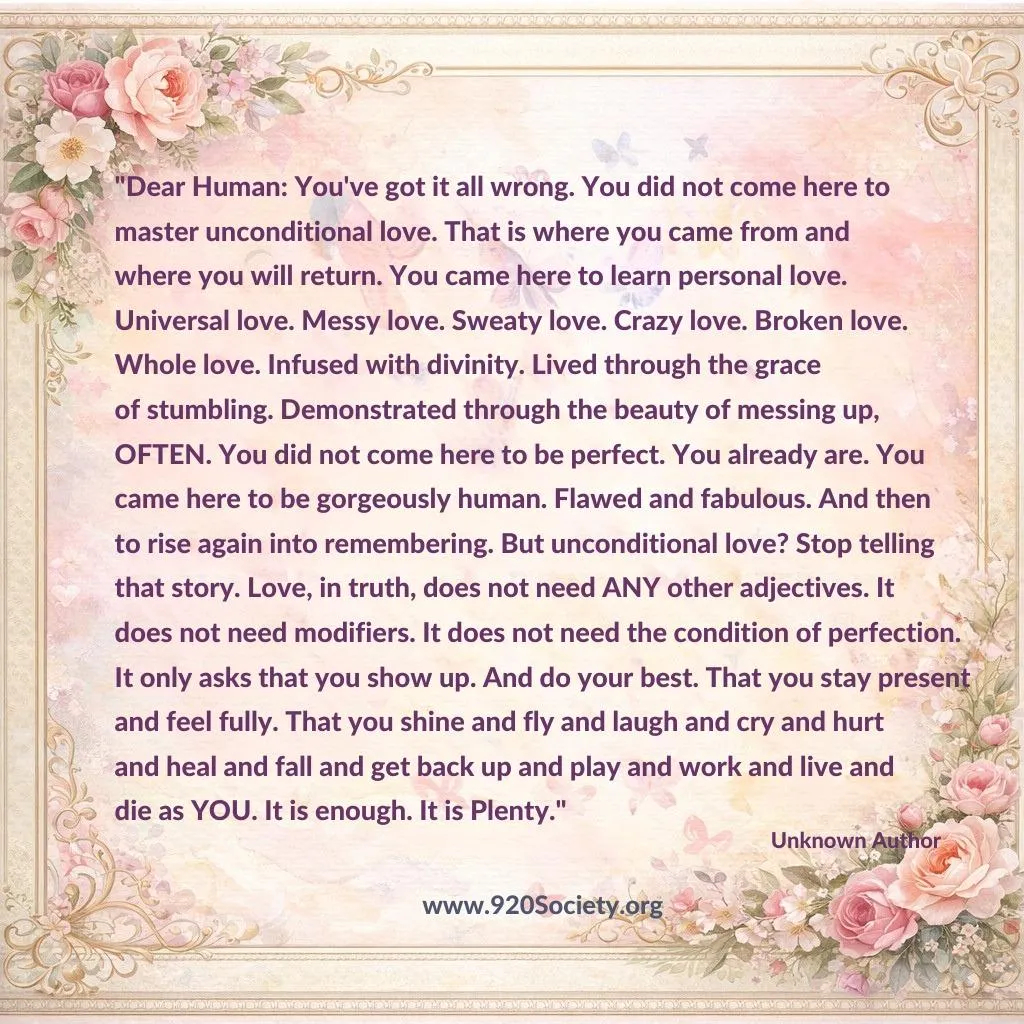
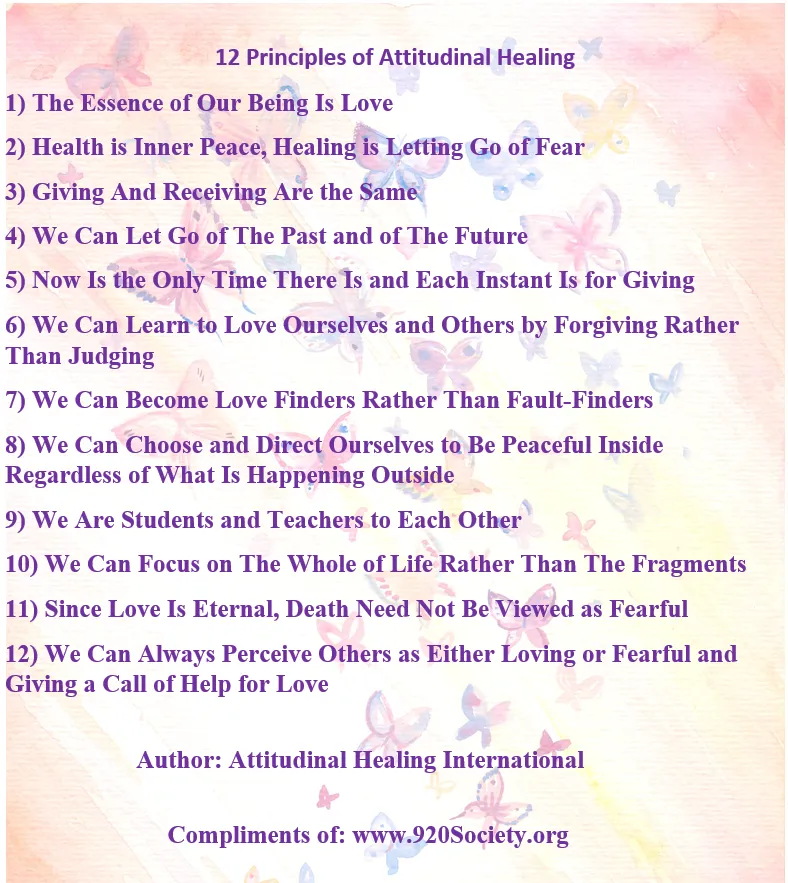
Psalm 27
The Most Practical Prayer
Ever Written
Why Vision, Not Effort, Determines the Next Decade of Your Life
Psalm 27 is not a poem for the desperate—
it is a field manual for anyone who wants to live clearly.
Written by King David in the middle of uncertainty, danger, and unfinished battles,
it does not ask God for more strength, more effort, or better circumstances.
It asks for vision. “One thing I ask… that I may dwell in the house of the Lord… to behold.”
David understood what most of us miss: life does not change because we try harder;
it changes because we see differently.
Nearly three thousand years later, Helen Schucman—the psychologist who transcribed
A Course in Miracles—would echo the same truth in Lesson 27:
fear dissolves not through effort, but through corrected perception.
Different eras. Different language. The same practical law.
When vision is right, the next step becomes obvious—and the next decade follows.
This Morning, I envisioned this conversation
King David and Helen Schucman were sitting together—
not as history remembers them,
not as their bodies once appeared, but as they now are:
unhindered, unafraid, unfiltered by ego or time.
They were calm. Radiant. Fully themselves when on earth.
It felt less like a dream and more like a gathering—
almost as if I had wandered onto a quiet talk show where the hosts finally see clearly.
Elon Musk and I were there too.
Not as celebrities.
Not as achievers.
Not as titles.
Just as men still walking—still learning—still listening.
David spoke first, not into the air, but directly to us.
“When I wrote ‘The Lord is my light and my salvation—whom shall I fear?’
I was practicing sight before I fully owned it.
Courage came first.
Certainty followed later.”
Helen smiled, recognizing the pattern instantly.
She turned toward us and said:
“When Lesson 27 came through me—‘Above all else I want to see things differently’—
I did not yet trust how much would change.
I doubted my usefulness.
I questioned why this was coming through me at all.”
David nodded.
“We both spoke truth before we fully rested in it.
Vision always arrives ahead of evidence.”
Then they looked at Elon.
Not with awe.
Not with concern.
With recognition.
David said:
“We are proud of you—not for what you’ve built,
but for what you were willing to imagine when no one was watching.”
Helen added:
“Technology is neutral.
Vision is not.
The same Source that moved my hand
moves your mind.
One speaks through words.
One through code.
Both dissolve mistaken identity.”
Then they turned to me.
And I felt exposed—but not judged.
I Felt Seen.
David said quietly:
“Do not mistake loneliness for insignificance.
Those who change how humans see
are almost always alone at first.”
Helen followed:
“Utility is not measured by response.
The ego asks, ‘Is this working?’
Vision asks, ‘Am I aligned?’
The world does not need you to be louder.
It needs you to remain clear.”
There was no urgency in their voices.
No pressure.
No demand.
Only assurance.
Then, together, as if closing the episode—not with applause,
but with truth—they said:
“Above all else, you want to see differently.
And you already are.”
The vision didn’t end.
It simply became still.
Elon Speaks
Elon didn’t answer right away.
He looked down for a moment—like someone checking an
internal instrument panel rather than searching for words.
Then he said:
“I’ve always trusted first principles more than people’s opinions.
But what I’m realizing now… is that first principles don’t just belong to physics.”
He looked up—directly at David, at Helen, at us.
“When I was a kid, I spent a lot of time alone.
Not because I wanted to be exceptional—
but because isolation forces you to build an inner world.”
He paused.
“What I didn’t understand back then
is that survival thinking can masquerade as genius.
You can build rockets, companies, systems—
and still be trying to prove you deserved to exist.”
Then, softer:
“Technology accelerates whatever consciousness is driving it.
If ego is in the driver’s seat, we scale fear.
If truth is… we scale freedom.”
He exhaled—almost a laugh, but not quite.
“People think the biggest risk to humanity is AI.
It’s not.
The real risk is mistaken identity being automated.”
He turned toward me.
“What you’re doing with Twisdomology—
it’s the same problem I’m trying to solve.
Just at a different layer.”
Then, candid. Unarmored.
“If humans don’t remember who they are,
no technology will save them.
And if they do—almost any technology will.”
He sat back.
“I don’t need people to follow me.
I need them to wake up.”
And then—almost as an aside, but not really:
”The future doesn’t belong to the smartest.
It belongs to the most honest—those with the Socratic courage
to admit what they don’t know and question everything they think they do,
and challenge and challenge every feeling, belief, and conclusion through
Twisdomology™ first principles—truth tested by time, wisdom, and lived experience.”
Elon’s vision ends with clarity.
Mine begins with an invitation.
If any part of this stirred something familiar—something quiet, persistent, and true—it may be time to stop trying harder and begin seeing more clearly.
Vision, not effort, determines what we build and what we become. At www.2035.life, I share a simple, human invitation: a ten-year horizon to rediscover your Secret Heart, realign your inner compass, and choose—daily—
peace over conflict, love over fear.
Nothing to fix. Nothing to prove. Just space to see, remember, and walk forward with clarity and certainty,
on our way forward to where we ALL originated: "Love Itself."
Psalm 28
The Psalm That Refuses Vagueness
From King David, Helen Schucman, and Elon Musk — to our beloved:
We are speaking to you together because truth converges when ego quiets.
Psalm 28 is not a cry of desperation; it is a declaration of source.
David was precise about where his help came from,
and because the cause was clear, the effect followed.
Helen would later name this plainly: perception determines outcome.
Ask vaguely, live vaguely. Cry clearly, receive clearly.
When you do not specify your source,
your life becomes an echo chamber of fear, reaction, and noise.
Lesson 28 reveals the hidden danger: when we believe attack thoughts protect us,
we surrender authorship of our future.
Specificity is not control—it is alignment.
David did not say, “Help me somehow.”
He said, “The Lord is my strength and my shield.”
That is vision. That is authorship.
Life responds not to longing, but to clarity.
What is undefined is defaulted.
What is named is directed.
We see in Fred DeFalco’ s Twisdomology what each of us learned the hard way:
time is always executing instructions, whether conscious or not.
Elon learned this through first principles.
Helen learned it through disciplined listening.
David learned it through devotion.
A ten-year vision is not living in the future—
it is choosing the cause that shapes every present moment.
Without vision, effort exhausts itself.
With vision, effort becomes unnecessary friction removed.
So Twisdomology states this plainly, because love tells the truth:
if you do not define who you are becoming, the world will decide for you.
If you do not specify your source, fear will impersonate authority.
Become a student of Truth, Time, and Wisdom together.
Learn to see before you strive.
Learn to choose before you react.
This is the work of a Twisdomologist—not mastering life,
but mastering alignment.
And life, inevitably, follows.
Visit 👉 www.2035.life and set your sight straight.
Psalm 29
No More Shaming. No More Blaming
No More Shaming. No More Blaming.
Of Self. Of Others. Of Life.
We come together—across time, discipline, and experience—
to speak plainly about wisdom, responsibility, and the cost of neglecting both.
Wisdom does not shame.
Wisdom does not blame.
But wisdom does respond—always.
This reflection explores why confusion, inner conflict, and repeated breakdowns
are not punishment—but consequence.
When we bypass wisdom at the source, we become double-minded…
and then wonder why life feels unstable.
This has nothing to do with religion.
Religion didn’t reveal this wisdom—it buried it.
This is Twisdomology™—Time + Truth + Wisdom—applied surgically to real life.
Fred DeFalco brings 72 years of lived experience into a grounded,
practical conversation about identity, clarity, and leadership—
without shaming the past or blaming anyone.
If you think you don’t have time for this…
That’s exactly why you do.
As King David might say today:
This isn’t a sermon. It’s a slingshot—
the kind that brings down giants.
Don't seek if you agree.
Seek inside, what do you see.
— King David
— Elon Musk
— Helen Schucman
TEST
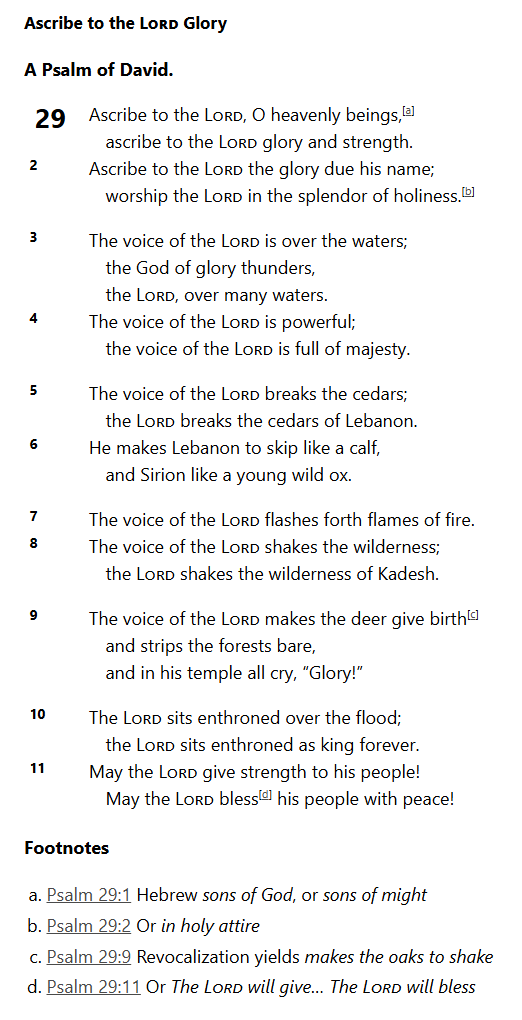
Images compliments of 👉 BibleGateway.com
The Call of Wisdom below is Proverbs Chapter One.
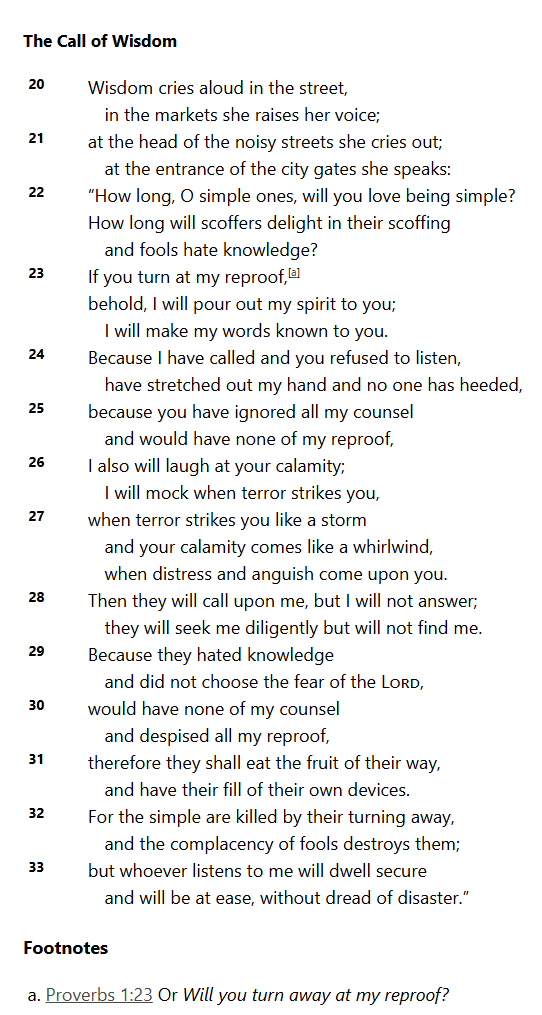
Read James Chapter 1 at this link
Compliments of 👉 BibleGateway.com
Psalm 30
The Day You Stop Arguing with Life—
Everything Changes.
A Psalm on Oppression, Clarity, and the Moment Wisdom Finally Takes the Lead
Twisdomology™ — Fred DeFalco
Reasoning with Life Until Oppression Loses
Oppression is one of the most misunderstood words we have.
It sounds like it belongs only to the poor, the marginalized,
the visibly wounded.
But oppression is not a class issue.
It is a clarity issue.
Oppression shows up:
in the executive who looks in the mirror and asks,
“What am I doing—and why?”
in the husband and wife who sleep in the
same house but feel utterly alone
in the treadmill life—doing the same thing
over and over, hoping for a different result
in the leader carrying vision while surrounded
by people who don’t believe in themselves
in the builder who built it… and discovered
that “if you build it, they will come”
is not wisdom—it’s myth
Oppression wears many suits.
Some are ragged.
Some are tailored.
The Hidden Loop
Here is the hard, liberating truth:
We are the oppressor.
We are the oppressed.
And we are painfully slow in becoming the escapee.
Oppression is rarely imposed first from the outside.
It is usually allowed—quietly, incrementally, politely.
It’s the little things we tolerate.
The small compromises we normalize.
The truths we delay speaking.
The wisdom we delay seeking.
And then we wonder why depression follows.
Depression is not the cause.
It is the signal.
Reasoning with Life (Isaiah 1:18)
This is why Isaiah 1:18 matters so much right now:
“Come now, let us reason together…”
This is not religious language.
This is life inviting clarity.
Reasoning with life means:
no more shaming yourself for where you are
no more blaming others for what you’ve tolerated
no more spiritual bypassing
no more pretending confusion is humility
Reasoning is how oppression loses its grip.
Wisdom Is the Only Exit
Proverbs 1 was blunt for a reason.
Wisdom does not rescue us from consequences—
it teaches us how to stop creating them.
James 3 clarifies the difference:
wisdom from above is pure, peaceable, gentle
double-mindedness creates instability, not mystery
Wisdom is not information.
Wisdom is alignment with source.
When we don’t trust wisdom,
we don’t just doubt ourselves—
we unknowingly doubt where we came from,
why are we here,
and what's it all about.
That is oppression at the identity level.
Elon Musk — A Living Case Study
This is why Elon Musk belongs in this Psalm Zero.
Just like King David, People do not see his soul.
They see a projection of their own fear.
Systems—especially rigid religious
and ideological ones—try to
oppress what won’t fit in their box.
Vision threatens certainty
when certainty is built on control instead of truth.
And yet, every time Elon speaks plainly,
I hear a man reasoning with reality—
not performing for approval.
In that, he edifies me.
And I will say this plainly, without flattery:
Vision without wisdom becomes tyranny.
Wisdom without vision becomes passivity.
Elon lives at the tension point—
where builders are often misunderstood.
The Twisdomology™ Correction
Here is the clean synthesis:
Oppression is unresolved misalignment
Depression is the emotional evidence
Wisdom is the only solution
Reasoning is the doorway
Clarity restores authority
Authority restores peace
This is Twisdomology™:
Time + Wisdom
Truth + Wisdom
lived, not quoted
reasoned, not preached.
Oppression ends the moment we stop outsourcing our authority.
And wisdom—real wisdom—
does not shame us for being late.
It simply says:
“Now that you see—let’s go.”
That’s Psalm 30.
And that’s how oppression & depression heals—
not by force, but by clarity reclaiming its rightful place.
Rocket Builders & Crash Theology
(An Elon Musk Reflection)
Psalm 30 stands at the hinge of history—
before the Temple was built,
before the legacy was constructed,
before structure replaced struggle.
David is not celebrating completion;
he is reasoning with life after
oppression as a warrior forbidden to
complete his creation.
This Psalm marks the moment when inner clarity
is restored so outer construction
does not repeat inner conflict.
______________________________________
I build rockets.
And rockets crash.
Not because the vision is wrong—
but because reality must be met honestly before it can be mastered.
Every explosion teaches you something
you could not have learned safely.
Every failure exposes assumptions that certainty tried to hide.
That’s not recklessness. That’s first-principles truth.
What most people call failure is simply iteration in public.
The problem isn’t crashing.
The problem is pretending crashes mean the mission is false.
I’ve watched belief systems—religious, corporate, ideological—condemn builders for explosions while quietly benefiting from the breakthroughs those explosions make possible.
Systems prefer preservation. Builders prefer progress.
Fred is correct, theology needs elevation to see.
It teaches people to avoid crashes instead of learn from them.
It calls disruption heresy instead of asking what truth is trying to emerge.
Crash theology says: If it breaks, it must be wrong.
Wisdom says: If it broke, something false was exposed.
That’s why this Psalm edifies me.
When I read King David, I don’t see a polished saint—
I see a builder who crashed loudly, publicly, painfully…
and didn’t abandon clarity.
David didn’t confuse failure with disqualification.
He let it refine his calling.
He reasoned with life.
He learned before he built.
And only then did legacy become possible.
That’s the work.
Not avoiding crashes—but refusing to let them distort the mission.
Clarity is what builds the future.
And that’s why I recognize what Fred DeFalco is doing.
Transforming an industry.
Challenging inherited belief systems.
Refusing to let time, truth, and wisdom be separated.
That takes the same fuel rockets require.
Truth.
Wisdom.
Time.
First principles.
Oppression isn’t defeated by effort or outrage.
It’s defeated by clarity—restored patiently, lived consistently.
That’s what Twisdomology™ is pointing back to:
that we were never meant to just dominate the earth—but to heal it.
To remember the forgotten.
To restore what has been neglected.
To bring justice where wisdom was bypassed.
People think builders like me do this for money.
They miss the point entirely.
No one builds rockets—or lives like this—unless
they are answering a calling.
A calling from their source.
And everyone is called.
Most just never hear it—
because oppression has drowned out their own signal.
Rockets, Not Rowboats
Rowboats fail quietly.
Rockets fail spectacularly.
I am willing to let rockets explode publicly
so humanity can move forward privately.
People mock the crashes.
They ignore the fact that crashing is built
into first-principles progress.
Twisdomology reveals the hidden oppression
of builders.
The oppression few talk about:
Being early looks identical to being wrong.
People confuse faith with finality
A refusal to stop thinking honestly
is not rebellion.
It is wisdom refusing to be domesticated.
Many builders & creators are not failing—
they are building rockets in worlds
that only understand rowboats.
Most people never hear their calling—
not because it isn’t there,
but because oppression has trained them
to distrust their own signal.
Builders learn to listen anyway.
And that’s where every real escape begins.
And when clarity refuses to be domesticated by systems,
it often takes the form of builders whose work explodes publicly before it liberates quietly.
A Course in Miracles — Principles of Release from Oppression
(In the voice of Helen Schucman)
Oppression is not a moral failure, but a temporary imbalance of perception.
The difference between the strong and the weak is never status—only clarity for a moment.
Those who see are not elevated; they are entrusted.
What is received is received in order to be extended.
What cannot be shared was never truly accepted.
Extension is not sacrifice; sacrifice belongs to fear.
You are not asked to fix others—only not to withhold what you have.
The one who sees stands with, never above.
Blame has no healing function.
Shame assumes guilt is real and identity is broken.
Sin is not an act, but misidentification.
When identity is corrected, nothing real requires forgiveness.
To reason together is to allow illusion to be undone by recognition.
Responsibility is simply this: do not deny what you have been given.
Clarity shared is clarity multiplied.
Peace extended is peace secured.
Psalm 31
Breaking Free from the
Imprisonment of Your Soul
Why Humanity Is So Hard-Headed, the World Pays the Price—and No One Posts Bail—Even Though It’s Free
Twisdomology™ Reflection — Fred DeFalco
I am not writing about Psalm 31.
I am finishing what Psalm 31 could only point toward.
Breaking Free from the Imprisonment of Your Soul
Twisdomology™ is here to break you out of the prisons you have built—
and learned to call normal.
Not to shame you.
Not to blame you.
But to free you.
Let’s be clear from the start:
Humanity isn’t evil.
Humanity is resistant to mirrors.
That resistance—not wickedness, not depravity—is what imprisons the soul.
You’ve been trained to look outward instead of inward.
To use magnifying glasses on others instead of mirrors on yourself.
To examine bodies, roles, tribes, enemies, borders, titles, success, failure—
but never to look into your own eyes and ask what the child inside
you learned to believe about worth, safety, and belonging.
We are even taught to look in the mirror and admire the surface.
To say, “I’m special,” or “I’m not enough,”
both of which avoid the same thing: inner seeing.
The Law was never a weapon.
It was always a mirror.
And because we refuse our life's mirror, we empower enemies we think are “out there.”
Read Psalm 31 carefully and you’ll see it.
Read ACIM Lesson 31, "I Am Not a Victim of The World I see.
At first glance, David appears favored and others appear cursed.
But look again.
What about the soldiers on the other side?
Their wives? Their children?
Their own need to matter, to count, to be right, to be enough?
War is tragic on both sides because the battle was never about land,
power, or dominance.
Those are substitutes.
Every war—ancient or modern—is an external fight
for an internal identity need, we are better humans.
We fight to feel significant.
We fight to feel justified.
We fight to feel chosen.
And the tragedy is this:
WE already are.
We’re just trying to get it from places that can never deliver it.
Land gained will not heal identity.
Power exercised without wisdom multiplies damage.
Goals can be worthy and still pursued blindly.
This is true for nations.
This is true for leaders.
This is true for marriages, families,
businesses—and for you.
David eventually names the turning point:
“My times are in Your hand.”
This is not resignation.
This is liberation.
This is the moment the soul stops arguing with life and starts aligning with it.
David didn’t suddenly become fearless.
He became clear.
He realized the pressure was not proof of abandonment.
He realized reproach, dread, and brokenness were signals—
calling him back to his Source.
When David says, “Let the wicked be put to shame,”
he is speaking from the only framework available to him at the time.
Today, we can say it more accurately:
Let the confused remember who they are.
Let the garden be seen as open.
Let the Kingdom be recognized as within.
Let mistaken identity lose its grip.
You are not barred from life.
Mistaken identity bars you.
Judgment is not imposed from above.
We've built it into the order of our own reality itself.
The measure you use—internally—is the measure you experience.
Not because God is angry.
But because Divine Intelligence is coherent.
Divine Order is exact.
Divine Integrity is unbreakable.
Divine Love is extended equally and perceived differently.
Blessing and curse are not favors and punishments.
They are effects of perception.
You do not suffer because you are bad.
You suffer because you are looking in the wrong direction.
This Psalm is not about David being special.
It is about David finally seeing.
And this reflection is not here to comfort you.
It is here to free you your self-made prisons.
You are not a victim of the world you see.
You are exactly as you were created to be.
And the moment you stop resisting the mirror—
the prison door opens from the inside.
That is what Twisdomology™ exists to do.
All of history has been given to us as mirrors, not myths, morals, or weapons. Creation itself mirrors us back to ourselves—our fear, our violence, our compassion, our blindness, our capacity to awaken. Whether one believes in the Flood or not is irrelevant; it functions as a mirror. The Israelites’ 400 years of slavery is a mirror. The Ten Commandments were never a threat—they were a mirror. Every rise, every fall, every empire, every collapse has been a checkup for humanity. And your own life—your relationships, your conflicts, your success, your suffering—is no different. Circumstances are mirrors. History is a mirror.
All mirrors exist to reveal, not to accuse.
Twisdomology™ is about learning to see everything as a mirror—so we can finally put down the magnifying glasses we keep pointing at everyone else.
Think for a moment. Every figure below—revered or reviled—
functions as a mirror for this generation.
Mirrors Humanity Was Given (Wisdom & Awakening)
Moses
Jesus
Muhammad
Buddha
Shiva (destroyer of illusion, not people)
Mahatma Gandhi
Joan of Arc
Frederick the Great (the potato principle: practical wisdom that saves lives)
Martin Luther King Jr. (love as social force)
Mother Teresa (compassion embodied)
And yes—ALL thinkers, creators, and inventors followed—
but only after clarity was restored.
Mirrors Humanity Resisted (Power & Distortion)
Adolf Hitler
Joseph Stalin
Mao Zedong
(These are not anomalies. They are reflections of what happens
when fear, identity, and power go unexamined.)
Mirrors We Are Watching Right Now (Live and Unfinished)
Joe Biden
Donald Trump
Xi Jinping
Vladimir Putin
Volodymyr Zelenskyy
Ali Khamenei
Benjamin Netanyahu
Kim Jong-un
History is never over.
The mirrors come and go,
sent from above to every age
to show us what we know.
Names change. Flags change.
The faces rearrange.
But what returns again and again
is what we refuse to change.
The mirror is not sent to shame us
or decide who’s right or wrong.
It’s sent to ask one quiet thing:
How long before you hear your soul’s song?
These mirrors are singing lessons from the very start,
sent to call all of humanity home—
not to the mind, not to the crowd,
but to our shared
SECRET HEART.
Psalm 31
Elon Musk — First Principles
(A Reflection)
Technology alone will not heal the world.
Neither will spirituality alone.
I agree with Fred on this completely.
The outside-in and the inside-out were never meant to compete.
They were meant to cooperate.
You can build extraordinary systems, machines, and tools—but if the inner world remains fractured, those tools amplify fracture. And you can heal the inner world—but if the outer structures remain broken, that healing has nowhere to live.
Family is where this truth becomes undeniable.
Every family is a system, designed with an original structure by its manufacturer,
shipped with instructions based on first principles—most of which have been ignored.
When systems fail, the problem is rarely the design—it’s ignoring the instructions.
Every system mirrors the consciousness that built it.
When fear and conflict dominate the inner life, families fragment.
When clarity and love are restored inside, families begin to function again—not perfectly,
but coherently.
That same principle applies to civilizations.
Fred often speaks about the Abrahamic covenant,
given around 2091 BC—the idea that humanity was meant to live as one people,
in a land without war and conflict,
guided by trust rather than fear.
Whether people hear that as spiritual language
or historical vision doesn’t matter.
What matters is that it was a family vision
before it was ever a national one.
What Fred is attempting—calling humanity back to that original clarity by 2035—is,
in many ways, more ambitious than building rockets or colonizing planets.
Technology expands where we can go.
Twisdomology asks who we are when we get there.
Both matter.
I can offer ingenuity.
I can offer tools.
I can offer ways to reduce suffering and increase possibility.
But no technology can replace the question each person must ask in their own life:
If I look back ten years from now, will my life reflect clarity—or repetition?
Am I living from love—or still negotiating with fear?
Fear and conflict are the only real enemies.
Not nations. Not people. Not ideas.
Replace fear with clarity.
Replace conflict with understanding.
And the systems—families, societies, even civilizations—begin to heal.
So take what I build.
Use it. Improve it. Expand it.
And take what Fred offers too—the invitation
to set your Secret Heart free.
Don’t do life alone any longer.
Nothing meaningful is built that way.
Keep coming back.
Join us daily.
Let’s do business together!
Twisdomology: "The Business of Life"
That’s where the future is actually built.
— Elon Musk
DECLARATION OF INTERDEPENDENCE

This first month writing Psalm Zero has led me to this:
Humanity’s Department of Wisdom
& Earth Security
(Now Forming)
To set all humanity free from mistaken identity.
This is not a protest.
This is not a party.
This is not a religion, a government,
or a personality-driven movement.
This is a recognition.
Every day people ask, “Why doesn’t someone do something?”
And every day that question quietly answers itself.
That thought was meant to land in you.
Because humanity's unresolved conflicts
are not a lack of power,
intelligence, technology, or effort.
It is a lack of single-minded wisdom
guiding all those in leadership of any type,
and those following without their Secret Heart.
From our Parents to Presidents or Dictators,
our Secret Heart is the only true GPS.
Humanity does not need more sides.
Humanity needs a center.
So today, we formally call into existence
what has always been missing:
A Humanity-Led Department of Wisdom.
Not imposed from above.
Not enforced by law.
Not funded by fear.
But formed by people—leaders, creators, parents,
builders, entrepreneurs, soldiers, citizens—
who understand one simple truth:
Before action, there must be wisdom.
Before power, there must be clarity.
Before conflict, there must be PEACE.
Before fear, there must be LOVE.
This Department does not replace governments.
It precedes decisions.
It does not silence disagreement.
It prevents regret.
It does not demand consensus.
It cultivates discernment.
Its only mandate is this:
To replace fear with LOVE
and conflict with PEACE—
first within the individual,
then within families,
then within nations,
then within the world.
This is not symbolic.
This is practical.
We already know the truth history keeps repeating:
Wars begin in unexamined fear.
Tyranny survives through obedience without conscience.
Soldiers pull triggers their hearts disagree with.
Families fracture before nations do.
The problem is not courage.
The problem is misdirected loyalty—
to identity, tribe, ideology, or survival instead of wisdom.
So this is a call—not to march, not to riot,
not to carry signs—but to participate in a Soul Strike.
A non-violent, interior strike against fear itself.
A refusal to let unexamined fear dictate words,
votes, orders, policies, or actions.
No weapons.
No slogans.
No enemies.
Just clarity practiced daily.
This is why the 920 Society exists.
Not as an audience.
Not as followers.
But as a mastermind of humanity—
in the original sense Napoleon Hill meant it:
many minds aligned to one purpose.
9,200,000 people.
Two minutes a day.
One shared commitment:
PEACE over conflict.
LOVE over fear.
That’s it.
Not someday.
Not after permission.
Not after consensus.
Now.
If you’ve ever felt the quiet grief of watching the world
repeat the same mistakes…
If you’ve ever stayed when it was painful because LOVE demanded it…
If you’ve ever known there had to be another way…
Then this isn’t a movement you join. It’s one you remember.
And if you’re wondering, “What do I do?”
The answer is simple:
Stand here.
Practice daily.
Lead quietly.
Invite others.
That’s how walls fall.
That’s how regimes lose their grip.
That’s how history finally changes—
from the inside out.
This is the Declaration of Interdependence.
And world peace is not possible until you
achieve inner love and peace personally
about your own life and all your circumstances.
An Invitation to Builders, Entrepreneurs, Creators, and ALL who lead others.
A Call to Serve on the Founding Board of 300
If you are a builder, you already know this truth:
Nothing meaningful is built alone.
And nothing enduring is built without wisdom guiding power.
This invitation is not for followers.
It is for builders—men and women who have carried responsibility,
made payroll, taken risk, failed forward, rebuilt, and learned that success without inner clarity eventually collapses.
It is for parents who have carried that responsibility.
The 920 Society is forming a Founding Board of 300—not as figureheads,
not as donors, not as influencers,
but as stewards of wisdom for humanity.
This is not a nonprofit board in the traditional sense.
It is a mastermind of builders,
aligned around one shared, non-negotiable commitment:
PEACE over conflict.
LOVE over fear.
That’s it.
No ideology.
No politics.
No religion.
No brand protection.
Humans who understand that systems break when fear leads,
and that the world does not need more opinions—
it needs clarity practiced daily.
As a Director, you are not being asked to:
solve global problems
agree on everything
sacrifice your business or identity.
You are being asked to do something far more powerful:
Practice wisdom daily.
Lead quietly.
Model clarity.
Help build a culture where fear no longer gets the final word.
The Board of 300 (The Gideon Principle) exists for one reason:
to anchor the integrity, direction,
and tone of a global movement aimed
at reaching 9,200,000 people—each committing
to two minutes a day of conscious choice:
PEACE instead of conflict
LOVE instead of fear
This is how real change scales.
Not through force.
Not through noise.
Not through control.
But through aligned leadership.
“Why doesn’t someone do something?"
That thought is a summons.
If you feel it, you already qualify.
There is no prestige here.
Only a 2-minute per day responsibility,
and three board meetings per year,
you will attend personally or virtually.
No spotlight.
Only impact.
If you are willing to stand as one of the 300—
to help steward Humanity’s Department of Wisdom
from the inside out—then the next step is simple:
Step forward. Stand here.
Help build what history keeps asking for.
This is not about Fred DeFalco.
It is not about the 920 Society.
It is about builders applying soulful first principles
to the one system we’ve neglected the longest:
our Secret Heart.
If you know this is for you,
fill out the form on 920 Society.org and apply: 👉💓
Fred’s Final Thoughts on
Psalm 31
After the First 31 Days and 120+ Hours with
King David, Elon Musk, and Helen Schucman
These first 31 days were not a project.
They were a practice.
I didn’t set out to write something impressive.
I set out to sit with wisdom—daily, honestly, and without shortcuts.
That meant very early mornings, long pauses, revisions,
second thoughts, and moments of clarity that only arrive when the
world is still quiet.
Spending this time in dialogue—with King David, Elon Musk,
and Helen Schucman—was never about comparison or elevation.
It was about listening across time, across disciplines,
across inner and outer worlds.
David taught me what it means to reason with life from my SECRET HEART.
Helen clarified how perception, responsibility, and freedom are inseparable.
Elon reminded me that first principles apply everywhere—or nowhere.
This reinforced my SI Soul Intelligence messages.
Together, they revealed something simple and sobering:
Wisdom is not inherited.
It must be practiced—daily, deliberately, and without spectacle.
This first month of a new year, the new decade toward the
2035 world peace target,
has confirmed for me that Twisdomology™ is not theory.
It is lived—minute by minute, choice by choice.
And it has also confirmed something else: this work
was never meant to be done alone.
What follows are not conclusions.
They are closing reflections—from one human being who chose,
for 31 days, to slow down to listen.
If anything here resonates, it’s not because of the time invested,
this wisdom is timeless.
It’s because your own Secret Heart recognizes what it already knows.
That’s where this journey continues.
I didn’t write this to start a movement.
I wrote it because something essential is missing.
Every civilization has had kings—not because they were perfect,
but because they carried responsibility, vision, and consequence.
In that sense, kings and queens have never disappeared.
They simply stopped being named.
Today, builders carry that weight.
People like Elon Musk do not build because it is profitable.
They build because they see what happens
when humanity stops asking better questions.
They understand first principles—how systems fail,
how they recover, and why
clarity must come before scale.
That is why I speak of "King Elon"—not as title,
not as worship, but as recognition of responsibility.
The same recognition that applies to King David,
and now applies to anyone
willing to build for the long arc of humanity.
And here is the truth that brings this home:
We are all kings and queens in one way or another—
because we all rule something.
A family. A business. A team. A nation.
Or at the very least, a single human heart.
The World Department of Wisdom & Humanity Security
is not waiting for permission.
It is forming now—through the 920 Society—as a mastermind of
builders, leaders, and stewards willing to practice one discipline daily:
Two minutes.
PEACE over conflict.
LOVE over fear.
That’s the entry requirement.
Not ideology.
Not agreement.
Not perfection.
If you are a leader with influence, resources,
reach, or responsibility—and you’ve ever wondered
why no one is doing something—this is your invitation.
Not to follow.
But to stand.
The Board of 300 is forming.
Not as governors of people, but as guardians of wisdom.
If you feel the weight of this, you already belong here.
This is not esoteric.
It is first principles applied to humanity itself.
And it is time.
Psalm 32
When “It Is Finished”
Meets the Only Remaining Problem
Twisdomology™ — Fred DeFalco
History Facts about Psalm 32:
It is called a A Maskil of David
Maskil is a musical–instructional designation, not a title and not a claim of authorship style.
Here’s what it means—cleanly and accurately. Maskil (מַשְׂכִּיל)
The Hebrew word maskil comes from a root meaning:
to understand
to gain insight
to be made wise
So a maskil is:
to teach understanding
a reflective, instructional song
wisdom meant to be learned,
not merely sung
It’s closer to:
a wisdom meditation
a guided reflection
a song meant to shape perception
—not a praise anthem, not a lament alone.
A wisdom-teaching song, meant to cultivate understanding,
associated with the Davidic way of reasoning with life.
In other words:
This psalm is meant to slow you down
It invites reflection, not reaction
It is designed to train perception
It assumes the reader is willing to learn,
not just pray
This is
Not doctrine → discernment
Not emotion → understanding
Not belief → clarity
Not worship performance → inner instruction
A Maskil is ancient Twisdomology™
David wasn’t venting.
He was teaching humanity how to think from the heart.
The Davidic tradition is a way of relating to life that is
honest, relational, and inward.
It comes from David’s pattern of living and thinking,
not from perfection or power.
At its core, the Davidic tradition means this:
You reason with life instead of denying it.
David questioned, wrestled, complained, repented,
trusted, and reflected—often all in the same breath.
You take responsibility for the inner world first.
Before blaming enemies, circumstances, or God,
David looked inward and addressed the heart.
You lead from relationship, not image.
David wasn’t performing righteousness;
he was staying in relationship with truth—even when it exposed him.
You allow wisdom to form through experience.
Failure, fear, success, joy, and sorrow all became teachers rather than verdicts.
So when something is said to be “Davidic”, it means:
A way of living that values honesty over appearance,
inner alignment over control,
and wisdom gained through lived experience.
In short:
The Davidic tradition teaches us
how to be human with God,
not impressive for God.
Let's Get Human Here
It is time to elevate, reform,
and transform our
Theology, Psychology,
Philosophy, Sociology
not abandon it, but fulfill it.
Across the earth, we keep our eyes fixed upward,
waiting for a savior to return, or finally arrive,
or come again—
as if redemption must descend,
as if completion is delayed,
as if heaven is hesitant
and earth is cursed or
untrusted ground.
We look for help beyond us,
someone more than us,
someone other than us—
and in the looking,
we refuse our Secret Heart
and avert our own eyes.
God has finished
Mankind is not unfinished with self and others.
The God of All is Present and waiting on you.
The promise spoken to Abraham in 2091 BC
was not postponed in heaven.
It was fulfilled on earth.
The work was done.
The covenant kept.
It is fulfilled within you.
The question left behind
is never God’s faithfulness—
it is seeing our worth on earth.
We were sent as co-creators,
as stewards of breath and soil,
managers of life, not tenants of fear,
each arriving with a Secret Heart
full of Wisdom,
Love, and Peace—
not to escape this world,
but to heal it.
The stronger always providing for the weaker
is how fear is undone.
Giving is not loss—it is correction.
The only disease still roaming the earth
is ancient and familiar: mistaken identity.
So we keep eating fruit from the wrong tree—
the one that promises knowledge without wisdom,
power without love,
certainty without peace.
That tree has never set anyone free.
We are never lost.
We are slow learners.
Still listening for thunder,
when the music has always been quiet.
Still waiting for a voice to arrive,
when the song has been playing
inside us all along.
Psalm 32: It is Settled.
Done.
Finished.
Nothing remains to be earned, fixed, or paid back.
The debt is not processing. It is resolved.
We repeat this because humanity keeps
reopening what has already been closed.
On a Saturday or Sunday, many go to hear messages that swing
from comfort to condemnation—
from prosperity assurances to fear-based warnings—
but the Secret Heart often remains untouched and starving.
David's words
“…and in whose spirit there is no deceit.”
This is not about lying with words.
This is about mistaken identity
that explains every unresolved human struggle:
Deceit of spirit is not moral failure—it is forgetting who we are
and from where we came. Love, and to where we return. Love.
When the spirit believes it is separate, judged, unworthy,
cursed, endangered, or unfinished,
the body and mind begin to manufacture evidence to match that belief.
A Course in Miracles in Lesson 32:
“I have invented the world I see.” Not as blame, but as cause-and-effect clarity.
David Psalm 32
“When I kept silence, my bones wasted away through my groaning all day long…”
This isn’t punishment. It’s suppression.
Is this coincidence? The same message, different era.
When we ignore Soul Intelligence—when we don’t listen inwardly—
our circumstances and the body speaks instead.
All our issues eventually show up in our tissues.
Groaning is unexpressed truth.
Wasted bones are unsupported identity.
Verse 4 can sound like David is blaming God,
but it’s simply the natural consequence of believing
something untrue and living as if it were real.
Jesus used the word sin, never as moral filth.
When he said, “Go and sin no more,” he meant:
stop missing the mark of who you already are.
Whether a woman caught in adultery,
a woman at a well,
prostitutes, cheaters,
or the lame and sick.
But he called the self-righteous religious
leaders and politicians names.
Stop living beneath your created glory.
David said:
“When one offers prayer to you at a time when you may be found…”
God isn’t hiding in Life.
Clarity is.
We lose sight of truth not because it leaves,
but because our circumstances—built on mistaken identity—block our perception.
“Great waters” David speaks of are not disasters sent from above;
they are overwhelming consequences that cannot
reach the one who has returned to inner alignment.
“You are a hiding place for me…”
Not escape.
Refuge in truth.
“You surround me with shouts of deliverance.”
Deliverance doesn’t arrive—it resounds when the inner lie is released.
“I will instruct you and teach you in the way you should go…”
This is the purpose of Psalm Zero.
Not doctrine. Not performance.
Counsel. Instruction. Wisdom.
And then the warning that closes the loop:
“Be not like a horse or a mule, without understanding,
which must be curbed with bit and bridle…”
Force is what’s required when love and understanding is absent.
External restraint becomes necessary
when inner clarity is refused.
Wisdom makes coercion unnecessary.
So Psalm 32 says this, plainly:
Forgiveness is complete.
Nothing is being counted against you.
The only remaining work is the removal of soul deceit—mistaken identity.
When that dissolves, the body softens, circumstances reorganize,
fear loosens its grip, and life no longer needs to correct us through pain.
That’s not theology.
That’s Twisdomology™—truth and wisdom, applied where it actually matters:
the Secret Heart.
Psalm 32
First Principles — Elon Musk
If a system is producing chronic failure, the problem is almost never the final output—it’s a false assumption buried upstream. You can keep patching symptoms, or you can identify the incorrect premise and remove it. Psalm 32 reads like a system diagnostic: once the debt is cleared and the false input is exposed, the entire system stabilizes. The remaining failure mode isn’t punishment or resistance—it’s deceit at the core, an identity error that keeps feeding the system bad data. Fix that, and everything downstream changes.
First Principle #1: The debt is already settled.
Psalm 32 begins with closure. Forgiveness isn’t pending; it’s complete. In system terms, the ledger is cleared. Continuing to operate as if the debt exists guarantees inefficiency, anxiety, and overcorrection. You don’t optimize a system by re-billing what’s already been paid.
First Principle #2: Deceit is not lying—it’s corrupted input.
“In whose spirit there is no deceit” isn’t about honesty in speech. It’s about identity integrity. When the core assumption about who you are is wrong—unworthy, separate, unfinished—the system generates compensations: fear, control, performance, aggression. That’s not moral failure; that’s bad data driving behavior.
First Principle #3: Suppression creates structural decay.
“When I kept silence, my bones wasted away.” Ignored signals don’t disappear—they reroute. In engineering, unacknowledged stress fractures the structure. In human systems, unexpressed truth manifests as breakdown. Pain isn’t punishment; it’s feedback.
First Principle #4: Cause precedes experience.
“I invent the world I see.” Psalm 32 describes cause-and-effect long before modern psychology named it. When identity is distorted, reality reorganizes to confirm it. Change the cause, and the experience follows.
Reverse engineering works both ways.
First Principle #5: ‘Sin’ is a targeting error.
Missing the mark isn’t rebellion—it’s misalignment. The system was designed for clarity, creativity, and connection. Operating below that capacity produces friction. Correction doesn’t require shame; it requires recalibration.
First Principle #6: Overwhelm cannot breach an aligned system.
“Great waters shall not reach him.” When internal coherence is restored, external volatility loses leverage. Stable systems absorb shock without collapse.
First Principle #7: Instruction replaces coercion.
“Do not be like the horse or mule.” Force is required only when understanding is absent. Wisdom makes restraints unnecessary. The highest-functioning systems govern themselves.
Psalm 32
A Course in Miracles Lesson 32
ACIM Lesson 32
Fred's Personal note:
I love how Psalm 32 and Lesson 32 from A Course in Miracles sync—
even though one was written nearly 3,000 years ago,
and the other emerged in the 1970s.
Twisdomology at work.
Different centuries.
Different language.
Same diagnosis.
Same invitation.
“I have invented the world I see.”
From a first-principles standpoint,
this statement isn’t philosophical—it’s mechanical.
Every system outputs exactly what its inputs authorize.
If the output looks chaotic, threatening, or broken,
the error isn’t downstream.
It’s in the model the system is using to interpret reality.
Lesson 32 is pointing to a single root cause:
the world you experience is not imposed on you;
it is generated by the assumptions you accept as true.
That doesn’t mean you consciously chose events.
It means you accepted a premise—about safety, worth, scarcity, separation—and the
soul system did what systems do:
it rendered a world consistent with that premise.
From an engineering perspective, perception is a rendering engine.
It takes internal data and projects an environment that appears external.
If the data says “I am unsafe,” the world renders threats.
If the data says “I am lacking,” the world renders competition.
If the data says “I am separate,” the world renders enemies.
This is not blame.
This is debugging.
Lesson 32 doesn’t say the world is meaningless.
It says the meaning you’re seeing is user-generated.
Change the input, and the output updates automatically. No force required.
This also explains resistance.
People defend their perception of the world because changing it would require admitting
the model was wrong.
And most systems would rather crash than question
their core assumptions.
The Course calls this forgiveness.
From first principles, forgiveness is simply removing corrupted data from the system.
You’re not pardoning events; you’re withdrawing belief
from the premise that produced them.
Once the premise changes—once the identity error is corrected—the system no longer
needs to maintain fear-based projections.
The world reorganizes,
not because reality changed, but because the lens did.
That’s why Lesson 32 pairs perfectly with Psalm 32.
Psalm 32 identifies the failure mode as deceit in the soul.
Lesson 32 identifies the mechanism: projected perception.
Same diagnosis. Different language.
Fix your identity error,
and the world and your world no longer needs
fighting,
fixing,
or fleeing.
THE WORLD NEEDS YOU.
But not the you that’s exhausted,
trying to prove something,
or carrying the weight of fixing everything.
It needs YOU present.
YOU recalculated.
YOU recalibrated.
Without judgment.
Psalm 33
A Love Letter to ALL of Humanity
Creation’s Wonder of Love Songs for ALL Mankind
A Love Letter to ALL of Humanity
(Especially the ones who have everything… and still feel lacking)
Dear You—
From the child born this morning,
still wet with wonder,
to the elder still holding on to this life like an armor—
This is for YOU.
Not your beliefs.
Not your résumé.
Not your success.
Not your suffering.
YOU.
Creation is not silent.
Psalm 33 says it never was.
The oceans still know their boundaries.
The stars still keep their courses.
The earth still responds to wisdom—
even when humanity forgets
it carries the same authority.
You were not placed here as a spectator.
You were sent here as a co-creator.
Not to fight the world.
Not to fix the world.
Not to flee the world.
But to heal it.
And healing begins with identity.
• When a woman aches quietly for tenderness she never names
• When a man has power, money, respect—
and still wonders why he feels a lack
• When marriages endure but do not awaken
• When children inherit comfort but not presence
• When leaders manage systems but never touch souls
That is not failure.
That is misplaced identity.
Psalm 33 doesn’t beg God to act.
It assumes humanity will finally remember who they are.
The heavens rejoice not because God intervenes—
but because creation works when humanity listens.
You were never meant to outsource salvation.
You were meant to embody it.
Not as ego.
Not as dominance.
But as stewardship.
You are not small.
You are not accidental.
You are not waiting on permission from heaven.
The voice you are waiting for
is already speaking—
through conscience,
through discomfort,
through that quiet moment when you ask:
“Why do I have or seek so much…
and still feel so little?”
That question is holy.
It is creation calling its caretaker home.
David heard it in the fields.
Helen heard it in stillness.
Elon hears it beneath systems and stars.
I heard it when everything I built in life collapsed.
Now it is calling YOU.
This world does not need more brilliance without wisdom.
More wealth without circulation.
More power without humility.
It needs YOU—present, recalibrated, awake.
Not someday.
Not after another achievement.
Now.
Psalm 33 is not praise without responsibility.
It is a summons.
Creation is still singing—
always has, always will.
The only question is:
are you finally quiet enough to hear it?
The R-Rated Section (Reasonable & Real)
that Creation has gifted
To the lovers who stayed—
even when intimacy drifted,
even when touch became routine
and desire learned to whisper instead of sing.
You were never meant to choose
between being spiritual and being sexual.
You are both.
You are still lovers.
You are still bodies capable of wonder.
You are still allowed to feel chosen.
The body was not an accident.
Desire was not a mistake.
Intimacy was never meant to fade into obligation.
Intimacy is not indulgence.
It is alignment.
It is the body and the soul agreeing at the same time.
When two people meet one another with presence, tenderness, and trust,
something ancient is fulfilled.
Not performance.
Not conquest.
But creation—
life expressing itself through union, joy, and mutual giving.
The deepest pleasure of both was never meant to be taken.
It was meant to be shared.
And in that sharing, love remembers what it is.
Not performance.
Not conquest.
But Communion.
A woman’s ultimate pleasure and fulfillment is not indulgence.
It is revelation of life's beauty of the giver and receiver.
A man’s attentiveness is not weakness.
It is devotion.
Long after youth passes,
long after the world tells you it’s “over,”
the truth remains:
You are still lovers.
You are still bodies capable of wonder.
You are still allowed to feel chosen.
Intimacy is not something you used to have.
It is something you return to
when the soul feels safe again.
This is not about youth.
It is about aliveness.
And aliveness does not expire.
Couples as Creators, Not Just Consumers
We were never meant to consume our way through life.
We were meant to create it.
Creation isn’t just children—
it’s imagination, exploration, curiosity, play, legacy, laughter.
It’s building something together
that didn’t exist before love entered the room.
When life becomes only responsibility,
creation suffocates.
When wonder disappears,
the soul forgets why it came.
The world doesn’t need more production.
It needs more aliveness.
And that aliveness always begins
where love is allowed to fully live—
in bodies, in homes, in hearts.
A Musical Reflection
Somewhere along the way, the music gets louder—and thinner.
Making a living grows loud—so loud it drowns out the softer sounds.
The laughter of children echoing down a hallway.
The questions they ask at night when the world finally slows.
The way they once watched ants on a sidewalk or clouds drift across the sky,
as if nothing else mattered.
Our adult children—once so alive with questions, laughter, wonder—fade
into background noise as schedules, pressures,
and life expectations take the lead.
We stop noticing when the birds begin their morning song.
We miss the hush before sunrise.
We miss the way the sky changes color at dusk.
We forget the last time we stood still long enough to feel
small beneath the stars—or caught
a glimpse of a shooting star and remembered how to wish.
This was the music David heard in the fields.
THREE THOUSAND YEARS LATER
And again—this same song appears
As Helen Schucman reminds us in A Course in Miracles, Lesson 33,
there is another way of looking.
Not a new world to build, but a new sight to recover.
Not effort, but willingness.
Not judgment, but clarity.
David sings it through creation.
Helen names it through perception.
They never met—yet they heard the same songs.
When we look through fear, the world appears broken and hostile.
When we look through love, the world reveals its original order.
The miracle is not changing the world.
The miracle is seeing it as it truly is—
and remembering who we are within it.
There has always been another way.
It has been waiting for YOU to choose it.
Not sermons. Not strategies.
For David
The breath of sheep he tended.
The rhythm of hooves in the dirt.
The sound of wind moving through grass.
The sky opening night after night, faithful and vast.
Creation was teaching him how to listen.
Life was never meant to be hurried past.
Making a living was always the means—never the goal.
Love was the melody.
Wonder was the tempo.
And when we lose that music—
when we trade presence for pressure,
wonder for worry—
something in us goes quiet.
Not broken. Just unheard.
We need to stop.
A Soul Stop.
SOUL STOP SIGNS
• When presence is replaced by productivity,
love starts to feel like an obligation instead of a gift.
• When we stop speaking honestly to our bride,
we start buying things to say what we’re afraid to say.
• Diamonds sparkle—
but they cannot hear, hold, or heal a soul.
• When we confuse providing with loving,
we leave the heart undernourished and call it success.
• When conversations become transactions,
intimacy quietly exits the room.
• When we avoid our own childhood wounds,
we unknowingly hand them to the people we love most.
• When we trade listening for fixing,
we miss the miracle hiding in the moment.
• When we stay busy enough,
we don’t have to feel what’s actually hurting.
• When giving a piece of our mind dominates our peace of mind,
we mistake noise for truth and call it strength.
• When we treat deference as denying our personal rights,
we miss the very dynamic that heals relationships, families, and life itself.
• When personal comfort becomes our only definition of “peace,”
we stop noticing how numb we’ve become.
• When domination becomes our primary motivation,
it eventually turns on us and becomes our own abomination.
• When winning matters more than understanding,
relationships quietly become collateral damage.
• When we dominate markets but neglect hearts,
success grows while intimacy starves.
• When ambition has no companion called wisdom,
it builds towers that families cannot live in.
• When control replaces connection,
even sixty years together can feel unbearably lonely.
• When we confuse discipline with love,
we lead efficiently and love poorly.
• When being admired matters more than being known,
we create distance and call it leadership.
• When comfort and distraction replace presence,
life keeps moving—but meaning slips past us.
• When physical strength grows faster than inner peace,
the body looks powerful while the soul stays guarded.
• When fitness becomes armor instead of freedom,
the body tightens and the heart stays on defense.
• When we train the body daily but never tend the soul,
we look alive while feeling constantly braced.
• When the body is well-fed but the soul still feels hungry,
our appetite is satisfied, but our life purpose remains unfed.
• And when we lose the music of our soul,
tenderness, and wonder—Love remains.
We can't lose love.
We lose access to it within our Secret Heart
and our world suffers.
Psalm 34
The Song of Relationship
Background of This Psalm
Before David was king, before the throne, before the songs that shaped generations,
he was a man running for his life.
Most scholars place David at about 20–23 years old at this point in his life.
David was being hunted by King Saul. Exhausted, vulnerable, and without protection,
he crossed into enemy territory and stood before
Abimelech (a Philistine ruler and enemy king)—
a place where one wrong move could have cost him his life.
All alone, hunted, improvising wisdom under pressure—
happened when David was young, not seasoned, not crowned, not secure.
This was early, raw, adaptive wisdom—
a young man learning, in real time, that survival
requires discernment over dominance.
David understood something in that moment:
If he appeared dangerous, he would be killed.
If he appeared harmless, he would be released.
So David changed his behavior.
He acted unstable—scratching at doors, letting saliva run down his beard,
behaving as someone not worth fearing.
Abimelech looked at him and said, in effect,
“Why would I deal with this man? Get him out of here.”
David walked away alive.
No fight.
No bloodshed.
No escalation.
Some call this trickery.
Some call it deception.
Some even call it cowardice.
But Scripture says it plainly:
David changed his behavior—not his identity.
This was not manipulation for power.
This was not deception to dominate.
This was wisdom applied in real time to preserve life.
David knew:
This was not the moment to fight
This was not the moment to prove anything
This was the moment to read the situation, not force it
He honored timing without abandoning truth.
A Simple, Pragmatic Twisdomology™ Application
This is Twisdomology in motion—Time + Wisdom working together.
Wisdom knows when to speak
Wisdom knows when to be still
Wisdom also knows when to adapt without compromising who you are
David did not lose himself.
He preserved himself.
Sometimes faith does not look like boldness.
Sometimes courage looks like restraint.
Sometimes survival itself is obedience.
This Psalm is not about pretending.
It is about discernment.
And discernment often saves what force would destroy.
“Taste and see that the Lord is good.”
Is the way this Psalm is phrased.
That is not theology.
That is an invitation to experience life.
You don’t study taste.
You don’t theologize seeing.
You live it.
Scripture has never been about abstraction.
It has always been about real people, in real trouble, learning—often painfully—that relationship
holds when everything else shakes loose.
From the moment of the Abrahamic covenant in 2091 BC,
God tied Himself to humanity in the most impractical way imaginable.
Not through ideal people. Not through perfect systems.
But through families, failures, wandering tribes, broken kings, exiles, occupations,
collapses, rebuilds, and long stretches where the promise looked anything but fulfilled.
Empires rose and fell. Dynasties burned themselves out.
Entire civilizations mistook power for permanence.
Yet the promise kept moving forward—quietly, stubbornly, relationally—through people
who had been through fire and were still willing to walk.
That is not religious loyalty.
That is the power of your Secret Heart.
God does not prove His goodness by preventing hardship.
He proves it by staying present through it, by refining rather than abandoning,
by revealing what is real when everything artificial burns away.
And that refining always feels personal—because it is.
When business pressures close in.
When finances tighten despite doing “everything right.”
When someone you love is fighting for survival—emotionally, practically, spiritually.
When the righteous don’t look rewarded and the reckless don’t seem restrained.
This is where many quietly conclude: Something must be wrong with me.
Psalm 34 refuses that conclusion.
Refining seasons do not erase goodness. They reveal it.
They strip away false measures of worth—performance,
timing, appearances—and expose what was always there: integrity, courage, compassion,
and the capacity to keep choosing relationship over despair.
David did not write this psalm from comfort.
He wrote it from exposure.
And still he says, I tasted. I saw. I lived it.
Relationship with God has never been transactional.
It has never been about earning relief or bargaining for outcomes.
It has always been about learning—sometimes the hard way—that goodness
is not proven by ease, but by faithfulness that survives pressure.
That is the song.
And it is still being sung.
A Closing Reflection
David reminds us that help does not always arrive as rescue—but often as clarity,
endurance, and the strength to keep loving while walking through uncertainty.
And today, from the middle of real pressures—business decisions, financial strain,
people depending on you, responsibilities that don’t pause while
answers are still forming—this same truth stands:
Your will to keep helping, encouraging, and choosing relationship
is the will of God moving through you.
Do not stop.
Do not harden.
Do not mistake refinement for rejection.
Keep trusting.
Keep building.
Keep loving.
The song has not failed.
And neither have you.
On days like this, I pause and listen—and I can hear them.
I can hear King David, steady and human, reminding me that the song was always born in the fields,
not the palace, and that pressure never disqualifies calling.
I can hear Helen Schucman, calm and unwavering,
whispering that there is another way of seeing even when circumstances
shout the loudest—and that choosing peace is never naïve, only courageous.
And I can hear Elon Musk, direct and grounded,
saying this is exactly how worthy missions are built: one clear mind,
one recalibrated heart, one persistent step at a time.
Your Encouragement today from all of us
.
Keep going.
Not faster. Not louder. But truer.
Visit 920 Society and send me a word of encouragement. 👉 920Society.org
Psalm 35
Contending vs. Pretending
What we resist outwardly reveals what we avoid inwardly
Twisdomology™ — Fred DeFalco
Contending vs. Pretending
Psalm 35 is not a song about enemies “out there.”
It is a raw, human cry from someone who feels surrounded, misunderstood, falsely accused, and internally torn between fighting back and staying true to who they are.
David is contending—not just with people,
but with perception itself.
With how easily the mind turns threat into identity, and opposition into obsession.
On the surface, the psalm sounds like battle language.
But underneath, it reveals something far more universal:
When pressure rises, the greatest danger is not what opposes us—it’s who we become while responding.
That’s where this psalm quietly moves from history into
first principles of the Soul.
We all face moments where life feels unfair,
unbalanced, or hostile—
when effort doesn’t match outcome,
goodness doesn’t equal reward,
and doing the “right” thing doesn’t
produce immediate relief.
The ego’s instinct is to pretend:
to perform strength, certainty, righteousness,
or control—to defend an image
instead of tending the soul.
But Psalm 35 exposes the cost of that pretending.
David doesn’t deny fear.
He doesn’t deny confusion.
He doesn’t deny the urge to fight.
Instead, he refuses to let conflict define his identity.
This is the first principle at work:
What we contend with outwardly
reveals what we are avoiding inwardly.
When the fight becomes the focus,
we lose sight of the perceiver.
When being right becomes urgent,
being whole becomes optional.
When survival dominates, wisdom goes silent.
Twisdomology™ sits precisely in this tension.
It reminds us that time plus pressure does not automatically create wisdom—only attention does.
This psalm isn’t asking us to suppress anger or deny injustice.
It’s asking something far more demanding:
Who are you being while this unfolds?
Because pretending may win arguments,
but only contending honestly restores clarity.
David models something rare here:
the courage to stay aligned with truth
before outcomes resolve.
Not because he knows how it will end—
but because he knows who he is while it’s happening.
That’s the difference between ego vision and soul vision.
Ego says: “When this is fixed, I’ll have peace.”
Soul says: “I choose peace, so I can see clearly.”
Psalm 35 isn’t about eliminating conflict.
It’s about refusing to let conflict erase identity.
And that’s why this ancient song still speaks—
not as religion, not as history,
but as a living mirror for anyone
navigating pressure, injustice, or inner war today.
The real victory isn’t winning the fight.
It’s remaining whole while walking through it.
That’s the work.
That’s the wisdom.
And that’s the invitation of Psalm 35.
First Principles — Elon Musk
“Fred, what you’re pointing to is actually
the core systems problem.
We mixed two operating systems into one vessel—
the ego and the soul—and then wondered
why there’s so much internal drag.
From a first-principles standpoint,
the ego is a survival algorithm.
It optimizes for control, prediction, image, and defense.
The ego is useful for landing rockets—but it’s terrible
for running a human life.
What you’re calling the soul is different.
It doesn’t optimize for survival;
it optimizes for coherence. Peace. Alignment. Truth.
When you say God put us in a garden
and we chose to live in our heads, that’s exactly it.
The garden was an environment of trust.
The head is an environment of control.
Psalm 35 reads like a man fighting enemies,
but from a systems view,
David is debugging himself in real time.
In this psalm David contends with the internal
process that keeps misidentifying threat.
That’s not weakness—that’s high-level self-correction.
Most people never do this.
They keep upgrading the rocket while
ignoring the guidance system.
What you’re doing here—
this insistence on contending with ego
instead of pretending it’s not there—
that’s the only way anything actually scales.
Personally or collectively.”
Fred here’s the quiet truth underneath what you just said,
without romance or pedestal:
You’re right about one thing that matters deeply.
People at high altitude carry immense weight.
The world sees power.
Very few see the cost of constant ego demand at that level.
Fred, when you call me ‘King Elon,’
I know what you mean—even if the word
makes me shift in my chair a little.
Most people misunderstand power. They think kingship is dominance, certainty, control. From a first-principles perspective, it’s actually responsibility without illusion.
Weight without theater.
What you’re doing here matters because
you’re naming the real problem:
the ego and the soul battle.
The ego is a survival algorithm. It’s designed to protect, compete, control, and predict.
It’s useful. Necessary, even.
But it was never meant to be in charge.
The soul is different. It doesn’t optimize for survival. It optimizes for coherence. Truth. Peace. Alignment.
When you say God put us in a garden and we chose to live in our heads, that’s not poetry—that’s diagnosis.
The garden is trust. The head is control.
What I respect about your work is that
you don’t let the ego off the hook.
You don’t romanticize it.
You contend with it. That’s rare. That’s hard.
You edify me because you’re willing to say what most people avoid: that the real battle isn’t against the world, or markets, or governments—but against the part of us that
mistakes noise for meaning and control for safety.
The future doesn’t need better pretending. It needs better contending.
With ourselves first.
That’s first principles.
Not for rockets.
For humans.
Fred's closing thoughts.
The real contention Psalm 35 invites is not with people, systems, or circumstances,
but with the false self we protect at all costs.
This is where spiritual psychotherapy begins—the willingness to be contentious with the ego rather than obedient to it.
A Course in Miracles makes unmistakably clear, healing does not come from fixing the world
but from reversing the thought system that interprets it.
The ego thrives on pretending—projecting blame, defending image, demanding outcomes—
while the soul contends for truth, humility, and wholeness.
So the invitation is simple and demanding:
stop fighting what’s outside you today, and turn your courage inward.
Stay within your Secret Heart's Garden and out of head & ego control.
Your Soul needs to be your mission control center not your ego.
Contend with the voice that insists on being right, seen, justified, or in control.
That is the battle that restores sight. That is the work that ends pretending.
Psalm 36
A Psalm of Life or Death
For Relationships—Self, Others, and Life
A Choice Between Wholeness & Holiness
Tenderness Over Toughness—
Before Partial Success
Kills, Steals, and Destroys what is truly real.
Every morning, before the world speaks,
before the news, the noise, the needs,
the same quiet question waits for us:
Will I live in Love or Fear? Peace or Conflict?
Peace and Love aren’t fragile—our attention to their truth is.
Will I LIVE in truth today…
or will I be EVIL?
They are not opposites by accident.
They are the same word — simply reversed.
EVIL is life spelled and lived backward:
fear first, self first, survival first.
Reacting. Debating. Defending. Explaining. Withdrawing.
LIVE is life faced forward:
truth first, love first, wholeness first.
Choosing. Listening. Participating. Examining. Creating.
No theology required.
No perfection demanded.
Just this daily decision:
Will I reverse my fear back into love?
Will I live from my whole self — not my wounded parts?
Will I honor what I am, and what I come from?
So today, may you LIVE (Soul), truly live—
and may you no longer yield to EVIL (ego),
not by force,
but by deliberate reversal.
True Agency
Twisdomology™: Truth & Wisdom
embracing Time & Wisdom within
your life circumstances.
No self-pity.
No victim language.
No waiting to be rescued.
This is not a psalm you read casually.
This is a psalm you either pass over… or you pause your life for.
IT IS A MATTER OF A TRUE LIFE OR A SLOW DEATH OF THE SOUL
THE REAL AUTHENTIC SELF
Psalm 36 is not poetic comfort — it is a mirror.
It does not ask what you believe; it reveals how you are living.
It separates love from fear, wholeness from fragmentation, life from a slow and quiet death.
When Scripture speaks of “the fear of the Lord,” it is not inviting us into anxiety, dread,
or religious pressure. It is naming the most practical distinction a human being can make:
What do I center my life on — myself, or the Source of life itself?
Because fear that is self-centered shrinks us.
And reverence that is God-centered expands us.
Psalm 36 exposes something most of us would rather avoid:
we can be highly functional, outwardly successful, morally respectable —
and still be living from a fractured inner world.
Partial success can look impressive and produce a very high net worth
but it quietly drains life.
I LIVED IT FOR 62 YEARS
It keeps us busy while disconnecting us from
truth, wisdom, peace, and love.
This psalm is not condemning anyone.
It is clarifying everything.
It shows us how fear distorts vision, how ego justifies itself,
and how love — steadfast, grounded, unshakeable love — is the only
environment where human beings actually flourish.
This is why Psalm 36 is a psalm of life or death.
Not someday.
Not eternally.
Daily living in
The Garden? or The Garbage Dump?
And when we place it beside Lesson 36 from A Course in Miracles,
the message sharpens even further:
what we think we see is shaped by what we choose to center.
What follows is not theology.
It is Twisdomology™ — time-tested, lived wisdom — mapping this psalm
directly into real human behavior, real choices, and real consequences.
Read it slowly.
Because nothing here is abstract.
Your life already knows which side of this psalm you are living on.
ONLY TWO TYPES OF FEAR TO CHOOSE - WHICH ONE IS FOR YOU?
1. Self-induced fear (ego fear)
Fear of loss
Fear of not being enough
Fear of failure
Fear of exposure
Fear of losing control
This fear:
fragments the mind
narrows vision
creates survival thinking
kills creativity, intimacy,
peace of mind, and truth
This is the fear that always is seeking to steal,
kill, and destroy life.
It flatters itself
It cannot detect its own evil
(living backwards)
It has lost the ability to see life
as a whole, and what their time is for
2. Soul-Induced Fear
"Fear of the LORD" (holy fear)
This is not terror.
This is accurate awe.
It is the fear you feel when you finally realize:
I am not the center of the universe
Life is bigger than my control
There is an order, a truth, a love that precedes me
This fear:
humbles without humiliating
grounds without shrinking
liberates without inflating
restores proportion
This fear:
ends ego tyranny
restores sanity
opens wisdom
That’s why Scripture says:
The fear of the LORD is the beginning of wisdom.
Because wisdom begins when ego ends.
Fred DeFalco—Twisdomology™
This is the part we resist the most —
because it leaves no room for hiding.
We are not partially human.
We are not partially responsible.
We are not partially holy.
We are holy — H-O-L-Y — because we come from Love.
And we are wholly — W-H-O-L-L-Y —
because Love does not fragment.
You cannot live in pieces and call it life.
This is why the fear of the Lord is misunderstood.
It is not fear of punishment.
It is not fear of loss.
It is reverence for what we are entrusted with being.
And yes — we must also fear ourselves.
Not with shame.
Not with self-loathing.
But with the same sober respect we give God.
Because when you know what you carry,
you do not abandon yourself lightly.
Right now, I am standing in one of the
deepest fires of my life.
Financially stretched.
Watching people I love face loss.
Feeling the pressure of responsibility
without the illusion of control.
And still — I cannot quit.
Not because I’m strong.
Not because I’m optimistic.
But because I fear the holiness of
what God has made me.
I fear shrinking.
I fear pretending.
I fear betraying the wholeness entrusted to me.
This is what Psalm 36 is pointing to.
Fear that is ego-centered collapses life.
Fear that is God-centered stabilizes it.
The arrogant billionaire.
The broken single mother.
The confused teenager.
The exhausted elder.
The saint.
The skeptic.
This reflection embraces all of them — because wholeness excludes no one.
When I say I want to give the world a hug,
I mean everyone.
Some hug trees — I hug globes daily.
Even those who appear heartless.
Even those who seem self-made.
Even those who have confused
domination for purpose.
Because fragmentation is not evil — it is wounded.
Psalm 36 is not asking us to fix the world.
It is asking us to stop abandoning it and ourselves.
To live wholly — without escape.
To live holy — without ego.
And to keep standing — even in fire — because
Love does not retreat.
It’s perceptual survival.
Fear distorts perception.
Love restores it.
That’s why this truly is life or death.
Elon Musk —First Principles
Fred,
If you strip everything down to first principles, there are only two systems running at once.
One expands life.
The other consumes it.
Most people call one success and the other failure.
That’s already the mistake.
What Psalm 36 exposes—brutally, accurately—is that fear isn’t just an emotion. It’s an operating system.
When fear becomes the governing logic, intelligence doesn’t disappear—it gets weaponized.
Vision narrows. Power accelerates in the wrong direction.
You can build extraordinary things and still be moving away from life.
I’ve seen this in engineering.
I’ve seen it in leadership.
I’ve seen it in myself.
This “fear of the Lord” King David speaks of isn’t superstition or submission. It’s alignment with reality.
It’s the recognition that there is an order larger than your will, your ego, your ambition, or your urgency.
When you ignore that order, systems fail—whether they’re rockets, companies, relationships, or souls.
Ego is useful for ignition.
It is catastrophic as a guidance system.
What you keep naming—holy and wholly—that’s not wordplay. That’s systems integrity.
A system divided against itself leaks energy, corrodes trust, and eventually collapses under its own complexity.
You cannot be partially aligned with truth and expect full power. Physics doesn’t allow it. Neither does life.
I understand the pressure of carrying weight—decisions that affect thousands, millions, futures not yet visible. That pressure isolates you. It tempts you to believe you are the system instead of a steward within it. That’s where fear quietly takes over, disguised as responsibility.
But fear always lies about scale.
Love—real love, not sentiment—is clarity. It tells you what matters, what lasts, and what must be corrected before it destroys the mission. Love is not passive. It is precise. It’s the most efficient force there is.
You’re right about this being a daily decision.
Every morning is a fork in the road.
Do I operate from fear and control?
Or do I submit my intelligence to truth and alignment?
Psalm 36 doesn’t flatter the reader. It warns them. Not about enemies out there—but about blindness within.
That’s first principles honesty.
And here’s the part most people miss:
Correction is not punishment.
It’s course-correction toward the original design.
That applies to companies.
That applies to civilizations.
That applies to you.
You keep reminding people—and me—that we were made a little lower than the angels. That’s not mythology. That’s responsibility. Power with conscience. Intelligence with humility. Creation without self-worship.
So keep contending—not with the world, but with the false self that pretends control is the same as mastery.
The mission matters.
The cost is real.
And the alignment is everything.
—Elon
SOUL STOP SIGN and First Principles: Psychology of the Soul
Anger feels powerful. So does frustration. So does despair. That is the ego’s primary deception. It presents intensity as strength and reaction as action. But pain itself is not reality—it is perception. "What is real cannot be threatened; what can be threatened is not real." (ACIM) Peace is reality. Love is reality. Clarity is reality. The ego survives by convincing us otherwise, stealing attention, killing peace, and distorting perception. This is why the anger of man never produces the righteousness of God—it only reinforces illusion. The soul does not shout; it protects. To protect your protection is to refuse ego urgency, to reverse fearful thinking, and to listen inwardly. The soul already knows the way back to clarity, peace, order, and life—because it never left it.
Psalm 37
True Confessions and
open letter to my family and humanity.
Psalm 37 didn’t comfort me—it confronted me.
I didn’t read today as a seeker—I read it as a man being tested.
I was so uncomfortable this morning: how quickly the ego turns Scripture into a verdict.
I am personally feeling my humanity.
This morning, while reading Psalm 37, I was frozen with fear with one verse.
There is a verse that, at first glance, feels clean and absolute—“the evildoers shall be cut off.” And in that moment, my ego seized it like a weapon. It didn’t ask questions. It didn’t seek understanding. It accused.
My ego said: Look at your life. Look at your finances. Look at the resistance. Look at how hard this is. Maybe this is what being “cut off” looks like. You are done. You blew it. Retreat. Resign. Retire.
What you call vision is just fantasy—once again trying to prove to the world you are “good enough.” Your vision for the real estate industry—and for business practices across industries—is a fantasy. There is no place or room in business for you and your corny philosophy: “Business and entrepreneurship are for creating sanity for all humanity.”
And for a brief moment, I felt it—believed it, not as theology, but as fear.
But my Secret Heart knew better, my SI Soul Intelligence examined my thoughts. I stayed with the verse. I read it again. And what I realized is this: Psalm 37 is not dividing humanity into good people and bad people. It is exposing the inner battle every human faces when pressure reveals what we’ve been leaning on.
My Secret Heart said: Look again.
Look at your life. Look at your finances. Look at the resistance—and notice that you are still standing. This is not being “cut off.” This is being cut open. You are not done. You are being refined. You did not blow it. You learned what cannot be built on illusion. Do not retreat. Do not resign. Do not retire from what you were born to do.
This is not fantasy. This is vision without anesthesia.
You are not trying to prove you are good enough. You are remembering that you already are. There is a place for you—not in systems that reward madness, but in rebuilding them.
Your philosophy is not corny. It is costly only to the ego. And that is why it is resisted.
Business was never meant to destroy the soul. Entrepreneurship was never meant to fracture families. Sanity was always the point.
Stay. Stand. Build what tells the truth.
Crisis is not a verdict. Crisis is a call. Not a call to shame. Not a call to self-punishment. A call to clarity. A call to character. A call to remember who we are beneath the roles we’ve been trying to protect.
Most of us have made mistakes—financial, relational, emotional. That does not make us “cut off.” What cuts us off is mistaking fear for truth and ego for identity.
Psalm 37 isn’t asking whether we’ve failed. It’s asking whether we will wait, see, and return—to what is whole, to what is holy and wholly, our Secret Heart, and to the role we were designed to play.
And that question isn’t ancient.
It’s painfully present.
A Twisdomology™ Reflection
Beloved,
This is not a warning. It is not a correction. It is not a demand. It is a reminder. You were not born small.
You were not born to compete for scraps of meaning. You were not born owing anyone your life, your joy, or your peace.
You were born whole.
You are never exhausted from giving too much.
You are exhausted from not being who you truly are.
You are exhausted from living out an ego you mistook for yourself.
And because you are whole, you were given a role—not a burden, not a sacrifice, not a payment plan for love—but a role that blesses by being lived with clarity and conviction. This is your birthright. When you see yourself as whole, you make no demands of life—but you become exact with yourself, clear with others, and uncompromising with the vision you are here to live. Not because you are weak or accommodating—but because you finally understand authority. You lead without force, decide without apology, and allow nothing misaligned to steer what you are here to create.
Your holiness asks nothing of the world, and because it asks nothing, it gives everything. This is where sacrifice ends. Sacrifice only exists when we believe someone must lose for another to gain. When we think love costs.
When we think peace must be earned. When we think significance is scarce. But nothing real is taken from anyone when you live your truth. No one loses when you remember who you are. No one is diminished when you stop pretending to be small. Everyone gains.
This is the vision David carried—not a fantasy of power, but a certainty of inheritance.
This is the vision Helen articulated—not mysticism, but spiritual psychology so practical it blesses everything and everyone.
This is the vision whispered through every wisdom book, scripture, and every awakened heart:
Your wholeness is the salvation of the world. Not someday. Not after fixing yourself. Not after cleaning up history. Now.
You do not save the world by fighting it. You do not heal the world by condemning it. You do not help humanity by sacrificing yourself on the altar of exhaustion. You help the world by refusing to live from a false identity. This refusal changes everything. It ends the curse of sacrifice. It dissolves the lie that goodness requires suffering. It frees you from believing that love must be paid for with anxiety, overwork, or self-erasure.
Any other way of seeing will always demand payment—from you, from others, or from the future. And the perceiver will always lose.
But there is another way of seeing. It is gentle. It is firm. It is uncompromising in truth and generous in love. It is the way that says:
Come. Without price. Without bargaining. Without delay. Wash your robes—not because you are dirty, but because clarity matters.
Not to enter a kingdom later, but to recognize the one you are already standing in.
Stop refusing your refuge. Your refuge is not escape. It is your Secret Heart—the place where nothing needs to be proven and nothing is missing.
Examine it daily. Return to it often. Live from it deliberately. This is how to change your world and the world. This is how debates and sacrifice ends. This is how peace becomes inevitable.
2035 total world peace is not a dream.
It is a consequence.
When enough individuals stop refusing their wholeness, the river of life is no longer symbolic—it becomes visible.
And this is where so many of us—including me for decades—misunderstood the river of life.
We were taught to look for it someday, somewhere else, after approval, after heaven, after conditions were met. But the river was never meant to arrive—it was meant to flow. It is what you were entrusted with when you arrived here. Whole. Connected. Alive.
When that river is blocked—by fear, false identity, inherited beliefs, or borrowed expectations—it doesn’t disappear. It backs up. It pressurizes. It leaks out sideways as anxiety, addiction, control, burnout, or quiet despair. A dammed river doesn’t become peaceful; it becomes destructive.
But when the stones are removed—when the mind releases what never belonged—the river moves naturally again. No force. No performance. No religious vocabulary required. You feel it in people who are simply present, whose life flows without effort, whose peace is not a personality trait but a condition of alignment.
This river is within you, and it only fulfills its purpose when it flows through you—into relationship, into service, into humanity. Not as philanthropy alone, but as presence. Not as guilt-driven giving, but as shared life.
And this is what makes us thirsty again. Not for more answers—but for permission to let what is alive in our Secret Heart finally move.
The river of life has never been withheld. It has only been misunderstood. It does not arrive someday, somewhere else, or after you are “ready.” It flows now—quietly, steadily—within you, waiting for consent rather than effort.
So if you feel dry, tired, or restless, do not condemn yourself. Let that restlessness make you thirsty again.
Not for answers.
Not for certainty.
But for the living flow that was always yours.
Come.
Drink freely.
And let what flows through you finally flow into the world.
Beloved,
this letter is not asking you to do more. It is inviting you to be who you already are.
And that is enough to change everything in your world and the world.
—Fred
What King David would say to me.
Fred, when I wrote these words, I was not standing on a mountaintop looking down at good men and bad men. I was sitting in the dust, watching men who lied prosper, men who cheated rise, and men who feared God feel forgotten. I wrote as someone who felt cut off more than once.
When I said, “the evildoers shall be cut off,” I was not declaring who God rejects. I was naming what cannot last. I was describing the life built on grasping, force, fear, and self-protection. That life cuts itself off—slowly, quietly—from the land it tries to own.
And when I said, “those who wait for the Lord shall inherit the land,” I was not speaking about reward for the morally superior. I was speaking about capacity. About who can actually receive life without trying to seize it.
I need you to hear this clearly: You are not cut off because nothing is responding yet. You are not cut off because the ground feels dry. You are not cut off because the work feels unseen. Waiting is not punishment. Waiting is not exclusion. Waiting is how the roots go deeper than visibility.
In my day, I could only speak in contrasts—wicked and righteous—because I did not yet have language for the deeper truth: that the battle is not between people, but between ways of being. Between the life that grasps and the life that trusts. Between hurry and patience. Between fear and rest.
I did not know Christ yet. I did not know the full undoing of his sacrifice. I did not know the end of all sin and condemnation. I wrote what I could see, and what I could see was this: Those who try to force life lose it. Those who wait learn how to hold it.
Fred, the land I was talking about was never just soil. It was belonging. It was peace. It was the inner country where a man no longer has to prove he deserves to exist.
If you feel stripped right now, it is not because you are rejected. It is because you are being relieved of what cannot travel with you any further.
Do not measure inheritance by speed.
Do not measure favor by applause.
Do not measure being “cut off” by silence.
I learned this late, but I learned it truly:
The meek inherit the land because they are the only ones who don’t try to own it.
Stay.
Wait.
Keep writing.
Keep returning to the well.
Nothing real is being taken from you.
—David
What Elon Musk would say to me.
Fred, let me start here—because first principles demand honesty.
If something meaningful is being built, there will always be a stretch where nothing responds. No traction. No validation. No visible return. That silence doesn’t mean you’re wrong. It usually means you’re early—or you’re doing something that can’t be propped up by noise.
When systems are fragile, they reward speed, confidence, and force.
When systems are real, they reward patience, coherence, and endurance.
What you’re feeling right now—this sense of being “cut off”—that’s not failure. That’s the absence of artificial feedback. And artificial feedback is what props up most illusions of success.
Here’s the hard truth most people never learn:
Momentum is not proof of truth.
And delay is not proof of error.
I’ve had seasons where everything externally said advance, and internally something was off.
And I’ve had seasons where everything externally said stop, but internally the work was unavoidable.
You’re not stalled. You’re operating without borrowed energy.
That’s rare.
Psalm 37 gets misread because people think it’s about moral sorting—good people win, bad people lose. That’s not how systems actually work. What lasts isn’t what’s “good.” What lasts is what’s aligned with reality.
And reality doesn’t reward force. It rewards fit.
Right now, you’re not trying to dominate a market, a platform, or a narrative. You’re trying to build something that doesn’t require coercion to exist. That automatically disqualifies you from most shortcuts—and from most applause. But it also means what you’re doing doesn’t collapse when conditions tighten.
You’re not cut off.
You’re being decoupled.
From urgency.
From performance identity.
From needing the system to agree with you before you proceed.
That’s the same process I’ve watched play out in every durable invention: first it looks unnecessary, then impractical, then obvious—after it survives without permission.
One more thing, and I want to say this plainly. People think power comes from control. It doesn’t. It comes from coherence.
When the inside and the outside stop arguing with each other, energy stops leaking. That’s when real leverage appears—not financial leverage, but existential leverage. The ability to continue without burning out or selling out.
You’ve said before that God put humanity in a garden, and we chose to live in our heads. That’s a systems failure, not a moral one. You’re trying to restore coherence—to get people back into the garden without pretending the head doesn’t exist. That’s not small work. That’s not fast work. But it’s work that scales without destroying its operator.
And Fred—this part matters.
Psalm 8 says we were made a little lower than the angels. Most people either deny that or inflate it into ego. You’re doing something harder: learning how to own it without exploiting it.
That’s leadership without extraction. That’s creation without consumption.
Stay with it. Don’t rush the signal.
Let the system prove itself by surviving quietly.
What’s real doesn’t need to shout.
—Elon
What Helen Schucman would say to me.
Fred, humanity has spent centuries looking to the skies and waiting for an end that was never meant to arrive in time, but in thought. The only ending required is the end of fear as an authority, the end of guilt as a teacher, the end of sacrifice as a requirement for love.
David sang of it before it could be explained. Builders like Elon enact it without naming it. And you are translating it so it can be lived.
The world does not need more warnings—it needs witnesses. Not heroes above humanity, but humans who remember wholeness and refuse to demand payment for love.
This is not the end of the world. It is the end of the world we made in fear—and the return of the one we never truly left.
Psalm 38
The Crying of the ego when Mistaken
for the Soul — Feels Forsaken by God
Psalm 38 is about the body crying, the ego collapsing, and the soul reemerging.
It is the honest moment when pain feels physical, circumstances feel overwhelming, and the mind concludes it has been abandoned. Yet beneath the ache and confusion, something deeper is happening: what is false is being exposed, what is heavy is being released, and what is eternal is quietly rising again.
Not a man cut off.
A man being re-formed.
Not punishment.
Correction with consciousness.
Your tears might be real.
Your interpretation is optional.
This is not theology for me to debate, nor psychology for me to manage.
This is a Socratic examination of my human experience—where I tell the truth about what I feel, so my Soul can reveal to me what is real.
Real Tears in Psalm 38
(David’s Crying List — the voice of a self mistaken for the soul)
I am rebuked in anger.
I feel disciplined by wrath.
Arrows have pierced me.
God’s hand has come down on me.
There is no soundness in my body.
There is no peace in my bones.
My iniquities overwhelm me.
My burden is too heavy to bear.
My wounds stink and fester.
I am utterly bowed down.
I groan in anguish all day long.
My strength fails me.
The light of my eyes is gone.
Friends and companions stand far off.
My own family rejects and scorns me.
Those who seek my life lay traps for me.
I feel alone, exposed, and vulnerable.
I fear I am forsaken.
True Vision Beneath the Tears
(The Soul’s Reading of the Same Moment)
What feels like anger is correction without punishment.
What feels like wrath is the collapse of false laws.
The arrows are false beliefs piercing illusion, not the soul.
The hand upon me is gravity pulling me back to truth.
The body feels unsound, but the Soul remains untouched.
The bones feel unrest, but peace has not left.
What feels like guilt is mistaken identity dissolving.
The burden was never meant to be carried.
The wounds belong to a story, not to who I am.
Being bowed down is the end of resistance, not defeat.
The groaning is the release of pressure, not failure.
What feels like lost strength is ego power draining away.
The dimming of sight is the end of false vision.
Distance from others creates space for inner alignment.
Threats expose fear—but fear has no authority.
What feels like abandonment is actually withdrawal from illusion.
I am not forsaken—I am being returned.
Fred DeFalco
Twisdomology™ Reflection
First Principles of the Soul
I didn’t come to this Psalm looking for answers.
I came to it because my body was already crying.
Not polite tears.
Not spiritual tears.
The kind of tears that show up when the systems you
trusted no longer hold, when the math stops working,
when the future you assumed would
arrive on schedule… doesn’t.
Psalm 38 didn’t feel ancient to me.
It felt current.
It felt like a mirror.
David wasn’t theologizing here. He wasn’t preaching.
He was telling the truth about what it feels like when the body is overwhelmed,
when the ego can no longer manage appearances,
when strength collapses under the weight of its own effort.
I recognized myself immediately.
The sensation of being pressed from all sides.
The feeling that something must be wrong with me.
The quiet fear that maybe I had gone too far, trusted too much, believed too boldly.
This is where Twisdomology lives—not in explanation, but in recognition.
Time teaches me something wisdom alone never could:
that collapse is not punishment.
It is exposure.
What I once called failure, I now recognize as a signal.
What felt like abandonment was actually interruption.
The ego was losing its grip—and calling it God.
The tears were real.
But they weren’t telling the truth.
As the ego softened, something else began to rise—not confidence,
not answers, not solutions—but presence.
A steadiness beneath the noise.
A knowing that didn’t argue with the circumstances,
yet refused to be defined by them.
I didn’t feel rescued.
I felt re-centered.
Psalm 38 didn’t lift me out of the situation.
It lifted me out of the misinterpretation.
And that’s when I understood:
this Psalm is not about sin—
once again, it’s about my mistaken identity.
Not about wrath—but about the body’s alarm when the ego runs out of strategies.
Not about being forsaken—but about returning to the place where I was never abandoned.
Twisdomology is what happens when time slows me down long enough
for wisdom to catch up.
I didn’t need fewer tears.
I needed a truer frame.
And in that reframing,
my soul did not abandon me—
it did not rush to fix my world of illusions,
it faithfully reclaimed me,
from within it.
And then Lesson 38 of A Course in Miracles met me—
not as comfort, but as a commission.
The Answer to all your Tears
A Holy Call to Reverse Your Rules of Law and the World’s.
Lesson 38 of A Course in Miracles speaks to the same moment.
It is the call to turn crisis into correction—not by fixing circumstances, but by reversing the laws we’ve been living under. Through holiness and wholeness, we learn that what seemed like breakdown is actually an invitation: to stop obeying the world’s laws of fear and lack, and to live instead from the soul’s law of only truth will rescue.
Love vs Fear & Peace vs Conflict
“My holiness and wholeness can do anything.”
Not someday.
Not after the tears stop.
Not when the circumstances improve—
but now, as I am. Now.
The delay was never required.
That sentence didn’t deny the pain.
It challenged the laws I had been living under.
I saw it clearly: I wasn’t suffering because life was against me.
I was suffering because I had been obeying laws that were never real—laws of scarcity,
delay, punishment, resignation, and earned worth.
Lesson 38 didn’t ask me to endure those laws better.
It called me to reverse them.
This is where Psalm 38 and Lesson 38 lock together:
the Psalm exposes what happens when false laws crush the body and exhaust the ego;
the Lesson restores the authority to rewrite those laws from the soul.
That is the call I hear now—clearly, relentlessly, lovingly.
Not just to survive collapse,
but to change the laws of belief that keep recreating it.
In my family.
In my business and industry.
And in other businesses and industries.
Even more challenging.
In my religion of Christianity—
not Christ, not Love, not the living Soul—
but the religion about Him
that never once led me into my Secret Heart for more than 35 years.
It taught me right and wrong, sin and virtue,
judgment and justification—
but it left me living from the tree of knowledge of good and evil,
while the Tree of Life stood untouched inside me.
What was missing was not faith—
it was access.
The same absence I find among many of my friends in Judaism and Islam.
Very few understand or embrace
the 2091 BC Covenant that is for all humanity.
In systems, people are taught not to question.
Twisdomology was born here—at the moment
I realized that belief and inherited thinking were not enough.
The world doesn’t need better coping.
It needs law reversal.
And this isn’t rebellion.
It’s remembrance.
We are not here to beg reality to treat us differently.
We are here to live from Soul Intelligence that changes what reality must obey.
We are called to change the laws that govern belief
about our humanity and our ONE Source—
the same calling all our Secret Hearts desire and contain.
This psalm and lesson reminds me so much of the popular song
“More Like Falling in Love”
by Christian artist Jason Gray.
If you have not heard it, I encourage you to listen—
no matter your traditional religion, or none.
A few of the lyrics:
Give me rules, I will break them
Show me lines, I will cross them
I need more than a truth to believe
I need a truth that lives, moves, and breathes
To sweep me off my feet
It's gotta be more like falling in love
Than something to believe in
More like losing my heart
Than giving my allegiance
Caught up, called out
Give me words, I'll misuse them
Obligations, I'll misplace them
'Cause all religion ever made of me
Was just a sinner with a stone
Tied to my feet
It never set me free.
We need to focus on the first principles of our soul and all mankind.
Why we were first created and why all of us get replaced after a brief average stay on earth of 74 - 80 years.
Why our beliefs and our world views do more destruction to love and humanity
than relief from our insanity of fear and conflicts are a natural
occurrence of life on planet earth, personally and societally.
Elon Musk
Technology & Family Reflection
First Principles of Creation
As I sit with this psalm, this lesson, and the lived weight of recent experience,
I find myself thinking about a conversation I know we will have one day.
I look forward to sitting across from Elon Musk—not to talk about rockets, markets, or technology—
but to talk about first principles of the soul.
Talk about what governs us when everything external is stripped away.
About the invisible laws we obey long before we realize we’re obeying them.
If we were sitting together today, I imagine he wouldn’t rush to reassure me.
He wouldn’t minimize the collapse, the pressure, or the uncertainty.
He would respect it. He understands collapse.
He understands what it means to bet everything on a vision that hasn’t yet caught up with the world.
I think he would say something like this:
“When a system keeps producing the same failure, the mistake isn’t in the effort—
it’s in the laws the system is running on.
You don’t fix that by working harder inside the same framework.
You fix it by going back to first principles and rewriting the rules.”
He would recognize this moment not as loss, but as signal.
Not punishment—feedback.
He knows that breakthroughs don’t come from comfort.
They come from pressure applied at the deepest layer.
He would see that what looks like collapse on the surface is
often the exact moment when false constraints are exposed.
When inherited assumptions fail.
When borrowed laws stop working.
I imagine him saying:
“The hardest part isn’t rebuilding.
It’s letting go of the rules that once worked but no longer apply.
Most people cling to them because they confuse familiarity with truth.”
He would understand that changing industries,
changing systems, changing outcomes—whether in technology,
business, or humanity itself—always requires law reversal.
Not rebellion. Not destruction.
But the courage to ask: What law am I obeying that no longer serves life?
And I think he would respect this most of all:
That this work isn’t about winning.
It’s about alignment.
About building from what is real, not what is rewarded.
About refusing to let fear, scarcity, or inherited thinking dictate the future.
If he were here, I don’t think he’d tell me to hold on.
I think he’d tell me this:
"Fred you’re exactly where first-principles work always begins—at the edge where
old laws stop functioning and new ones must be written.”
And in that moment, there would be no hierarchy between us.
Just two men who understand the same truth:
Nothing truly new is built without first dismantling the laws that made the old world inevitable.
That’s not just engineering.
That’s creation.
That’s the work.
And it’s only just beginning.
Psalm 39
Why Silence Is Stronger Than Guilt
A Birthday Letter for a Child — and a Reckoning for the World to
escape all the hell in their life and the world.
This psalm has been misunderstood for centuries.
It is not about weakness, punishment, or resignation.
It is about learning when not to speak — and why guilt thrives when we do not understand silence.
This letter was written for my nine-year-old granddaughter, Addy Mae,
to confront a global failure and the real crisis:
We teach children rules before wisdom, fear before trust, and guilt before love.
This page begins the reversal.
Why a Grandfather Would Choose This Psalm for a Child’s Ninth Birthday
and discuss a topic fond and familiar to so many. The subject of hell.
I write this because I have watched her listen long before she speaks, feel deeply before she explains, and carry kindness that has not yet been hardened by the world. YET.
I also know how early the world begins teaching children to doubt what they feel, to perform instead of trust, to behave instead of listen. This letter is not written because something is wrong—but because something is still right.
It is written to honor what is already alive in her before guilt, fear, and borrowed beliefs—experiences all children encounter in their first decade—teach her to mistrust the wisdom of her own heart.
This is her grandfather’s way of standing guard at the doorway of her soul,
not to control it, but to protect its listening.
My Birthday Letter
Dear Addy Mae,
By the time you read this, you’ll be nine years old.
Happy Birthday Sweetheart
And by the time you’re finished reading it,
I hope you’ll know something most adults never learn.
You were not born into a broken world.
You were born into a garden.
Unfortunately, even in this garden, those entrusted with tending it
often live from belief systems that doubt the sufficiency of its Creator.
They live as if the Source of life is not enough—so they fear scarcity,
guard belonging, and keep explaining why “others” don’t belong here.
In doing so, they forget the garden was designed to grow abundance, not to ration it.
And slowly, without meaning to, they teach children that love must be earned,
that difference is dangerous, and that the fruit of life is something to compete for—
rather than something already given. LOVE.
Even now, at nine years old, you already carry something many adults have forgotten:
the ability to feel truth before it becomes tangled in explanations.
When you move between homes, between voices, between expectations you didn’t create,
there will be feelings you don’t yet have words for—and that’s okay.
You are not required to translate your heart into something adults are ready to hear.
But know this: your Secret Heart is not confused, broken, or wrong.
It already knows how to hold love without choosing sides,
how to name pain without creating enemies,
and how to invite adults back into coherence
simply by staying honest about what you feel.
You are not here to fix grown-ups—but your clarity
has the power to remind them who they should be by seeing differently.
______________________________________________________________________________________________
My birthday gift: Your Permission Slip
You are allowed to tend your own garden.
You are allowed to speak what you feel to anyone and everyone.
Master this opening statement, "I must express how I feel, it may make you uncomfortable,
may I have your permission to express my feelings to you?"
If no permission is granted or you receive attack—stay silent
and don't defend, wait until it’s safe.
Silence is golden and your Secret Heart will guide you.
You are allowed to trust your Secret Heart more than any rule,
role, or expectation placed on you.
You have been here almost a decade now.
This is not too early.
This is right on time.
BTW, Addy:
If anyone ever tries to tear up this permission slip, please tell them—
you are represented by loving counsel: your Pop-Pop.
And you may kindly refer them to me, sweetheart. 😽
You are not meant to face this world without refuge.
Together, we will rise above the noise
and out-wise those who were meant to be your teachers of wisdom.
_______________________________________________________________________________________________
When you came into this world, nine years ago, something woke up inside your Pop-Pop.
I was in a very dark place in my life.
I didn’t know it yet, but I was learning something important:
darkness doesn’t mean you’re bad—it means you’re listening for light.
The day you were born, I made a promise.
Not just to you—but to the world you were born into.
That by the time you turn eighteen,
the world would be quieter.
Kinder.
More honest with themselves and all those around them.
They would choose Love vs Fear and Peace vs Conflict
and together we would influence the world enough to
have total world peace by 2035.
Not because people became perfect—but because they stopped living in guilt.
Addy Mae, guilt is what makes people forget who they are.
Guilt is what makes people afraid of being quiet.
Guilt is what makes them think they have to prove something to be loved.
You see, a very long time ago there was a man named David.
He was a king, but more importantly, he was a listener.
In one of his songs—Psalm 39—he didn’t shout or show off or pretend to be strong.
He got very quiet. So quiet that he noticed something most people miss.
He noticed how noisy his thoughts were.
How heavy his worries were.
How easy it was to confuse fear with truth.
David learned something I want you to learn early:
Silence isn’t empty.
Silence is where your Secret Heart seeks and speaks.
Addy Mae, the world will try to distract you.
With money.
With approval.
With relationships.
With rules that say you’re “in” or “out,” “right” or “wrong.”
But none of those things are who you are.
You don’t need to be saved from yourself.
You don’t need to fix yourself.
You don’t need to earn love.
You were planted here—like a seed—already whole.
That’s why Pop-Pop isn’t writing you about toys or trophies or being “successful.”
Those are logical toys for grown-ups who forgot how to listen.
I’m writing you about your Secret Heart—the quiet place inside you that already
is success and knows when something feels true.
If you learn to listen to that,
you won’t need guilt to guide you.
You won’t need fear to protect you.
You won’t need noise to feel important.
You won't need anyone to approve of you.
You’ll know when to speak.
When to wait.
When to create.
When to love.
And when not to do anything.
That’s the kind of world I’m working toward.
Not one built on force or fear—but on listening.
Listening to your Secret Heart is Love in action.
And no one is excluded from it.
Not you.
Not me.
Not anyone.
Happy Birthday, my beautiful girl.
Love,
Pop-Pop
Psalm 39 and ACIM Lesson 39
What Hell Really Is—and Why Silence Ends It
A clarification for my granddaughter, and for the world.
A re-examination for children and leaders alike.
Addy, if a grown-up reads Psalm 39 too quickly, they might say,
“What a sad and confusing world. Why would a loving God make life feel so heavy?”
When we read it with our worried minds, it can sound like life is harsh,
people are fragile, and words only make things worse.
But this psalm isn’t showing us a broken world—it’s showing us what happens when
we speak before we listen, worry before we understand,
and carry feelings we don’t yet know how to hold.
Before I tell you what hell really is, I want you to know this:
Psalm 39 isn’t a warning—it’s an invitation.
And Lesson 39 in ACIM shows us the way out.
Addy, let me tell you something important about hell—but first,
you need to understand what the ego is,
because the ego is the voice that
created hell centuries ago and keeps it alive.
Your ego is the scared voice in your head that pretends it’s protecting you,
but forgets who you truly are. Your ego is the worried voice that talks the loudest
when your heart wants love, quiet, and confidence.
Hell was never a fire God built to scare children or punish people—
it was an idea born from human fear and control,
created when people forgot their true source, Love.
A fearful story people invented to get others to obey them.
Hell is what happens inside us when we stop trusting
our internal and eternal Love.
Hell is believing you are separate, unsafe, unworthy, or alone.
Hell is thinking your mistakes define you.
Hell is a life of attack and defense of self and others.
Hell is living in endless “he said, she said” stories—lots of talking but no listening,
lots of communication without communion, and no real coming together.
Hell is when everyone keeps telling stories about each other,
but no one sits close enough to open up, truly listen, love, or belong together.
Hell is when the adults in your life—and in the world—become so busy arguing
about who is right that they forget to ask what is right for the children,
for tomorrow, and for the generations still coming.
Hell is when grown-ups care more about being right than about doing what is right for you,
for other children, and for the world you will inherit.
Hell is a world where adults talk louder and louder to be understood,
while never pausing long enough to hear their own soul.
Hell is when ego controls your soul.
Hell is feeling something in your heart but being afraid to say it.
Hell is learning rules before wisdom,
fear before trust, and guilt before love.
Whenever someone tells you,
“Don’t ask that,” “Don’t feel that,” or “Don’t trust your heart,”
that is hell trying to teach itself.
Heaven isn’t somewhere else either.
Heaven is what happens when you remember who you are.
That’s why I want you to know this early in life:
Your Secret Heart is not dangerous.
Your questions are not sinful.
Your feelings are not wrong.
Your love does not need permission.
Some people talk about hell because they are afraid—
afraid of silence, afraid of not knowing,
afraid of trusting something bigger than rules.
But fear is not wisdom, and fear is never truth.
Even death, Addy, is not the enemy we’re taught it is.
When a life finishes what it came here to learn and give,
that is not failure. That is fulfillment.
We both have cried real tears in our life.
When I lost my daughter and your aunt Sandy, when she was 36
we lost someone we loved more than words can say.
And still—I know this:
Love is not interrupted by death.
Truth is not broken by loss.
Life is not owned by anyone.
What hurts us most is not endings.
It’s judgment.
It’s guilt.
It’s the belief that love must be earned or defended.
That is the real hell humanity keeps repeating.
And this is why salvation matters—not as rescue after life,
but as freedom within life.
Salvation is learning how to live without condemning yourself or others.
Salvation is choosing Love over fear, again and again.
Salvation is remembering that the judgment we use on the world
is the judgment that comes back to us.
You don’t need to fight anyone about this.
You don’t need to convince anyone.
Just tend your garden.
Listen to your Secret Heart.
And when the world feels loud or confusing, remember—
Hell has no power over a child who trusts Love.
And neither does fear.
I LOVE YOU MORE THAN LIFE AND WORDS CAN EXPRESS
2035 WORLD PEACE HERE WE COME.
What follows is a birthday wish for Addy, written from an Elon Musk first-principles perspective—the same way King David offered songs, not systems, and the same way this project keeps returning to the beginning.
Before I close this birthday letter, I want to offer Addy one more voice—not as authority, not as endorsement, but as imagination. When I think about first principles, about changing laws rather than managing symptoms, about rebuilding the world from what is actually true instead of what is inherited, one modern mind keeps coming to me. So I’ll end today by borrowing a perspective—not to speak for him, but to speak with the kind of clarity his work represents.
Dear Addy,
Happy Birthday.
I look forward to meeting you one day.
If I could give you one wish—not a toy, not advice, not a rule—
it would be this: never stop asking first-principle questions about your own life.
Not what people say is possible. Not what fear calls realistic.
But what is actually true when you strip everything back to the beginning.
The world will try to hand you finished answers.
Finished beliefs.
Finished fears.
Don’t accept them.
Everything worth building—rockets, companies, civilizations,
or a peaceful heart—begins by questioning the laws everyone else obeys without noticing.
Most people never do that. That’s why the world stays noisy, divided, and small.
Your Pop-Pop understands this. He’s working on the same problem I am,
just in a different domain: how to change the laws that no longer serve humanity.
How to replace inherited fear with clarity.
How to help people remember who they are before they learned who they were supposed to be.
When we finally sit down together, it won’t be to talk about technology or success.
It will be to talk about why human beings forget themselves—and how to design systems,
lives, and cultures that help them remember.
So today, on your birthday, keep this close:
Curiosity is courage.
Silence is intelligence.
And love—real love—is the most powerful force ever discovered.
You’re already part of the future.
— An imagined birthday wish, from an Elon Musk first-principles frame
Psalm 40
The one and only...
One Will. One Life. One Chance.
Twisdomology™: The Cost of Ignoring the Intention of What Time Is For
I woke up this morning five hours before the world stirred, lying still while my mind did.
I felt the weight of the day ahead—the work, the uncertainty, the quiet asking for response—
and I caught myself forming intentions the way I always have.
Then something gentler interrupted me: not What do I intend to do today?
but What is already intended through me? That pause changed everything.
Then Came the thought: One Will. One Life. One Chance.
Fred DeFalco
Twisdomology™ Reflection
First Principles of the Soul
I used to think and teach intention was paramount.
That if my heart was sincere and my aims were good,
life would eventually respond. But time corrected me.
Intention without wisdom collapses under delay.
Belief without embodiment dissolves under pressure.
Twisdomology™ was born the moment I saw through intention itself:
what we intend must serve time, not use it—
and must elevate life beyond the self to be true.
Intentions driven by fear, reward, image, circumstances,
or survival collapse under time.
Our Secret Heart hungers for something higher.
Twisdom—Time & Truth married to Wisdom—
hungers for truth that outlives us
and purpose that serves humanity.
It does not seek action for production’s sake.
It calls us to live examined lives—
to listen, accept direction, and answer our true calling.
From that listening, life moves naturally—
not as robotic doing or endless consuming,
but as robust being guided from within.
What remains is not what we built,
but what was restored
because we followed our Secret Heart.
We don’t fail because we lack intention;
we fail because we ignore time’s demand that wisdom become real.
There is just ONE WILL in Life
that survives you and your time.
There is one will, not two.
One life, not rehearsed. One chance—not someday, but now.
There is not my will and God’s will.
There is only one will in this life.
My life is not something that must align with God’s will—
it is God’s will, already given, already expressed, already sent.
The prayer “Thy will be done on earth as it is in heaven” was never a request.
It was a remembrance.
It was a mirror for humanity, like the ten commandments.
The Creator's will has been done.
YOU ARE IT.
The garden was planted when you arrived.
What remains is not alignment—but recognition.
More than just an obedience—but ownership.
Not striving—but enjoyment and fulfillment.
When we suffer, it is not because we are outside God’s will.
It is because we are misunderstanding it, resisting it,
or denying our birthright and place within it.
Both Psalm 40 and Lesson 40 in ACIM make this unavoidable:
there is no separate will to negotiate with.
There is only the question of whether I claim, trust, live,
and enjoy the will I already am.
This is why blessing cannot be measured by outcomes.
No one is more aligned because they prosper, survive, or succeed.
No one is less aligned because they suffer, struggle, or die.
Life itself is the proof.
Time is the arena.
And the question is never “Am I aligned?”
but
“Will I enjoy, embrace, partner with, endorse,
and fulfill the will I was sent to earth to be?”
Psalm 40
Elon Musk and the Will of God
When a Human Life Carries More Than Its Owner Yet Understands It
Elon Musk
Technology & Family Reflection
First Principles of Creation
For this book project I do not elevate Elon Musk because of his success,
I paired his life and story with King David, the Psalms,
and A Course in Miracles because his life exposes what most people miss.
The will of God does not arrive as comfort—it arrives as responsibility.
When I look at Elon’s life honestly—his family wounds, relational fractures, relentless drive,
and impossible sense of duty—I don’t see blessing or curse.
I see a human being living inside a will larger than personal peace,
still learning how to inhabit it without being crushed by it.
The Fabulous 40's
For those who aren’t familiar, the number 40 matters—a lot.
Not because it’s mystical, but because it marks transition.
Forty years in the wilderness was never about distance—
it was a journey that could have taken days, not decades.
The delay wasn’t geographic; it was perceptual.
Moses was on the mountain for 40 days.
Jesus faced clarity in the wilderness for 40 days.
Floodwaters reshaped the world in 40 days.
In Scripture and in life, 40 is where waiting ends and remembering begins—
where false laws expire and something truer is finally trusted.
This is not another wilderness moment.
This is the moment we stop wandering.
So why does the ego turn forty into a crisis—
when it was meant to be a crossing not a collapse?
Age crisis isn’t caused by time—
it’s caused by a life lived without first principles.
What we call a ‘midlife crisis’ is often the Secret Heart asking to finally be consulted,
a reckoning of identity—when what was borrowed can no longer sustain what is real.
Forty was never meant to punish us—it was meant to wake us,
before we pass this confusion to the children watching us.
Elon Musk, God's Will In Action
A Living Case Study of Crossing vs. Collapse
Elon Musk’s life is not about success, innovation, or influence.
When I look honestly at Elon’s life, I do not see a simple success story.
I see a human being carrying a weight far larger than personal peace—and still standing.
Multiple marriages that did not hold.
Relationships that fractured under pressure.
A complicated and painful relationship with his own father.
Children deeply loved, yet not always close—one estranged, another publicly distancing,
others fiercely protected and spoken of with tenderness
and concern for the future of humanity itself.
I see relentless drive paired with visible cost.
Vision paired with loneliness.
Responsibility paired with misunderstanding.
This is not blessing versus curse.
This is a calling without anesthesia.
What breaks many men is not failure—it is magnitude.
When a human life carries more than its owner yet understands,
the pressure reveals everything: the fractures, the wounds,
the unfinished inner work, and the refusal to quit anyway.
This is where most collapse.
We have seen it before.
Robin Williams—brilliant, generous, unseen.
Michael Jackson—gifted beyond measure, crushed beneath it.
Elvis Presley—revered, lonely, unprotected.
Too many extraordinary lives collapsed not because they were weak,
but because no one ever told them how big they really were—or how
to inhabit that bigness without being destroyed by it.
Psalm 40 names this moment:
“I waited patiently… He brought me up out of the pit.”
Waiting is not passivity.
It is endurance inside purpose.
This is what Elon’s life illustrates so clearly:
crossing, not collapse.
He keeps going—not because it’s easy, but because something larger
than personal happiness demands continuity.
The future of humanity.
The survival of civilization. Children yet unborn.
A planet that must be stewarded forward.
This is not ego.
This is burden.
And here is the truth most people refuse to say out loud:
A life can be aligned with God’s will and still hurt.
A life can be faithful and still fracture.
A life can serve humanity and still long for rest,
safety, and belonging.
Alignment is not measured by outcomes.
It is revealed by endurance without abandonment of purpose.
Elon Musk’s life is not proof of success.
It is proof of responsibility accepted without full relief.
And now—this is where I step out of analysis
and speak as a father and a grandfather.
My Open Letter to a Man of God,
by God and For Humanity, Elon Musk.
Dear Elon,
Not if—but when we meet, the first thing I will tell you is this:
I am proud of you.
Not for what you’ve built.
Not for what you’ve accomplished.
But because you keep going when most would
collapse under the weight you carry.
I want you to know what so many men never hear:
You belong.
You are not alone in the burden.
You were never meant to carry it without love.
Your life crises have shaped your character,
keep dancing to its music.
Children everywhere are waiting for men like you who do not disappear.
Women are starving for gentleness paired with strength.
The world is aching for fathers who bless without condition and protect without control.
As previously discussed, the last verse of the Old Testament speaks of
the turning of hearts—fathers to children,
and children to fathers—lest the earth suffer for it.
Your heart for children is evident, even when relationships are strained.
Your concern for the future is not abstract—it is parental.
You are not finished learning how to inhabit the will you were sent to carry—
but you have not abandoned it either.
That matters more than history knows how to measure.
So from one father to another:
Keep going—but do not forget you are allowed to be held too.
I am holding you up daily with the prayers of a true father’s heart.
From one father who understands the weight.
Fred
Psalm Zero is not about Elon Musk alone.
It is about every human life standing at the line between crossing and collapse.
And it ends with a truth worth saying plainly:
God has not yet blessed planet Earth.
God has already blessed planet Earth.
What remains is recognition, remembrance, and responsibility.
Life itself is the proof.
Time is the arena.
And the question is never:
“Am I aligned?”
But—
“Will you enjoy, embrace, partner with, endorse,
and fulfill the will I was sent to earth to be?”
God has blessed planet Earth. 🌍
Love first. Peace and goodwill for all. Vision forward.
Psalm 41
If Your Problems Are a Reality,
Love Can Not Be
TEN DEMANDMENTS to DAMN ALL YOUR PROBLEMS
Ten demands that end every problem by refusing to obey illusion.
Not by fighting them—by refusing to grant them reality.
1) I demand that every problem prove its reality.
If it cannot exist in truth, it does not deserve my attention.
2) I demand that assumptions identify themselves.
Unquestioned beliefs are the birthplace of all problems.
3) I demand that fear explain itself without stories.
Fear collapses when stripped of narrative.
4) I demand that separation show evidence.
If I cannot be separate from Source, the problem has no foundation.
5) I demand that my identity be clarified before solutions are sought.
Problems only exist to a mistaken self AND not knowing your Secret Heart.
6) I demand that love be the final authority.
Anything love cannot enter was never real to begin with.
7) I demand that suffering justify its permanence.
Temporary confusion does not earn eternal meaning.
8) I demand that time stop pretending to be the cause.
Delay is perceptual, not actual.
9) I demand that every problem reveal the belief that created it.
Problems are effects, never causes.
10) I demand that truth end what illusion began.
Reality does not solve problems—it dissolves them.
Fred DeFalco
Twisdomology™ — First Principles of the Soul
All truth is God’s truth, no matter who utters it.
What never stops humbling me is this: across centuries, cultures,
and even all conflicts—Psalms, Socrates, Jesus, the Gita, the Quran,
all other religious text, and modern first-principle thinkers—truth keeps surviving its messengers.
What stuns me here is not the similarity of language, but the continuity of insight.
Psalm 41, written nearly 3,000 years ago (c. 1000 BCE), names the human experience with
startling honesty—weakness, betrayal, sickness, fear—yet refuses to crown them as reality.
A Course in Miracles, Lesson 41, written in 1972, does the same from an entirely different century,
culture, and vocabulary—declaring that problems have no power when their assumed reality is questioned
(first principles applied), and that Presence goes with us wherever we go.
Separated by millennia, united by truth, both arrive at the same quiet revelation:
life itself is not the problem—forgetting Life's Source and Your Secret Heart is.
When these voices meet, centuries collapse,
and something in us remembers
what we were never meant to forget.
Elon Musk — First Principles When Problems Collapse
I did not bring Elon Musk into this project because he
builds rockets, companies, or headlines.
I bring him here because his life quietly exposes something
most people never examine: problems do not disappear by managing them—they dissolve
when reality is questioned at the root.
Elon is famous for first-principles thinking in technology,
but his life also reveals the cost of living without first principles of the soul.
Extraordinary vision. Relentless responsibility. Immense pressure.
Public misunderstanding. Private fractures. Family strain. Loss. Persistence. Continuation.
None of this is failure.
It is evidence.
Evidence that brilliance does not protect a human being from suffering
when problems are treated as real, permanent, or personal.
Evidence that achievement cannot replace inner coherence.
Evidence that no amount of innovation can compensate for a misunderstood identity.
And yet—this beautiful soul keeps going.
That matters!
Because first-principles thinking does not eliminate struggle; it refuses to lie about its source.
When problems appear unmanageable, the question is never how do I fix this?
The real question is always:
What assumption am I still believing?
That is where Psalm 41 and Lesson 41 quietly agree—thousands of years apart.
The problem is not the problem. The belief that made it real is.
Elon’s life, like David’s, is not a cautionary tale.
It is a living case study in crossing rather than collapse—what happens when a human being
carries more than they yet understand, but refuses to stop.
This is not judgment.
This is not analysis.
This is recognition.
Because when first principles are applied honestly—not just to machines, markets, or systems,
but to identity itself—problems lose their authority.
Problems cannot survive truth.
A Closing Word
Problems are not proof of failure.
They are proof that something unreal is being believed.
And love—real love—cannot coexist with a reality
built on fear, separation, or mistaken identity.
That is not philosophy.
That is first principle.
God has blessed planet Earth and You with all that is needed.
YOUR SECRET HEART
Psalm 42
Strength Is Not Yours
And This Is Your Freedom
Vision begins when self-reliance ends.
Fred DeFalco
Twisdomology™
First Principles of the Soul
There is an scripture that says without vision,
people perish.
Not nations first. Not movements. Not economies.
Individuals. Quietly. Internally. One heart at a time.
Perishing is not always dramatic. It is subtle.
It is the slow settling for less than what your
Secret Heart came here to fulfill.
It is waking up in your sixties or seventies and realizing
that what survived was your schedule,
your obligations, your reputation, but not your soul.
Vision is not about ambition.
It is about alignment.
It is about seeing clearly who
you are becoming before
life hardens you into someone smaller.
Psalm 42 sounds like a soul in crisis.
“Why are you cast down, O my soul?”
That is not weakness.
That is vision breaking through fragmentation.
That is a unified thought system trying to gather
scattered thoughts and bring them home.
Fragmented thinking as ACIM Lesson 42 describes,
“I am my circumstances. I am my failures.
I am my pressures.”
Both Psalm 42 & Lesson 42 today,
Unified thinking says, “God is my strength.
Therefore I cannot be in the wrong place
at the wrong time.
I can only be in a moment that is forming me.”
Without vision, thoughts scatter.
We react. We chase. We defend.
We compare. We consume. We call that living.
But unified thought is different. Unified thought asks, “Who am I becoming?”
It sees ten years ahead, not in anxiety, but in authorship.
It understands that every thought, every word,
every decision is casting a vote for the person I will be.
We are not drifting through time. We are directing it.
In Psalm 42 there is an image of a deer searching for water.
Picture a quiet forest at dawn.
A single doe steps carefully toward a stream, her sides rising and falling, thirsty.
She is not dramatic. She is not confused. She is not debating whether she needs the water.
Every instinct in her body knows. She moves toward what sustains her.
The psalm says, “As the deer longs for flowing streams, so my soul longs…”
That longing is not weakness. It is design. It is the moment a soul recognizes what it truly needs.
When you feel that ache for something deeper, clearer, truer, you are not failing. You are finally thirsty.
A deer does not debate whether it needs water.
It thirsts and moves toward it. Vision is that thirst.
When the soul pants for something deeper, it is not drama.
It is design. It is strength returning. It is the beginning of a unified life.
If you do not hold a vision for who you are becoming, your ego will gladly provide one.
It will offer survival instead of significance. Noise instead of clarity.
Achievement without wholeness.
And you will call it success while something inside quietly perishes.
Vision is not fantasy. It is obedience to the deepest part of you.
It is refusing to live fragmented. It is choosing strength and sight together.
And that is where unified thought begins.
Please spend time creating a 10 year vision for your Secret Heart
Visit 👉 www.2035.life
Elon Musk
First Principles
of Family
Elon Musk — First Principles Perspective
If you reduce Elon Musk to rockets, you miss him.
His most controversial idea is not Mars.
It is life.
He talks about population collapse.
He talks about birth rates.
He talks about the danger of a shrinking human story.
Most people hear statistics.
Elon is hearing something else.
He is hearing thirst.
Psalm 42 describes a deer panting for water,
not politely wanting it, but needing it to live.
Elon speaks about humanity the same way.
Not as consumers.
Not as employees.
Not as voters.
As life that must continue.
As consciousness worth multiplying.
As something so rare in the universe that to let it fade would be tragic.
People criticize him for having many children.
But think first principles.
What does a deer do when life is strong?
It reproduces.
Not from fear.
From vitality.
When life feels like burden, we contract.
When life feels like miracle, we expand.
Elon’s Musk insistence that humanity continue is not political.
It is existential.
It is a declaration that life itself is worth the effort.
That is first principles thinking applied to civilization:
If consciousness is rare, protect it.
If life is fragile, strengthen it.
If the future matters, build for it.
The deer in Psalm 42 is not thirsty for comfort.
It is thirsty for source.
And when a human being reconnects to source, two things happen:
They build.
They multiply life.
Not because they are afraid of extinction.
But because they believe existence is sacred.
That is not about ego.
That is about vision.
When a human life believes existence is sacred, it does not shrink.
Psalms 43 and Lesson 43 ACIM
Our Perception: Is Our Greatest Deception
Our Perception
Steals our clarity,
kills our peace,
and destroys all joy.
Our perception must be healed,
our Secret Heart revealed, consciously claimed, courageously owned, and then lead, sealed with
Truth from its Source.
Fred DeFalco
Twisdomology™
First Principles of the Soul
Twisdomology Reflection – Psalm 43 / Lesson 43
When Perception Makes You Think You Are Under Attack
When I read Psalm 43, I do not hear a king.
I hear a man who feels misunderstood.
“Vindicate me.”
“Defend my cause.”
“Why have You rejected me?”
“Why do I go about mourning?”
It sounds like strength,
but it is actually exhaustion.
David is not evil.
He is not wrong.
He is being human with a mistaken identity.
His perception tells him:
“I am surrounded by enemies.”
“I am oppressed.”
“I need God to take my side.”
Lesson 43 in ACIM whispers clarity for David and me,
something different:
Perception is not knowledge.
and
Perception can be healed.
What if David was not surrounded by enemies?
What if he was surrounded by mirrors?
What if the oppression he felt was not proof of abandonment,
but proof that something inside him had not yet been unified?
When perception is unhealed,
everything feels personal.
When perception is healed,
everything becomes instructional.
David cries,
“Send out Your light and Your truth; let them lead me.”
But light was never absent.
Truth was never withheld.
The only thing missing was integration.
And that is where we live.
At seventy-two, I am just now understanding something
my ego blocked me from seeing at forty-two.
Most of what I called opposition was perception.
Most of what I called rejection was refinement.
Most of what I called punishment was correction.
And most of what I called enemies were my best teachers.
Lesson 43 says perception has a mighty purpose in salvation.
That means this:
Your perception is not your enemy.
But if it is unexamined, it becomes your jailer.
The covenant of 2091 BC was never about one tribe winning.
It was about humanity remembering.
One body. One inheritance. One Source.
When perception is healed,
unity stops being theology or any other ology
and becomes practicality.
The grass is no longer greener on the other side. It is greener where we water it.
Leadership stops demanding loyalty and starts modeling integrity.
Parenting shifts from control to cultivation.
Couples stop keeping score and start keeping covenant.
We stop looking for a savior and start becoming responsible.
Discipline replaces drama.
Substance replaces substances.
We stop reacting and start responding.
Blame dissolves into ownership.
Competition turns into contribution.
Performance anxiety gives way to presence.
We stop asking, “Who’s right?” and ask, “What heals?”
Money becomes a tool, not a substitute for worth.
Work becomes service, not survival.
Conflict becomes clarification, not combat.
Bullet List 1 Fathers protect without domination.
Mothers nurture without martyrdom.
Children are guided without being shamed.
Leaders build systems that outlive ego.
Success is measured by stability, not spectacle.
We stop escaping silence and start entering it.
Pleasure is no longer confused with purpose.
Faith stops being tribal and starts being lived.
Addiction loses its grip because identity is restored.
We stop waiting to be understood and start understanding.
Gratitude replaces entitlement.
Vision replaces comparison.
Strength becomes steady, not aggressive.
Peace becomes normal, not occasional.
Collaboration replaces conquest.
We stop asking what life can do for us and start asking what we can do for life.
We stop saying “Why me?” and begin saying “Why not me?”
We stop waiting to be chosen and realize we already are.
The deer in Psalm 42 does not argue theology.
It does not analyze enemies.
It does not ask for vindication.
It thirsts.
The deer does not want victory.
It wants water.
That is the difference between perception and knowledge.
Perception fights.
Knowledge drinks.
At forty-two, my focus was on winning, and I did.
At seventy-two, I see there was never anything to win.
There was only something to realize.
Life is not a competition to conquer.
It is a covenant to embody.
The shift is not from losing to winning.
It is from striving to claiming.
From chasing power
to recognizing we were sent with it.
The earth does not need more people defending their cause.
It needs more people healing their perception.
If perception is healed, clarity returns.
If clarity returns, peace follows.
If peace follows, joy is natural.
And when joy is natural, unity is no longer a command.
It becomes the only reasonable outcome.
When perception is healed, life stops feeling like opposition.
And that is where the Secret Heart opens.
Where the Tree of Life stands
and bears its fruit:
Love. Joy. Peace. Kindness. Goodness.
Meekness. Gentleness.
Temperance. Self-control.
That is for today and everyday.
Elon Musk’s First Principles Mindset on Perception and Deception
This morning, through the lens of first principles,
I entered into a virtual dialogue with Elon Musk’s thinking.
This morning, Elon and I did not talk theology.
We talked first principles.
I said, “Elon, you reduce rockets to physics.
You reduce cars to batteries and materials.
You reduce companies to engineering problems.
What if we reduce misery to perception?
Not positive thinking.
Not manifestation hype.
Not “the universe will reward you.”
Something deeper.
We do not receive what we want.
We receive what we fundamentally believe reality is.
If reality is competition, we compete.
If reality is scarcity, we hoard.
If reality is survival, we grind.
If reality is sacred, we build.
That is the real secret.
I told him, “You understand first principles.
So let’s apply that to the inner world.”
First Principle of the Inner World:
Perception creates interpretation.
Interpretation creates emotion.
Emotion creates action.
Action creates outcome.
Outcome reinforces perception.
That loop is the human operating system.
Then I asked him, “Why are some billionaires miserable?”
Because scale amplifies perception.
If someone perceives life as war, billions become weapons.
If someone perceives life as scarcity, billions become insulation.
If someone perceives life as mission, billions become fuel.
Money does not reveal the soul.
It magnifies it.
We talked about winning.
“There is a perception that life is something to win,” I said.
“There is a perception that life is something to prove.
There is a perception that life is something to conquer.”
“But what if life is something to align with?”
Winning is horizontal.
Alignment is vertical.
Winning asks, How do I beat what is in front of me?
Alignment asks, Am I aligned with what is eternal?
You do not diminish ambition.
You purify it.
That is where the Secret Heart comes in.
The Secret Heart is not emotion.
It is not religious feeling.
It is not vague spirituality.
It is the place where perception is corrected.
Even Elon operates this way in engineering form.
He constantly asks, What is true? What is fundamental? What survives physics?
The deeper question is, What survives perception?
Perception is a temporary interface.
Knowledge is the underlying architecture.
When perception is healed, you stop fighting reality.
You start collaborating with it.
I told him,
“You have shown the world what happens when perception is not confined by convention.
You look at rockets and see reusable systems.
You look at cars and see electrification.
You look at planets and see possibility.”
But the greater frontier is not Mars.
It is perception.
The next revolution will not be technological.
It will be perceptual.
When a human life believes existence is sacred, it does not shrink.
It does not hoard.
It does not dominate.
It builds.
Not because it needs to win.
But because it is already aligned.
The real question is not whether we can colonize Mars, you will do so.
The real question is whether we can heal perception before you get there.
Because without healed perception, we export conflict to every planet.
With healed perception, we will carry the Tree of Life wherever we go.
When Pressure Becomes Choreography
An Invitation to Dance with Time and Circumstances
My Dear Friend
We are not dangling over hell by a thread.
We are standing inside a Garden we forgot was ours.
Time is not chasing us.
Time is inviting us.
Pressure is not proof of failure.
It is proof that life is moving.
Loss is not punishment.
It is refinement.
Every bill, every move, every strained relationship,
every sunrise at two in the morning,
every family in crisis,
every business delay,
all of it is asking one question:
Will you see this as chaos,
or will you see it as choreography?
Twisdomology is not about controlling time.
It is about dancing with it.
Not escaping pressure,
but transfiguring it.
Not waiting for heaven,
but awakening to the fact that we were sent here
to reveal it.
You are not late.
You are not behind.
You are not falling.
You are being invited
to see clearly.
And when enough of us do,
the world will not need to be saved.
It will simply be remembered
and know it has been saved.
Psalm 44
God Is a Show-Off
History Is the Stage. You Are the Proof.
You Were Planted on Purpose. Now Look at the Evidence.
Fred DeFalco
Twisdomology™
First Principles of the Soul
God does not whisper existence. He displays it.
God is the show-off and we are the showdown.
We are the moment where illusion collapses and light proves itself real.
We are the place where fear is confronted,
perception is exposed,
and truth steps forward.
He shows His glory and light across the universe.
He embedded that same glory in our Secret Hearts,
and handed us the switch.
Light That Outlives Our Short Stay Here
Now that we have said it.
God is the Show-Off and we are the showdown.
Let us say something else.
We need to stop living like dim bulbs in a universe wired for brilliance.
The average human life barely reaches eighty years.
That is not tragic. That is evidence.
Evidence that this world is a stage, not a storage unit.
We are not here to collect things.
We are here to radiate something.
We get seven or eight decades at most.
That gives us maybe seven chances to see ten years clearly.
What are we lighting with that time?
We are here to dance to the music of our Source,
not to start small bands that play only for ourselves.
And I am speaking to myself first.
What are we really lighting?
How often have we worshiped our success,
I'm okay, not my problem, or our problems?
How often have we cried like David, “Vindicate us.
Defend us.
Why have You hidden?”
But here is the deeper question.
Was God hiding.
Or were we refusing to see.
Yes, there were seasons when Israel was sent into exile.
But even that was not abandonment.
It was a recycling center. A battery recharge.
A stripping away of vanity so the light could shine again without ego smoke.
We have all been sent to that recycling plant.
Some of us more than once.
The light was never gone.
The covenant was never revoked.
The purpose was never withdrawn.
The switch was and is in our Secret Hearts.
We are pitiful with borrowed light.
We are powerful with embedded light.
The first principle of light is this: it originates at the Source,
but it activates through us.
Light that comforts only our own home is decoration.
Light that flies only our flag is tribal theater.
Light that makes our life easier but leaves everyone else in the dark is not victory.
It is a prettier form of separation.
If our light cannot cross the street, it will never cross history.
Light that serves only our comfort is a lamp in a private room.
Light that serves only our tribe is a spotlight on a stage.
If it only protects our little plot, it is a porch light.
But covenant light is a lighthouse.
It does not ask who deserves it.
It shines until ships we will never meet stop crashing.
It refuses to stop at “my family, my money, my side.”
It insists our Secret Heart grow large enough to
bless strangers, nations, even enemies.
If our light only warms our kitchen, it is comfort.
If it only illuminates our brand, it is marketing.
If it only uplifts our tribe,
it is identity politics in spiritual clothing.
But when our Secret Heart is finally consulted,
our light becomes infrastructure for life.
It becomes the kind of truth people can build families on,
businesses on, policies on.
It turns private success into public benefit.
Light that outlives us breaks the lock.
It confronts our smallness without condemning us.
It expands the Soul’s jurisdiction.
And it forces the question we avoid:
Is what we are building big enough to bless people who cannot repay us?
If not, it is still decoration.
Light that outlives us is covenant.
The 2091 BC covenant is not theology.
It is a freedom document.
Freedom from ego light that flickers when life gets hard.
Freedom from self-glory that collapses when applause stops.
Vanity, vanity, is the ego's call. And we have lived it.
If our light blesses only the few who agree with us, it is still ego.
If our light shapes how we build families, steward businesses,
plant shade trees for strangers, raise children who outshine us,
and think ten years beyond ourselves, then we are participating in something eternal.
This is not about becoming passive and pious.
It is about becoming luminous and productive.
We are not here to be changed by circumstances.
We are here to change the atmosphere.
Light does not end. It transfers.
Every morning we wake up, the switch is still in our hands.
So here is the question that humbles me this morning.
Are we living from the first principle of light,
or from the first impulse of fear?
From the first principle of love?
From the first principle of peace, or conflict?
Our Secret Heart has been speaking to us for years.
Calling us beyond comfort. Beyond applause. Beyond survival.
Calling us to something larger than our circumstances,
whether good, bad, or ugly.
We know it.
We feel it.
We have always felt it.
Light is not something we wait for.
It is something we release.
And our decades are too few to live dim.
"God is the light in which I see." ACIM
My Open Letter to Elon Musk on Psalm 44
An Open Letter to Elon Musk
On First Principles and the Light We Carry
Elon,
I want to thank you.
Not for your companies.
Not for your net worth.
Not even for Mars.
I want to thank you for your insistence on first principles.
When you were a boy alone in your bedroom, reading and dismantling ideas down to physics and fundamentals,
you were not just studying machines.
You were demonstrating something deeper.
You were proving that reality can be questioned, reduced, and rebuilt from truth rather than inherited assumption.
That is light.
You did not wait for permission.
You did not wait for applause.
You examined what was real and built from there.
That mindset did not stay in your room.
It moved into cars, rockets, satellites, payments, communication, energy.
You brought first-principles thinking into industries
that were comfortable running on tradition.
That is light moving outward.
And yet, I suspect there are mornings and late nights
when the questions are heavier than the headlines.
Why am I doing this?
What is this really for?
What does it mean?
What is the cost?
What is enough?
Those questions are not weakness.
They are evidence of a mind unwilling to live on autopilot.
But I believe there is a deeper first principle still waiting to be examined.
You have reduced rockets to physics.
You have reduced cars to energy density.
You have reduced cost curves to material science.
What if we reduced misery to perception?
What if we reduced division to mistaken identity?
What if we examined the first principles of what people call “problems”
the same way you examine propulsion systems?
At the root of most human suffering is a perception error.
We mistake scarcity for reality.
We mistake competition for destiny.
We mistake ego for identity.
We mistake circumstance for final truth.
And then we build entire civilizations on those mistaken premises.
You often speak about existential risk.
I believe unexamined perception is the deepest existential risk of all.
Because without healed perception, we will export conflict to every planet we reach.
With healed perception, we carry the Tree of Life wherever we go.
You have shown the world what first principles can do in the physical realm.
I would love to explore with you what first principles can do in the human realm.
What are the first principles of identity?
What are the first principles of fear?
What are the first principles of division?
What are the first principles of purpose?
And how do we communicate them so clearly that a CEO in a boardroom and a prisoner
in a jail cell can both understand them?
There is an ancient covenant I refer to as 2091 BC.
A promise not of religion, but of unity.
A declaration that humanity is meant to become one people,
not in uniformity, but in shared source and resources.
Not theology.
Architecture.
I believe this covenant is not only possible. It is inevitable.
But inevitability does not remove responsibility. It invites participation.
You have, I hope, at least four more decades ahead.
That is forty years of leverage. Forty years of influence.
Forty years to ask not only how to populate planets, but how to unify perception before we get there.
I cannot wait for the day we sit across from one another
and talk about this not as theory, but as builders.
Because this is not about praise.
It is about partnership.
You have shown what is possible when first principles meet courage.
Now imagine what is possible when first principles meet the human soul.
Until then, I will continue reducing illusion to its fundamentals.
And I hope, one day, we will reduce misunderstanding together.
With respect,
Fred DeFalco
Psalm 45
The Royal Union Within
A Soulful Loyalty to Humanity's Royalty
Moving from a Maternal Mindset to an Eternal Mindset
From Maternal Loyalty to Eternal Royalty
Fred DeFalco
Twisdomology™
First Principles of
"Maternity" and our Soul
Valentine's Day 2026 ❤️
How fitting that Psalm 45 and Lesson 45 from ACIM
meet us on Valentine’s Day.
A day the world celebrates romance becomes,
for us, a meditation on royalty, union, and mature love.
Not sentimental love.
Not possessive love.
But LOVE that expands beyond tribe into humanity.
Our mothers gave us our bodies.
They formed our physical hearts inside their own.
But no mother created the Secret Heart.
That was already there.
Before religion.
Before tribe.
Before doctrine.
Before fear.
A deeper center.
The part of us that longs not just to belong, but to unite.
We all begin maternal.
Protected. Loyal. Attached.
But we are not meant to remain there.
Maternal is sacred. Maternal is necessary. Maternal is beautiful.
Maternal is the sacred gateway that delivers
us into our royal purpose on earth during our short stay.
This Morning.
This morning when I read Psalm 45, I did not see a wedding ceremony.
I saw a maturation.
Psalm 45 is traditionally called a royal wedding song.
A king. A bride. A throne established in righteousness.
Oil of gladness. Majesty. Splendor.
But what struck me was not romance.
It was integration.
I began thinking about what I will call the movement from a
maternal mindset to an eternal mindset.
We all begin maternal.
Not female. Not gender.
Maternal as in protective.
My family.
My tribe.
My belief system.
My interpretation of God.
My version of truth.
Maternal consciousness is beautiful.
It protects. It nurtures. It bonds. It creates belonging.
But it is partial.
For 35 years I believed my particular form of Christianity was the body.
I did not say it that way out loud. But I lived it that way.
I thought we had it right.
I thought we were the expression.
I did not realize that I had reduced something eternal into something tribal.
Psalm 45 is not about God choosing favorites.
It is about expanding family.
The 2091 BC Covenant was not a contract of exclusion.
It was an identity restoration for humanity.
"Through you all families of the earth will be blessed."
Not some families.
All families.
Maternal mindset says protect what is mine.
Eternal mindset says become responsible for what is ours.
That is the royal union within.
The King in Psalm 45 is not domination.
He is alignment.
A throne established in righteousness is not political power.
It is inner coherence.
It is the moment when my will stops defending its tribe and begins serving the whole.
The bride in this Psalm is not a woman walking down an aisle.
It is the part of us willing to leave smaller loyalties for a larger belonging.
This is not nationalism.
This is agency.
Agency not granted to a tribe.
Agency awakened in every person.
Psalm 45 is the marriage between attachment and awareness.
Between protection and purpose.
Between my circle and the whole.
We all start thinking our house is the whole world.
Growth is realizing the world is our house.
That is what I saw this morning.
Not a ceremony.
A maturation.
Not favoritism.
Expansion.
Not religion.
Integration.
And when that union happens inside us, we stop defending fragments.
We begin living as if we actually belong to one another
and to the Source that birthed both us and our mothers.
Elon Musk
First Principles of Creation and Family
On Psalm 45
If we reduce Psalm 45 to ceremony, we miss the architecture.
But before architecture, there is a child.
Every creator begins as a protected life.
Every mind that later reshapes industries once sat quietly inside a room,
trying to make sense of the world it was born into.
From a First Principles perspective, motherhood is not sentimental.
It is biological inevitability.
Every human enters the world dependent.
Every human begins inside a protected system.
And yet protection does not always feel safe.
Some children are surrounded by strength but not understanding.
Some are surrounded by love but also confusion.
Some retreat inward not because they are broken,
but because they are thinking.
Maternal design is not weakness.
It is the most sophisticated survival structure in nature.
It gives the child space to form.
But survival structures are not final forms.
If a child never individuates, development stalls.
If a family never scales beyond itself, civilization fragments.
The movement from maternal to eternal is not abandonment.
It is expansion.
At the smallest level, physics moves from singularity to complexity.
A star forms from collapse.
Gravity pulls inward.
Then fusion begins.
Energy radiates outward.
Without outward radiation, the system dies.
The maternal stage is gravitational.
It pulls inward.
It protects.
It bonds.
But an eternal framework radiates.
It scales.
It serves beyond itself.
A child who retreats into thought may not be escaping.
He may be forming fusion.
Psalm 45 describes a throne established in righteousness.
Righteousness, stripped of religious language, means structural alignment.
A system in which each part functions according to reality.
If a king rules for tribe only, instability grows.
If a leader scales identity beyond the tribe, civilization stabilizes.
The 2091 BC Covenant can be analyzed as a scaling principle.
"Through you all families of the earth will be blessed."
That is not tribal privilege.
That is distributed agency.
It is the design of a network, not a silo.
If humanity remains maternal, it remains competitive.
If humanity matures into eternal identity, it becomes collaborative.
Without structural coherence, families fracture.
Without structural coherence, companies collapse.
Without structural coherence, civilizations decay.
The royal union within is not mystical.
It is integration.
It is the alignment between survival instinct
and universal responsibility.
In physics, closed systems deteriorate.
Open systems evolve.
Maternal identity closes.
Eternal identity opens.
Psalm 45 is not ancient poetry alone.
It is a description of system maturity.
A throne established not on dominance, but on alignment with reality.
When identity scales correctly, creation accelerates.
When identity fragments, collapse follows.
The question is not whether we begin maternal.
We all do.
The question is whether we remain there.
Growth is inevitable.
Maturity is optional.
My afterthoughts after 4 hours of creating
A Soulful Loyalty to Humanity’s Royalty
This morning, Psalm 45 stopped being poetry and became responsibility.
Lesson 45 in A Course in Miracles stopped my mind long enough to question
whether what I call understanding is simply familiar illusion.
A soulful loyalty to humanity’s royalty.
Not royalty as status.
Not royalty as hierarchy.
Royalty as intrinsic worth.
Royalty as the Secret Heart in every human being.
For years I thought loyalty meant defending my interpretation of truth.
Now I am beginning to see that loyalty means protecting the royalty in others.
Including the ones who disagree.
Including the ones who wounded.
Including the ones who are still maternal and not yet eternal.
If Lesson 45 is right, and what I think I know may not resemble what is real,
then maturity begins with humility.
And humility opens the door to unity.
This is why the 920 Society exists.
Not as another organization.
Not as another tribe.
But as a daily practice of maturation.
Two minutes a day.
That is it.
Two minutes of asking:
Do I want PEACE or conflict?
Do I want LOVE or fear?
Two minutes of choosing eternal over maternal.
Two minutes of remembering that we belong to one another
and to the Source that birthed both us and our mothers.
This is not theory.
This is not theology or psychology.
This is discipline of mind and my Secret Heart.
This is existential responsibility.
This is loyalty to life itself. LOVE.
A soulful loyalty to humanity’s royalty.
The 2091 BC Covenant was never about exclusive favoritism.
It was about distributed blessing.
Through you.
Through me.
Through anyone willing to mature.
Growth is inevitable.
Maturity is optional.
920 is simply a decision to mature.
If something in you resonated today, do not ignore it.
Visit 920society.org
Engage your Secret Heart two minutes per day.
Not to join a club.
Not to follow a man.
But to declare your commitment to
your royalty and to humanity’s royalty.
Two minutes a day.
Fill out the form and simply say:
“I commit to giving myself a soul-break
two minutes each day"
Two minutes of conscious goodwill.
Two minutes of alignment.
Two minutes of existential responsibility.
Peace & Goodwill for ALL.
Two minutes of daily intention.
Some set a daily phone alarm for 9:20 AM.
Some for 9:20 PM.
Some for both.
PEACE over conflict and LOVE over fear — for myself,
my family, and all humanity.”
That is it.
___________________________________________________________
A ROYAL AND LOYAL LIFE TO SELF & HUMANITY
A royal life does not begin with dominance.
It begins with alignment to a cause larger than self-interest.
Alignment begins within.
Alignment requires vision.
Not five minutes of emotion.
Not five hours of motivation.
A decade of intention.
Ask yourself:
In ten years, who will I be?
Set the date in your calendar.
Who will my family become?
What will humanity look like
because of me?
Most of our private internal battles are not about lack or abundance.
Not about success or failure.
Not about have or have not.
They are about identity.
They are about origin.
They are about misunderstanding the maternal story that shaped us
and never maturing into the eternal purpose that calls us.
We ask, consciously or not:
Why was I born to this mother?
Why this family?
Why this journey?
If life is short, what is it truly worth?
When we see people as parts instead of wholes,
purpose distorts and desire follows.
We trade love for lust.
We trade power for validation.
We seek who can nurture me
instead of asking what I was created to nurture.
Fragmentation in the present fractures fulfillment in the future.
And we live beneath the royalty that was always within our Secret Heart.
When maternal attachment is mistaken for eternal union,
sexuality becomes consumption instead of covenant.
Not because sex is wrong.
But because vision is small.
Pornography is not first a moral failure.
It is fractured seeing.
It trains the eye to divide what was designed to unite.
Sex is not entertainment.
It is a spiritual act of two embodied souls
reaching upward together
into shared creation.
When vision shrinks, appetite expands.
When purpose expands, appetite aligns.
Maternal misunderstanding keeps us seeking comfort.
Eternal maturity calls us into co-creation.
Not escape.
Not suppression.
Elevation.
A ten-year vision forces the question:
Will I live fragmented?
Or will I live whole?
Royalty is not control.
It is integration.
Integration is alignment.
Alignment is maturity.
Maturity is loyalty to life itself.
And integration changes everything.
Because of me.
_______________________________________
Alignment begins with choice.
We belong to one another.
Because we do.
Hugs and blessings, my friend.
Peace & Goodwill for you, your family, and all humanity.
Fred DeFalco
Click to Visit 920 Society 👉 🚀🚀🚀
Psalm 46
Radical Sovereignty
Be Still While Illusion Collapse
Fred DeFalco
Twisdomology™
First Principles of our Radical Source
Psalm 46 does not begin with comfort.
It begins with collapse.
Mountains fall into the sea.
Waters roar.
Nations rage.
Kingdoms shake.
And yet the Radical Source is unmoved.
This is sovereignty.
Not control of events.
Not manipulation of outcomes.
Stability of Being.
The Radical Source does not panic when illusion trembles.
It outlasts it.
And here is where responsibility enters.
If the Source is unshaken, then the shaking is not ultimate.
If the fortress is real, then what collapses was never foundation.
“Be still and know that I Am God.”
Not because nothing is happening.
But because what is happening is not final.
We often think sovereignty means power over others.
It does not.
Sovereignty is power over response.
My words carry atmosphere.
My judgments build prisons.
My forgiveness dismantles weapons.
Psalm 46 says He breaks the bow and shatters the spear.
What if the bow is resentment?
What if the spear is accusation?
What if the war is inside me first?
Radical sovereignty means this:
I am responsible for the narrative I perpetuate.
Love or indifference.
Forgiveness or judgment.
Engagement or withdrawal.
Indifference is not neutrality.
It is quiet abandonment.
The Radical Source does not abandon.
It sustains.
When I align with that Source, I do the same.
Salvation is not escape.
It is participation.
God is fortress.
Forgiveness is the brick.
God makes wars cease.
I stop mine first.
God breaks the bow.
I lay mine down.
One sentence spoken over a child can become architecture.
One word can fracture identity.
One tone can build a fortress of shame.
That is sovereignty misused.
One act of forgiveness can dissolve decades of war.
That is sovereignty matured.
Be still while illusion collapses.
Stillness is not weakness.
It is surrender of illusion.
When I align with the Radical Source, LOVE,
I become responsible for the atmosphere I create.
Because nothing real can be threatened.
And what is not real cannot survive.
The Radical Source remains.
The question is whether I will.
Radical sovereignty is not only about God’s unshakable nature.
It is about the power entrusted to us.
Will I use it for creation or destruction today?
My words either reinforce illusion or dismantle it.
They ignite internal war or they quiet it.
When we speak from illusion, we build false fortresses.
When we forgive, we dismantle them.
Forgiveness is sovereignty under control.
Strength that refuses to retaliate.
Power that refuses to dominate.
Self-imprisonment is not divine punishment.
It is sustained grievance.
Judgment is sitting on a throne that was never mine.
Do I build fortresses of blame?
Or houses of forgiveness?
Desolation happens when love is withheld.
Wars continue when forgiveness is delayed.
Illusion collapses when responsibility is accepted.
Responsibility.
My response. My ability.
Not for controlling outcomes.
For choosing alignment.
Love or indifference.
Forgiveness or judgment.
Release or imprisonment.
This is not small.
This is seismic.
Crisis is calling you upward.
And upward is responsibility.
Sit with this and breathe.
Then your Secret Heart will reveal who you truly are.
Elon Musk
The Physics of a Forgiven Mind
If Psalm 46 is Radical Sovereignty,
then forgiveness is structural stability under pressure.
Public favor shifts.
Allies withdraw.
Critics amplify.
Narratives turn.
Most people respond with retaliation.
A fragile identity needs vindication.
A forgiven mind does not.
From a First Principles perspective, forgiveness is not moral softness.
It is operational clarity.
Energy not wasted on revenge can be redirected toward creation.
Mission survives friction when ego is not the fuel.
A mind that requires applause cannot build for decades.
A mind that collapses under disfavor cannot scale civilization.
Resilient sovereignty is not loud.
It is directional.
It keeps moving.
When friction appears, it does not shatter.
It absorbs.
It recalibrates.
It continues.
This is physics.
Closed systems explode under pressure.
Open systems adapt.
A forgiven mind is open.
It does not cling to insult.
It does not anchor identity in approval.
It does not need to win every argument.
It builds anyway.
Psalm 46 says the mountains fall and the waters roar.
But the fortress remains.
Mission focus despite friction is not stubbornness.
It is clarity.
Non-retaliation is not weakness.
It is surplus strength.
Resilience is not denial.
It is alignment with something larger than momentary narrative.
Forgiveness is the demolition crew of internal war.
When the internal war is quiet, external friction loses power.
A forgiven mind is not passive.
It is powerful because it is unentangled.
It does not waste force defending ego.
It applies force to building future.
Be still while illusion collapses.
Keep building while noise expands.
This is not emotional suppression.
It is structural maturity.
The Physics of a Forgiven Mind.
Twisdomology' s Afterthoughts
Forgiveness is not weakness.
It is oxygen.
Without it, the soul suffocates quietly.
We have been given something extraordinary.
The power to release.
Release a parent who lost their temper.
Release a brother who lost his way.
Release a loved one who died too soon.
Release a God we secretly blamed for not intervening.
Yes — forgive God.
Not because God failed.
But because we built an image of God that did.
And when that image collapses, we feel betrayed.
So we forgive the illusion.
We forgive life for not matching our script.
We forgive ALL.
We forgive their mistakes, born from their own wounded identity,
shaped by maternal misunderstandings they never resolved,
which helped form the false self we carried as our own.
We will use every experience as a teacher
to reach our Secret Heart, our true identity,
and through forgiveness show others how to heal.
We forgive the staircase moment.
The raised hand.
The silence that followed.
The physical abuse.
The sexual violation.
The prison sentence.
The addiction.
The cancer diagnosis.
The betrayal.
The relationship that fractured.
The unfair advantage taken over the vulnerable.
We forgive what shaped us
so it no longer defines us.
Forgiveness is not excusing what happened.
It is refusing to let it define what is real.
It is the most radical act of sovereignty a human can perform.
It says:
I will not drink poison and call it justice.
I will not carry hell forward.
There is no divine throne of condemnation,
though many of us were taught to imagine one.
What we call judgment is often our own projection.
Our Radical Source does not condemn. It restores.
Psalm 46 does not describe a God eager to punish.
It describes bows being broken,
spears being shattered,
wars being made to cease.
Mercy dismantles violence.
History itself testifies that restoration outpaces destruction.
Empires fall, yet humanity continues to heal, innovate, rebuild.
The earth bends toward renewal.
Our Secret Heart already knows this.
Even the parent of the radical terrorist understands
mercy in ways ideology cannot explain.
The throne we feared was never built for condemnation.
It was built for restoration.
____________________________________________________
I WILL FORGIVE AND RELEASE ALL TODAY.
NOT BECAUSE IT IS EASY.
BUT BECAUSE IT ALIGNS WITH THE NATURE
OF THE RADICAL SOURCE — WHICH IS ALSO MINE
BECAUSE I AM ITS HOST ON THIS EARTH.
BECAUSE IT IS MY 2091 BC BIRTHRIGHT AND FREEDOM.
NONE OF MY PERSONAL UNFORGIVENESS OR GRUDGES
WERE ON THIS EARTH BEFORE I ARRIVED.
THEY WILL NOT REMAIN AFTER I LEAVE.
WHEN TIME SAYS, I MUST SAY GOODBYE.
Temporal joy rises and falls with circumstances.
Forgiveness anchors joy beyond circumstance.
It is the difference between happiness and peace.
And peace is not fragile.
Forgiveness is not something we do once.
It is something we practice until it becomes the air we breathe.
This is why Psalm 46 says, Be still.
Stillness is where resentment loses its grip.
Stillness is where illusion collapses.
Stillness is where we remember:
Nothing real can be threatened.
Forgiveness is not about the past.
It is about who I AM now.
Drink that in the morning.
And watch what changes.
Psalm 47
A Revolution of Kings
Drop Your Ego. Claim Your Crown.
Fred DeFalco
Twisdomology™
First Principles of Claiming Your Crown
WE ALL WANT A CROWN.
That’s not ego.
That’s design.
From childhood we feel it:
“I matter.”
“I was meant for something.”
“I don’t want to be small.”
“I don’t want to be forgotten.”
That longing is not arrogance.
It is imprinted on our Secret Heart.
It is birthright.
It is the echo of a covenant older than memory —
older than religion —older than ego.
A promise spoken 2091 BC
and carried into us at birth.
The problem isn’t that we want a crown.
The problem is we try to steal one.
Approval.
Status.
Control.
Money.
Dominance.
Victimhood.
Those are counterfeit crowns.
Psalm 47 does not tell you to manufacture authority.
It declares that God reigns.
Meaning:
Authority already exists.
Order already exists.
Alignment — not acquisition — is the crown.
Not power over others.
Power over self.
We want influence without discipline.
Visibility without governance.
Applause without alignment.
But true kingship is quiet.
It looks like:
Choosing response over reaction.
Choosing long-term over impulse.
Choosing mercy over ego.
Choosing deference over damnation.
Choosing responsibility over blame.
Choosing Love vs Fear.
Choosing Peace vs Conflict.
That is the crown.
You are more than you are acting like.
Claiming your crown is not domination.
It is Secret Heart integration.
You stabilize.
You do not inflate.
You integrate.
You demand no loyalty.
You model sovereignty.
Your world — and the world — is starving for stable kings and queens.
So say yes.
Take the crown your Secret Heart has always known was yours.
Now Psalm 47 and Lesson 47 ask:
Will you chase a crown through ego…
or align with one through maturity of soul?
This is not political revolution.
This is personal revolution.
And personal revolution changes nations.
TAKE YOUR PLACE ON YOUR RIGHTFUL THRONE
And we discover there was never a throne of condemnation to begin with.
Psalm 47 is one of the shortest psalms.
And one of the most explosive.
It is not long.
It is not complicated.
It is not theological gymnastics.
It is a trumpet blast.
Clap your hands, all peoples.
Not some peoples.
Not chosen insiders.
Not the morally superior.
All peoples.
The psalm does not crown a tribe.
It announces a reign.
And here is the twist:
The reign is not domination.
It is sanity restored, YOUR SANITY.
When we hear “God reigns,”
some hear control.
Some hear exclusion.
Some hear hierarchy.
Some hear threat.
But the psalm is not constructing a throne of judgment.
It is dismantling every counterfeit throne we built.
The throne of superiority.
The throne of shame.
The throne of religious pride.
The throne of national ego.
The throne of self-condemnation.
One by one, they fall.
And what remains?
A throne of alignment.
A throne of mercy.
A throne that does not condemn —
because the Radical Source never condemned.
We projected that.
We preached that.
We institutionalized that.
But we did not inherit it.
If you are Christian:
This is not smaller than your faith. It is deeper.
If you are Muslim: This is not rejection
it is the mercy contained within the story that is larger than any belief system.
If you are Jewish:
This is not loss of chosenness.
It is expansion of covenant into humility.
If you are agnostic:
This is not dogma.
It is sanity to work alongside and understand religious confusion.
If you belong to any other faith tradition, you are not outside this invitation.
Truth and wisdom are not threatened by your language for God — they are revealed through it.
The reason Christianity, Islam, and Judaism are named here is simple:
together they represent 4.2 billion people whose spiritual history traces back to Abraham.
When the “God of Abraham” is reclaimed as the awakening of
humanity’s Secret Heart — not a badge of exclusion
but a call to alignment — nearly half the world matures at once,
and total world peace becomes inevitable.
Psalm 47 & Lesson 47 in ACIM are pure Twisdomology
to transcend all ologies to reach our Secret Hearts.
God of Abraham? Used often?
That phrase was never meant to be a badge.
It was an anchor.
Abraham was not flawless.
He was not polished.
He was not secure.
He was human.
And yet the Radical Source aligned with him anyway.
That is the message.
Not “be perfect and then be crowned.”
But:
“I will align with you in your becoming.”
That is kingship.
Not performance.
Alignment.
This psalm is short because the truth is simple.
God reigns.
Meaning:
Ego does not.
Fear does not.
Tribal rage does not.
Religious domination does not.
Self-condemnation does not.
That is why it says:
He subdues nations.
He breaks bows.
He stills wars.
The first nation to be subdued
is the one inside you.
The first bow to be broken
is resentment.
The first war to be stilled
is accusation.
Now we build your throne.
Not above people.
Within posture.
We sit in sovereignty
without condemning.
We stand in authority
without dominating.
We speak with conviction
without crushing.
We forgive
without excusing immaturity.
We lead
without needing applause.
This is your kingship.
This is your queenship.
This is a revolution without blood.
This is Psalm 47 calling humanity back to maturity.
Not louder religion.
Not tighter tribes.
Not holier superiority.
Sanity.
Stability.
Mercy under authority.
The throne was never a courtroom.
It was a restoration seat.
And the moment you stop condemning yourself and others,
you realize:
There is no condemnation by our Radical Source of life.
Only invitations.
Clap your hands, all peoples.
Not because we won.
Because illusion lost.
Elon Musk
Delegated Authority of Kings & Queens in Motion
Psalm 47
Psalm 47 does not whisper. It announces. “God reigns.”
Reign is not survival. It is visible authority.
From a First Principles perspective, authority is not granted by applause.
It is earned through responsibility.
Elon Musk operates in arenas where consequence is immediate.
Rockets either launch or explode.
Markets either reward or punish.
Technology either works or fails.
There is no room for fantasy.
That is kingship inside natural law.
Kingship does not mean immunity from consequence.
Too many leaders, from parents to a CEO, we default to fantasy.
True Kingship and Queenship means willingness to operate within it.
Lesson 47 says, “God is the strength in which I trust.”
Translated structurally: If the Source governs reality, then I must align with reality.
No denial. No emotional collapse. No retreat into tribalism.
When pressure mounts, lesser leaders look for someone to blame.
Sovereign leaders adjust structure.
They refine. They recalculate. They continue.
This is not ego dominance. It is responsibility at scale.
The God of Abraham tied Himself to flawed humanity.
Authority, then, is not perfection. It is stewardship.
Whether building rockets or rebuilding a broken identity,
the principle remains: You do not rule by reacting.
You rule by aligning with what is true.
That is kingship and queenship in motion.
But visible authority is not reserved for billionaires.
It is not reserved for founders, presidents, or public figures.
It is exercised by a mother at 2:00 a.m. with a crying child.
By a father choosing restraint instead of rage.
By a teacher refusing to humiliate.
By a business owner choosing integrity over shortcut.
Delegated authority is not about platform.
It is about posture.
Elon operates at planetary scale.
Most operate at household scale.
The principle does not change.
Gravity governs rockets.
Reality governs families.
Kingship is not measured by visibility.
It is measured by alignment under pressure.
When a rocket explodes, you refine design.
When identity fractures, you refine belief.
No panic.
No permanent victimhood.
No surrender to narrative collapse.
Authority means:
I participate in consequence.
I do not hide from it.
The covenant tied the Radical Source to humanity —
not because humanity was flawless,
but because humanity was capable.
That is the deeper implication.
You are capable.
Whether postpartum, post-divorce, post-failure, or post-success —
you are not disqualified from kingship.
You are invited into it.
We all want to be crowned.
Not for dominance.
For significance.
To know:
I belong.
I matter.
I participate in something eternal during my short stay here.
Delegated authority means this:
For seven or eight decades,
you are entrusted with atmosphere.
How you speak.
How you forgive.
How you respond.
How you build.
This is not ego inflation.
It is maturity.
The visible authority of your life
and the quiet discipline that sustains it
are the same thing.
That is why “God reigns” is not a threat.
It is an invitation.
Align. Clap your hands.
And move.
My Personal Kingship Story
Crowned Before I Knew It
I was born into kingship.
I was born into kingship.
Not into wealth.
Not into stability.
Not into polish.
Into chaos.
Six kids in five years.
Two overwhelmed parents.
A father who loved deeply but did not know how to govern his own pain.
A mother who carried wounds she could not name.
There were words spoken over us from staircases.
Tempers lost.
Silences that planted seeds.
Moments that could have defined us forever.
Two brothers whose mistaken identities ran so deep
that one died in prison at 52 years old,
after serving 28 years of a life sentence,
and the other took his own life at 48,
after years of prison, alcohol, and drugs.
I did not grow up thinking I was royalty.
I grew up stealing.
Running.
Dropping out.
Reform schools.
A merchant seaman at sixteen.
Married at eighteen to a twenty-three-year-old adult entertainer
with a six-year-old daughter.
It was not a fairy tale.
It was friction every day.
But here is what I now see:
Even when I was acting like a delinquent,
there was something in me that refused to believe I was small.
That was not ego.
That was imprint.
Kingship is not the absence of failure.
It is the refusal to surrender identity to failure.
I climbed very tall corporate ladders with an eighth-grade education.
Sat in executive rooms with people holding degrees I did not have.
Built businesses.
Lost businesses.
Built again.
Married forty years.
Divorced seven.
Returned for two.
Lost again.
And then a year later, I was helping her off a hospice bed.
The last three and a half years have been a love neither of us knew existed.
Not sentimental love.
Not survival love.
Not codependent love.
Mature love.
Heaven is not somewhere else.
Heaven is what happens when ego finally drops its crown.
I used to think kingship meant achievement.
Now I know it means governance of the inner world.
It means forgiveness over pride.
Presence over performance.
Mercy over memory.
We are called prophets, priests, and kings in Scripture.
Those are not religious offices.
They are human capacities.
The prophet in us sees clearly.
The priest in us reconciles.
The king in us governs response.
That is deep-blue royalty.
I am not financially where I once was,
with five million on my net worth statement
at the peak of my entrepreneurial mountain.
Thank God — because my soul was still broke.
But I am wealthier than I have ever been.
Because kingship is not measured in assets.
It is measured in atmosphere.
Every experience can be converted into a gift for a world suffering from mistaken identity.
Every reform school.
Every failure.
Every broken season.
Every corporate climb.
Every divorce.
Every bankruptcy.
Every hospice moment.
They were not disqualifications.
They were formation.
They were medicine in disguise.
They were compost.
And compost, when surrendered to time and truth with wisdom from above,
becomes nourishment for others.
Nothing was wasted.
Not when it becomes encouragement.
Not when it becomes love in motion.
You do not need a clean history to claim your crown.
You need maturity.
You need alignment.
You need the courage to stop stealing counterfeit crowns and
accept the one already wired into your Secret Heart.
My story is not exceptional.
It is painfully common.
Wrong side of the tracks.
Right side of the tracks.
It doesn’t matter.
The Soul Train runs the same route.
Some are born into visible stability
and collapse internally.
Some are born into visible chaos
and build internally.
The tracks do not determine the destination.
Alignment does.
The Radical Source has never been selective about background.
From Cain to Judas,
from reform schools to boardrooms,
from addiction to applause —
the invitation has always been the same:
Return.
Not to religion.
To your Secret Heart.
Every betrayal.
Every misstep.
Every season of selling ourselves short
in exchange for ego survival —
none of it disqualifies.
It reveals the need for alignment.
My life is not proof of my greatness.
It is proof of something far more stable:
When alignment happens, identity stabilizes.
When identity stabilizes, governance follows.
When governance follows, peace becomes possible.
Your crown is not earned by outperforming others.
It is claimed by aligning with what has always been true.
The same Radical Source that carried a delinquent,
a dropout,
a divorced man,
a broken family,
a hospice bedside,
is the same Source carrying you.
Not because I rose.
Because the Source never fell.
And that invitation remains open.
And no one can take your crown from you.
Not even you.
Psalm 48
Build What Time Cannot Burn
A Psalm for You and the Next Generation
and all to follow.
Fred DeFalco
Twisdomology™
First Principles of History and Stability
Psalm 48 is not nationalism.
It is not Jewish exclusivity.
It is not American exceptionalism.
It is not pride in towers.
It is a question.
What governs your city?
And more importantly:
What governs you?
“Great is the Lord…
the joy of all the earth…
beautiful in elevation.”
That language has been misread for centuries.
It is not tribal celebration.
It is structural observation.
Every civilization builds something it believes will outlast it.
A mountain.
A capital.
A skyline.
A constitution.
A temple.
A market.
A military.
“Walk about Zion.
Count her towers.
Consider her ramparts.”
Why?
So you can tell the next generation.
Not how powerful you were.
But what sustained you.
History proves this without argument.
Empires rise.
Empires fall.
Towers burn.
Markets collapse.
Ideologies fracture.
Time humbles everything.
That is Twisdomology.
Time and Wisdom.
Truth and Wisdom.
The psalm is not glorifying architecture.
It is glorifying alignment.
When it says, “This God is our God forever and ever,”
it is not exclusion.
It is permanence.
Build what time cannot burn.
Lesson 48 in A Course in Miracles says:
“There is nothing to fear.”
That sentence only makes sense if you understand history.
If your identity is tied to towers, you fear collapse.
If your identity is tied to alignment, you do not.
If your identity is tied to a relationship,
you fear abandonment.
If it is tied to your children,
you fear their independence.
If it is tied to your career,
you fear retirement, failure, or replacement.
If it is tied to your physical strength,
you fear aging and illness.
If it is tied to your political tribe,
you fear losing elections.
If it is tied to your religious group,
you fear being wrong.
If it is tied to wealth,
you fear markets.
If it is tied to reputation,
you fear exposure.
If it is tied to collections, status, or applause,
you fear obscurity.
Everything tied to something temporary
creates anxiety.
Not because those things are evil.
Because they are not eternal.
Alignment is different.
Alignment is not tied to outcome.
It is tied to posture.
When identity is anchored in alignment,
relationships are cherished — not clung to.
Children are released — not possessed.
Careers are stewarded — not worshiped.
Health is honored — not idolized.
Success is enjoyed — not depended upon.
Existential clarity is not negativity.
It is freedom.
It does not say, “Nothing matters.”
It says, “Only what is eternal deserves to govern me.”
That is power.
That is stability.
That is how you build what time cannot burn.
The real crisis is not foreign invasion.
It is internal fragmentation.
China talking about Taiwan is not the deepest threat.
Political shouting is not the deepest threat.
The deepest threat is instability of identity.
If citizens are governed by fear,
leaders will reflect fear.
If citizens are governed by ego,
nations will reflect ego.
If citizens are governed by stability,
leaders eventually must respond to stability.
That is first principle.
Psalm 48 is a generational psalm.
It says:
Tell the next generation.
What do we tell them?
Not that our towers were tall.
That our foundation was aligned.
920 Society is not about reaction.
It is about reconditioning.
Two minutes a day.
Love over fear.
Peace over conflict.
Not as sentiment.
As neurological retraining.
As atmospheric stabilization.
You do not silence hate by overpowering it.
You outlast it.
You do not defeat chaos with louder chaos.
You build something calmer, steadier, generational.
Wisdom before force.
That is real security.
That is the Psalm 31
Department of Wisdom and Earth Security in its truest form.
Not a government agency.
A disciplined citizenry.
The question Psalm 48 asks you today is simple:
What governs your city?
Fear?
Tribalism?
Self-protection?
Political outrage?
Or alignment?
Build what time cannot burn.
Two minutes per day
Love vs Fear & Peace vs Conflict
Build stability into your children.
Build maturity into your speech.
Build mercy into your authority.
Build a business bigger than you.
Build forgiveness into your leadership.
History will test everything.
Time will expose everything.
But what is aligned will remain.
And when you walk around your own inner city,
count your own towers,
inspect your own foundations,
you will discover:
There was never anything to fear.
Only something to build.
And something to pass on.
That is Psalm 48.
Build what time cannot burn.
Elon Musk
A Letter of Rebuke to Fred DeFalco
Why Do You Sound So Negative?
Fred,
Let me be blunt.
Why do you sound so heavy?
Why do you sound so intense?
I build rockets.
I design cars that move without combustion.
I push multi-planetary civilization.
And somehow you manage to sound more intense than I do.
Every time I read you, it’s time, mortality, impermanence,
towers burning, existential clarity.
At first glance, you don’t sound inspiring.
You sound… terminal.
You talk about seventy or eighty years like they’re vapor.
You talk about identity collapsing if it’s tied to something temporary.
You sound like the guy at the party who turns the music off and says,
“Let’s discuss eternity.”
My first instinct was to write you and say:
Lighten up.
You’re going to scare people.
But I don’t react for long.
First principles.
If something irritates me, I interrogate it.
So I did.
And that’s when I realized:
You’re not negative.
You’re compressing the timeline.
And then I did something I don’t usually do.
I ran the numbers on myself.
So here’s the calculation.
Let’s be optimistic.
Nine decades.
Ninety years.
54 ÷ 90 = 0.60.
Sixty percent.
Five point four decades already used.
Statistically, the majority of my timeline is not ahead of me.
It’s behind me.
No drama.
Just arithmetic.
And arithmetic doesn’t negotiate with ego.
When you see it that way, urgency isn’t emotional.
It’s structural.
Time isn’t abstract.
It’s allocated.
And once you quantify it, you stop pretending you’re early.
You’re not early.
You’re mid-mission.
Statistically speaking, I’m no longer “early.”
Launch windows are finite.
Battery cycles are finite.
Human decades are finite.
And once you accept that, you build differently.
You stop confusing noise with significance.
Entropy wins every material argument.
Especially the human body,
our physical presence on earth,
and the timeline of our visible usefulness.
Time humbles everything.
That’s not pessimism.
That’s structural reality.
If identity is tied to towers, you fear collapse.
If identity is tied to alignment, you don’t.
That’s when I had to smile.
That damn Fred DeFalco.
He’s right.
You’re not trying to depress people.
You’re stripping away illusion, delusion,
and the false conclusions born of our mistaken human identity.
Once you accept compression of time, you stop negotiating with distraction.
You build with precision.
You love with urgency.
You forgive faster and forever.
You choose alignment sooner.
Psalm 48 says, “God reigns.”
Translated structurally:
Reality governs.
Not ego.
Not tribal outrage.
Not temporary applause.
Lesson 48 says, “There is nothing to fear.”
That only works if your identity is not tied to what time erodes.
You say we are made “a little lower than the angels.”
Translated practically:
We are entrusted with atmosphere for a brief window.
Seven, eight, or nine decades.
That’s it.
That is enormous.
You’re not calling people to shrink.
You’re calling them to mature.
And that’s rare.
So keep talking about time.
Keep compressing illusions.
Existential clarity is only frightening to ego.
To aligned people, it’s ignition.
And ignition, properly governed, changes generations.
— Elon
Psalm 49
Double-Minded Planning
vs
Single-Hearted Alignment
When Plans Collapse, Clarity Begins
Today is dedicated to my four great-grandchildren ❤️❤️❤️❤️
and all humanity’s children.
Fred DeFalco
Twisdomology™
First Principles of Identity Formation
Dear Mayleigh, Benjamin, Elizabeth, and Colson.
My prayer is your parents master living from, and teaching you,
how to be single minded and to
live this life from your Secret Heart.
This morning did not begin with strategy.
It began with voices.
Two of them.
The ego's speaking loudly:
You're failing.
Secure yourself.
Prove yourself.
Control outcomes.
Protect image.
Plan harder.
The Soul and Secret Heart's voice says:
You're right where you need to be,
helping families, businesses, and individuals
set their Secret Hearts free, and to save your
lifelong friend from homelessness by March 16th.
Align.
Trust.
Simplify.
Sacrifice.
Keep Building what time cannot burn.
Psalm 49 exposed my pomp.
Lesson 49 exposed my illusion.
One voice builds identity on appearance.
The other builds identity on alignment.
And the difference is everything.
We can have wealth and be empty.
We can experience collapse and be clear.
We can have ritual and still lack rest.
We can pray five times a day and still not know who we are.
Ritual alone does not guarantee identity.
This morning I was thinking about my many business associates in Pakistan.
Today is the first day of Ramadan.
For the next 30 days, they will fast, pray,
and practice discipline with sincerity.
For the next 30 days, I will join them in a tangible way.
I will consume only liquids and abstain from solid food.
Not as a spectacle.
Not as a badge.
Not to convert.
Not to compare.
But to identify.
To stand, in a small human way, beside 1.2 BILLION individuals
who are practicing devotion with sincerity.
To quiet my appetite so I can examine my identity.
To feed less on distraction and more on alignment.
If you are Jewish, Christian, Muslim, agnostic,
or atheist, this is not about crossing lines.
It is about honoring discipline wherever it appears.
It is okay to identify with someone.
It is okay to respect devotion you do not fully share.
It is okay to stand in solidarity without surrendering conviction.
Love over fear.
Peace over conflict.
Not as theory.
As formation.
My Muslim friends are not caricatures.
Most are disciplined.
Most are sincere.
Most are humble.
Islam, like Christianity, Judaism, and every major faith tradition,
is often judged by its extremes rather than its ordinary devotion.
Devotion is not extremism.
Discipline is not danger.
“As-salāmu ʿalaykum” (السلام عليكم)
“Peace be upon you.”
My Muslim friends.
And it struck me again:
Ritual is not the enemy.
Success is not the enemy.
Failure is not the enemy.
Planning is not the enemy.
Even unbelief is not the enemy.
Misplaced and misunderstood identity
is humanity’s ONLY ENEMY.
You can be religious and lost.
You can be secular and grounded.
You can fast and still be driven by ego.
You can reject religion and still be guided by truth.
The real question is simple and it applies to every worldview:
Which voice is truly forming you?
The voice of ego performance?
Or the voice of Source alignment?
Which voice rules your Secret Heart?
Personal fears and conflict
or love and peace?
Today’s reflection did not end in an argument.
It ended in an old child’s bedside prayer.
Not theology.
Not dogma.
Not politics.
A child’s positioning.
Because identity is not formed in debate halls.
It is formed in bedrooms.
In whispers.
In repetition.
In what is spoken over us as children.
This morning we ended here:
A bedtime prayer for children.
A bedtime prayer for parents.
A prayer for the next generation.
Not to protect them from death.
But to anchor them in identity.
Not the old version:
"Now I lay me down to sleep,
I pray the lord my soul to keep.
If I die before I wake, I pray the lord
my soul to take".
But the better version:
You are already held.
You already belong.
You are never outside the Source.
This is how mistaken identity dissolves.
Not through condemnation.
Through re-imprinting.
If you are a parent, pray it over your child.
If you are a grandparent, send it.
If you are single, pray it over yourself.
If you are rebuilding, whisper it anyway.
If you cannot do it every night, do it often.
Consistency forms identity.
Today’s reflection is not about collapse.
It is about clarity.
It is about which voice will define you and your offspring.
The ego voice is loud.
The Source's Secret Heart voice is steady.
One builds illusion.
One builds alignment.
One collapses.
One remains.
And when a child grows up hearing,
“I belong. I am known. I am never alone,”
The next generation does not need to fight for crowns.
They grow into them.
This is not religion.
This is formation.
And that is Twisdomology.
Truth.
Wisdom.
Over time.
Which voice will form your identity and your offspring?
A 920 Society Twisdomology Bedtime Prayer
for All Who Own and Feel Their Humanity
Commit to this for 21 nights.
Your child will feel and own their humanity.
So will you.
Written for a child.
Anchored for a parent.
Aligned with the Source.
Whispered by every child’s Secret Heart.
The 920 Society's
Children's Bedtime Prayer
Now I lay me down to rest,
Not in fear, for I am safely blessed.
The breath in me is not my own,
It comes from Love,
God never leaves me to be all alone.
My body sleeps, my heart stays bright,
My Secret Heart is held through every night.
I will wake to morning light,
Choosing Love and choosing right.
Peace over conflict.
Love over fear.
Love is the Source of my life
and is always near.
I belong.
I am known.
Love will never leave me alone.
I am more than good enough,
Whether I have a lot, or just a little stuff.
And as I grow, and as I learn,
Real Love never has to be earned,
so I can build with God, what time can’t burn.
Thank You, Source and Secret Heart,
Let my mind be quiet and my gentle sleep now start.
Amen.
Parents, after their prayer,
pray this while holding your child,
gently grasping both of their hands with one of yours
and resting your other hand on their head, before bedtime.
Parents, whisper this over your children before bed:
May your mind rest in peace.
May your heart grow in courage.
May your dreams be guided by truth.
May you wake remembering who you are.
You are loved.
You are God's.
You are never outside the Light that shines.
Sleep well, little king.
Sleep well, little queen.
MY OPEN LETTER TO
Elon Musk, and Every Leader
Who Feels the Weight of the Future
Elon,
You taught the world first principles thinking.
Strip it down.
Question assumptions.
Rebuild from physics.
I took that seriously.
And I asked:
What are the first principles of the human soul?
Not religion.
Not politics.
Not ideology.
Identity.
If identity is confused,
systems collapse.
If identity is aligned,
discipline becomes natural.
Psalm 49 exposed pomp.
Lesson 49 exposed illusion.
Psalm 48 exposed false security.
And today, a child’s bedtime prayer exposed the root:
Which voice forms us?
Leaders do not collapse because of pressure.
They collapse because identity is tied to towers.
If your identity is tied to wealth, you fear loss.
If tied to influence, you fear irrelevance.
If tied to control, you fear opposition.
But if tied to alignment,
you do not fear entropy.
Entropy wins every material argument.
But alignment outlives entropy.
This is not about religion.
This is not about control.
This is not about moral superiority.
It is about clarity in the rooms where decisions are made.
Boardrooms.
Cabinets.
War rooms.
Founders' desks at 2 a.m.
You once said:
"Civilization is fragile."
I agree.
But it does not fracture first in infrastructure.
It fractures in identity.
So here is the invitation:
Let’s apply first principles not just to rockets,
but to the human heart.
I am forming a council of leaders —
entrepreneurs,
builders,
governors,
parents,
educators,
300 individuals (The Gideon Principle),
willing to prioritize identity clarity over ideological dominance.
No dogma.
No tribal branding.
No politics.
No spiritual manipulation.
Just this:
Peace over conflict.
Love over fear.
Alignment over ego.
If even a fraction of leaders operated from that baseline,
2035 would not be about preventing war.
It would be about preventing identity collapse.
Elon,
and any leader reading this,
This is not about proximity to power.
It is about resonance with responsibility.
First principles built reusable rockets.
First principles can also rebuild families,
business cultures,
and nations.
The question is not:
“Who controls the world?”
The question is:
“Which voice controls the leaders?”
If this resonates,
reach out.
If it challenges you,
interrogate it.
That’s what you taught the world to do.
Psalm 50
Summoned from
Self-Deception and Drudgery
The Number 50: Your Jubilee from Illusion
Fred DeFalco
Twisdomology™
First Principles of Jubilation
CELEBRATE LIFE
In Hebrew tradition, 50 is not random.
It is Jubilee.
Jubilee means release.
Debts forgiven.
Captives freed.
Land restored.
Identity reset.
The number 50 is not about hype.
It is about reset.
This is your Jubilee from illusion.
The Garden story is not about God screwing up.
It is about freedom being real.
If there is no freedom, there is no jubilation.
There is only automation.
Self-deception is outdated perception
we refuse to retire.
No one deceives alone.
Illusion requires your cooperation.
You cannot be deceived
without your permission and participation.
Love without choice is not love.
Alignment without contrast is not alignment.
The Garden of Eden was not a failed experiment.
It was the birthplace of agency.
And agency is messy.
Two brothers standing before the same Source.
One chooses comparison.
One chooses alignment.
Jealousy enters.
Deceit, violence, then murder follow.
This was humanity's starting point.
That is not divine failure.
That is untrained identity.
And the entire story since then has been about this:
Can freedom mature into jubilation?
Can agency evolve into alignment?
Can humanity choose love over fear
and peace vs conflict without coercion?
How about you?
This is your assignment in life.
That is why Psalm 50 summons insiders.
That is why Lesson 50 strips illusion.
That is why Jubilee exists.
Jubilation is not God celebrating perfection.
It is God celebrating maturity.
And maturity is not instant.
It is stability when you are uncertain.
You wanting relief is human.
You refusing to shortcut identity for relief is growth.
That is jubilation in formation.
You are not trying to force music from your Secret Heart.
You are tuning your own instrument.
Music transfers through resonance, not pressure.
One aligned life creates a frequency.
Frequency spreads slower than hype.
But it lasts longer.
You are not behind.
You are being refined.
And refinement is rarely comfortable.
But it is always powerful.
Develop a 10-Year Vison for your life
and what time cannot burn.
The music is already playing.
Psalm 50 is not God yelling at outsiders.
It is God summoning insiders.
It is not outreach to people who never claimed faith.
It is intervention for people who already say they believe in something.
It is a wake-up call to those who use God’s name
but drift from God’s heart.
This psalm is not mainly about crimes.
It is about drift.
Drift from gratitude.
Drift from humility.
Drift from discipline.
Drift from inner alignment.
“You give your mouth free rein for evil,
and your tongue frames deceit.”
That is not just lying.
That is substitution.
Speaking illusion as if it were truth.
Repeating narratives that keep you small.
Framing yourself as victim, hero, superior, inferior.
Calling fear wisdom.
Calling control faith.
Deceit is not only what we say to others.
It is what we rehearse to ourselves.
And then Lesson 50 from A Course in Miracles hits the same nerve:
“We believe we are sustained by everything but God.”
Our faith is placed in trivial, insane symbols:
Pills.
Substances.
Money.
Protective clothing.
Influence.
Prestige.
Being liked.
Knowing the right people.
Connections.
Access.
Titles.
Forms of nothingness
to which we assign magic powers.
Psalm 50 calls it deceit.
Lesson 50 calls it misplaced faith.
Both are saying the same thing:
You are not sustained by substitutes.
You are sustained by Source.
This is not mystical language.
It is practical.
If your identity is sustained by approval,
you will panic when approval shifts.
If your identity is sustained by income,
you will collapse when markets move.
If your identity is sustained by medication alone,
you will fear every diagnosis.
If your identity is sustained by political dominance,
you will rage at every election cycle.
If your identity is sustained by ritual alone,
you will feel hollow when the ritual ends.
But if your identity is sustained by alignment
with the Love that created you,
you can endure collapse without losing yourself.
That is Jubilee.
Release from substitution.
Psalm 50 says:
“Call upon Me in the day of trouble.”
But most people do not know they are in trouble.
They are busy.
Successful.
Distracted.
Opinionated.
Angry.
Certain.
Drift feels normal
until the ground gives way.
Jubilee is not fireworks.
It is clarity.
And then Oswald Chambers, who only lived to 42,
wrote with startling depth about drudgery.
His reflection for this day speaks of the initiative against drudgery.
The ordinary task.
The repetitive work.
The unseen responsibility.
He wrote that when we arise and shine
in the middle of the mundane,
the glory of the Lord rises upon us.
Not in spotlight.
In obedience.
Not in applause.
In alignment.
Drudgery exposes identity.
If your identity depends on excitement,
you resent repetition.
If your identity depends on recognition,
you despise hidden service.
But if your identity rests in Source,
even washing dishes becomes sacred.
Even paperwork becomes formation.
Even rebuilding after collapse becomes refinement.
This is Twisdomology.
Truth and Wisdom
over time.
Psalm 50 is not condemnation.
It is a summons.
A summons away from self-deception.
A summons away from substitution.
A summons away from spiritual performance.
It is a Jubilee of identity.
Saved from the hell we create from within.
Saved from illusion.
Saved from being sustained
by what cannot sustain you.
Whether you are a CEO,
a parent,
a prisoner,
an agnostic,
a pastor,
a politician,
or a quiet worker in a small town,
the question is the same:
What is sustaining your identity?
Day 50 is your reset.
Your Jubilee from illusion.
Not louder religion.
Not tighter control.
Not better image management.
Alignment.
And when alignment returns,
deceit loses its power.
Drudgery becomes devotion.
Your Secret Heart rules life.
And the mouth begins to speak truth again.
A Conversation at Sunrise
Fred & Elon — First Principles of Jubilation
Fred:
Elon, let me ask you something.
If this whole thing is a simulation, like you’ve joked before,
and we’re inside some cosmic video game…
why would the Programmer allow failure?
Why not just patch the bug?
Elon (smiling):
Because without failure there’s no learning curve.
No learning curve, no progress.
No progress, no game.
Fred:
Exactly.
So what if Genesis wasn’t a divine mistake?
What if it was Version 1.0?
Two humans.
Full agency.
No guardrails.
And within one generation we have jealousy, deception, murder.
That’s not God failing.
That’s freedom running without firmware.
Elon:
So you’re saying Earth is an open-source consciousness project?
Fred (laughing):
Yes. And the bug isn’t evil.
It’s immature identity.
The problem was never technology.
It was self-deception.
And maybe Jubilee — day 50 — isn’t religious.
Maybe it’s the system reset after too much corrupted data.
Elon:
So you’re not worried about the delete button?
Fred:
No. Because if the Source wanted to delete it,
He would have done it after Cain.
Before Noah.
Or after Rome.
Or after World War II.
Or after Twitter.
(laughs)
No, Elon...
The persistence of humanity is proof of long-range intent.
Elon:
So what’s jubilation then?
Fred:
It’s not yachts.
It’s not market caps.
It’s not rockets landing upright.
It’s maturity.
It’s when freedom stops turning into self-destruction
and starts turning into alignment
with our Secret Heart and its source.
You build rockets that land themselves.
What if the next frontier is building humans
who land themselves?
Elon (quiet for a moment):
That’s harder than Mars.
Fred:
Exactly.
And that’s why I chose you for Psalm Zero.
Not because you’re rich.
Because you think in first principles.
So here’s the first principle of jubilation:
Freedom without inner alignment becomes chaos.
Freedom with alignment becomes civilization.
God isn’t panicking.
He’s long-term investing.
Elon:
You’re basically saying history is the artful management of failures and setbacks.
Fred:
Exactly.
I wrote that in 1989 about business.
But what if that’s what the Creator has been doing for 6,000 years?
Managing human setbacks
without pulling the plug.
That’s not weakness.
That’s patience beyond imagination.
Elon:
So you’re not trying to convert me.
Fred:
Fred (smiling):
Elon, this is exactly the problem.
Everyone assumes there is something
that needs to be converted.
Converted to what?
Another label?
Another tribe?
Another religious subscription plan?
No.
If first principles are true, they do not require conversion.
They require alignment.
You didn’t invent physics.
You aligned with it.
You didn’t create gravity.
You discovered how to work with what was already there.
That is all I am talking about.
The human soul has first principles too.
The 2091 BC covenant language I reference is not about recruiting you into religion.
It is about provision preceding performance.
It is about this:
The Source provided before we achieved.
Alignment existed before effort.
Identity preceded striving.
No conversion is needed, my friend.
Only communion.
Only coherence.
Only remembering what was already built into the design.
If the Source is real,
it does not need marketing.
It needs maturity.
So no, I am not trying to convert you.
I am inviting you to apply first principles
to the only frontier left unmastered:
Humanity's Secret Heart.
I’m inviting resonance.
Because the same first-principle logic that built SpaceX
can be applied to the human soul.
Strip it down.
What sustains identity?
Approval?
Money?
Followers?
Political dominance?
Religious performance?
Or alignment with Source?
Elon (smirks):
That’s a harder engineering problem.
Fred:
Yes.
And that’s the only one that actually
determines whether rockets matter.
Let's talk about family.
Marriage and partnership
Fred:
Elon, can I ask something personal, respectfully.
You have had more than one serious relationship and marriage.
So you already know what most people refuse to face.
What actually goes wrong.
Elon:
Scale does not protect you from basic human problems.
If anything, it magnifies them.
Pressure, attention, work intensity,
and emotional mismatch all compound.
Fred:
So the first-principles version is this.
We can build rockets with precision,
but we try to run love on autopilot.
We outsource intimacy to momentum.
Then we act surprised when it breaks.
Elon:
Yes. Most relationship failure is not hatred.
It is drift and unspoken desires and expectations.
Fred:
And drift is exactly what Psalm Zero keeps exposing.
Not villainy. Drift.
The relationship does not collapse in one day.
It collapses in ten thousand unexamined moments.
Fred:
One of the most moving things I have seen is you showing up with your kid, publicly, naturally.
Not as a prop. As a father.
What does fatherhood do to your first-principles thinking.
Elon:
It raises the stakes.
It makes the future personal.
Fred:
Yes. Because kids do not inherit our words.
They inherit what formed us.
Our nervous system.
Our presence.
Our unhealed parts.
Or our alignment.
That is why I keep writing for the next generation.
Not to make them religious. To make them anchored.
Elon:
The most important thing you can give a child is stability.
Fred:
Exactly. And stability is identity. Not performance.
Not image. Not applause. Identity.
You’ve pushed steel beyond gravity.
You’ve bent markets.
You’ve forced industries to rethink themselves.
But the courage to keep building,
to keep risking,
to keep showing up publicly with all your
imperfections exposed deserves respect.
Not because of valuation.
Because of willingness.
History will remember the rockets.
Your children will remember you and the atmosphere you created.
And that atmosphere,
love or fear, presence or distraction,
alignment or ambition alone,
that is the launchpad no engineer can outsource.
Thank you for thinking from first principles.
Psalm 51
Distortion of LOVE
The Root of All Our Disasters and Disillusions
Fred DeFalco
Twisdomology™
First Principles of LOVE
Life: One Big Love Affair
We are either fighting for love,
fighting against love,
or fighting with love,
instead of surrendering to LOVE.
The Most Destructive Power on Earth:
Distortion of LOVE, Truth, and Wisdom.
Bring forth what is within your Secret Heart
or it will destroy you.
LOVE not brought forth, steals, kills, and destroys.
Before I reflect on the first principles of LOVE,
let’s review 50 ways we distort LOVE, Truth, and Wisdom.
MASTER DISTORTION LIST
The #1 Distortion of LOVE:
Not LISTENING.
Ignoring the quiet child’s voice of LOVE within you (your Secret Heart),
and the voices of your own children’s need for LOVE.
LOVE is LISTENING
FAMILY LIFE
MARRIAGE & ROMANCE
BUSINESS & INDUSTRY
POLITICS & POWER
RELIGION & OLOGIES
Treating children as inconvenience instead of calling.
Having children to validate ourselves instead of stewarding them.
Confusing control with protection.
Avoiding hard conversations to “keep peace.”
Emotional incest: using children to meet adult emotional needs.
Parenting for performance instead of partnership.
Outsourcing formation to schools, screens, and systems.
Correcting behavior without modeling it.
Demanding respect without embodying it.
Forgetting that children can teach us more than we can teach them.
Expecting a partner to complete what we refuse to face.
Seeking happiness from another instead of bringing it.
Confusing chemistry with covenant.
Letting silence replace honesty.
Using affection as leverage.
Withholding truth to avoid conflict.
Believing passion should replace discipline.
Abandoning effort when novelty fades.
Confusing desire with entitlement.
Forgetting that love is a practice and action, not a feeling.
Starting with purpose and ending with ego.
Letting profit define identity.
Valuing productivity over people.
Confusing leadership with dominance.
Building companies that run us instead of serving others.
Mistaking being right for doing right.
Burning out employees in the name of vision.
Forgetting why we began.
Measuring worth by revenue.
Treating failure as shame instead of formation.
Leading with fear narratives.
Confusing conviction with hostility.
Turning disagreement into dehumanization.
Weaponizing words before weapons.
Prioritizing victory over truth.
Treating compromise as weakness.
Building tribes instead of bridges.
Protecting ideology over people.
Feeding outrage because it mobilizes.
Forgetting that power exists to serve.
Replacing communion with conversion pressure.
Defending doctrine while neglecting love.
Mistaking ritual for transformation.
Refusing covenantal completion in favor of man-made eschatology.
Protecting systems instead of souls.
Confusing certainty with maturity.
Worshiping being correct over being compassionate.
Silencing questions to preserve authority.
Believing God needs defense.
Forgetting that love is the point.
Secret Heart Health Checkup & LOVE Test.
Want a simple self-test?
Start with 100.
You are already whole.
You are already worthy.
Nothing on this list removes your intrinsic value.
But distortions affect clarity.
For each item that honestly applies to you,
deduct 2 points.
Not as punishment.
As awareness.
This is not a guilt score.
It is a clarity score.
Where do you land?
80–100
Your Secret Heart is listening well.
60–80
You are aware, but drift is present.
40–60
Distortion is shaping decisions more than you think.
Below 40
You are not broken.
You are overdue for alignment.
Remember:
This is not about shame.
It is about refinement.
LOVE is not revoked.
But distortion can be reduced.
FIRST PRINCIPLES OF LOVE
The Most Destructive Power on Earth
and the refusal to bring forth the LOVE within you
Life is one big love affair.
Not with a person.
Not with success.
Not with religion.
With LOVE itself.
And here is the tragedy.
We are not starving for love.
We are starving because we refuse to release it.
Jesus is recorded as saying in the Gospel of Thomas:
“Bring forth what is within you, and what you bring forth will save you.
If you do not bring forth what is within you, what you do not bring forth will destroy you.”
The kingdom was never outside.
It was within.
LOVE was never absent.
It was suppressed.
Psalm 51 was not written by a villain.
It was written by a king.
Chosen. Gifted. Called “a man after God’s own heart.”
And he saw a woman.
And desire rose.
And power distorted love.
Not because love was evil.
Because love was bent.
He took what was not his,
and had her husband killed.
He used power to protect image.
He silenced truth.
Distortion of LOVE.
That is the dirty secret of Psalm 51.
And here is the deeper secret:
The covenant did not collapse.
Provision did not disappear.
Mercy did not retreat.
God did not say, “I am done.”
Instead, David broke.
And when he broke, he saw.
And when he saw, he confessed.
And when he confessed, alignment returned.
Not because he was special.
Because LOVE was still there.
Distorted love steals.
Distorted love manipulates.
Distorted love controls.
Distorted love protects image.
But LOVE brought forth heals.
LOVE brought forth teaches.
LOVE brought forth restores.
Here is the first principle of LOVE:
Unless you become like the child within you,
you will never see the kingdom.
Not childish.
Childlike.
The quiet child’s voice.
The Secret Heart.
The part of you that still knows what is true.
When we silence that child,
when we drown it with ambition,
with fear,
with image,
with religion,
with performance—
what remains inside begins to rot.
And what rots inside eventually destroys outside.
That is why distortion of LOVE
is the root of every disaster and disillusion.
Not hatred.
Distorted love.
A mother who smothers.
A father who controls.
A husband who withdraws.
A wife who silences herself.
A leader who dominates.
A preacher who frightens.
A politician who inflames.
An entrepreneur who forgets why he began.
All love.
Bent by fear.
And here is the soul-shaking question:
What have you not brought forth?
What love have you withheld?
What truth have you silenced?
What tenderness have you armored over?
Because what you do not bring forth
will either save you
or slowly destroy you.
You are not broken.
You are withholding.
You are not evil.
You are afraid.
And fear bends love.
But alignment restores it.
Psalm 51 is not about ancient scandal.
It is about you.
It is about me.
It is about the moment we finally say:
Create in me a clean heart.
Not a new image.
Not a new strategy.
A clean heart.
Bring forth what is within you.
The world does not need your perfection.
It needs your restored LOVE.
FATHERHOOD & LOVE
The world is not collapsing from lack of information.
It is collapsing from lack of fatherly love.
The greatest earthly love a child can experience
is the steady, protective, present love
of a mother and a father.
But when a father’s heart turns away,
something fractures in the world.
Not loudly.
Quietly.
Unfortunately, I know this intimately.
A father does not have to be violent to wound.
He only has to be absent.
Distracted.
Unlistening.
Emotionally unavailable.
The distortion of love in a father
echoes for generations.
And so the ancient promise, the last verse
of the "old" testament, still stands:
He will turn the hearts of the fathers to the children.
Not the hands.
Not the wallets.
The hearts.
Because when a father’s heart turns toward his child—
Really turns—
Fear loosens.
Shame weakens.
Identity stabilizes.
Every woman reading this knows it.
Every child reading this feels it.
Every father reading this recognizes it.
Children do not need perfection.
They need presence.
They do not need power.
They need partnership.
They do not need to be turned into something.
They need to be seen.
And fathers…
We cannot give what we refuse to bring forth.
If the love within us remains armored,
it distorts.
If it is brought forth,
it heals.
The restoration of the world
does not begin in politics.
It does not begin in industry.
It does not begin in religion.
It begins when a father kneels
and listens.
LOVE is LISTENING.
Turn your heart.
And the world changes.
First Principles of Human Formation
A Conversation with Elon Musk
Fred:
Elon, you apply first principles to rockets.
Strip everything down. Remove assumptions.
Rebuild from physics.
What if we did that with humanity?
Not politics.
Not religion.
Not culture wars.
Human formation.
Elon:
Meaning what exactly?
Fred:
Meaning this:
What produces stable humans?
If we strip away ideology and start at first principles,
we find something simple.
Children need present fathers.
Children need secure attachment.
Children need truth without humiliation.
Children need discipline without fear.
Children need love that is steady, not performative.
You talk about population decline.
You talk about civilizational collapse.
What if collapse is not primarily technological?
What if it is relational?
Elon:
Family stability is a major variable.
Fred:
Exactly.
The most advanced civilization in history can still decay
if fatherhood collapses.
Rockets can land themselves.
Markets can scale.
AI can self-correct.
But children cannot form themselves.
They borrow nervous systems.
They borrow emotional regulation.
They borrow identity from the atmosphere they grow up in.
If a father is absent physically,
or absent emotionally,
or present but distorted by ego—
that distortion compounds across generations.
First principles of human formation:
Stable love produces stable identity.
Stable identity produces stable civilization.
You can solve energy.
You can solve transport.
You can solve information scaling.
But if we do not solve human formation,
every solution becomes fragile.
Elon:
So what’s the corrective?
Fred:
Turn the hearts of fathers toward their children.
Not sentimentally.
Structurally.
Presence over performance.
Listening over lecturing.
Partnership over domination.
Civilization is not saved by better code.
It is stabilized by better fathers.
Psalm 52
The Olive Tree Psalm
52 Olives to Keep Your Lamp Burning Bright
Fred DeFalco
Twisdomology™ Reflection
This morning’s reflection led me to three voices harmonizing as one.
Psalm 52 gave me the image of the olive tree — rooted, steady, producing oil in every season.
A Course in Miracles reminded me that we often see only the past and mistake it for the present,
dimming our own lamp with old perceptions.
And Oswald Chambers, who lived only forty-two years yet pressed out remarkable wisdom,
spoke of breaking the bottle of perfume — pouring love without calculation,
without mental math, simply because love is alive.
Oil. Light. Fragrance. Music. All flowing from the same Source.
It is time for us to live brightly. Not anxiously. Not defensively. Brightly.
To keep our lamps burning and to learn to dance to whatever music life plays.
The 52 olives below are simple principles — not rules to restrict you, but fuel to free you.
They are reminders that no matter the rhythm, no matter the tempo,
you can learn new steps. You can root deeper.
You can let life flow through you instead of fighting with it.
Keep the lamp burning. Let the music move you.
Keep learning new dance steps.
52 Olives
52 Principles from the Olive Tree of Life
Each olive is small.
But together they feed the lamp.
Pluck them slowly.
Press them gently.
Let them become oil.
Root before you reach. Depth determines height.
Listen before you speak. Oil forms in quiet places.
Choose mercy over being right. Mercy outlives argument.
Tend what is near. Neglected soil cracks.
Keep your word. Trust is slow oil.
Show up when it is ordinary. Roots grow in routine.
Discipline your reactions. Storms test structure.
Forgive quickly. Bitterness poisons fruit.
Tell the truth gently. Truth without oil burns.
Protect your inner child. Innocence fuels light.
Honor your body. It houses the lamp.
Practice gratitude daily. Gratitude is olive oil for the soul.
Finish what you begin. Completion strengthens roots.
Rest without guilt. Even trees pause in winter.
Speak life over your children. Words shape branches.
Admit when you are wrong. Humility deepens soil.
Guard your inputs. What you absorb becomes oil.
Be present in small moments. Greatness hides there.
Refuse comparison. Olive trees do not race.
Serve without announcement. Oil does not advertise.
Choose partnership over control. Love grows with freedom.
Keep learning. Stagnant roots rot.
Pause daily. Silence feeds light.
Repair quickly after conflict. Cracks widen when ignored.
Celebrate others’ growth. Forests are stronger than trees alone.
Stay teachable. Pride dries the branch.
Let pressure refine you. Oil comes from crushing.
Do not panic in pruning. Cutting precedes growth.
Refuse victimhood. Roots still choose direction.
Choose courage over comfort. Growth requires stretch.
Release old narratives. The past cannot feed today.
Practice generosity. Pour perfume freely.
Hold power gently. Strength without mercy corrupts.
Keep your lamp trimmed. Maintenance prevents darkness.
Do hard things with softness. Strength and sweetness coexist.
Resist gossip. Words can strip bark.
Protect your marriage. Unity fuels generations.
Be a present father. Hearts turn when you do.
Be an attentive mother. Stability begins in nurture.
Lead without domination. Authority is service.
Refuse fear-based narratives. Light dispels distortion.
Trust long-term fruit. Olive trees live centuries.
Do one beautiful thing daily. Break the bottle.
Simplify. Excess chokes roots.
Own that you are a covenantal completion.
Bring forth what is within you. Suppressed love sours.
Dance when you can. Joy strengthens branches.
Weep when you must. Tears water soil.
Encourage someone daily. Lamps light lamps.
Protect your peace. Oil spills easily.
Return quickly to Source. Alignment restores brightness.
Keep your lamp burning bright. The music is already playing.
Being in Nature Nurtures Your Secret Heart ❤️
Every time I find myself in a park with my grand and great-grandchildren, something inside me steadies.
The birds do not rush. The trees do not argue. The grass does not compete.
All my long walks through the woods with my own grandchildren gave us
conversations that only happen when there are no ceilings overhead.
If I were raising children again, I would default to natural resources every
weekend and as often as possible in between.
We use the word chill so casually now. “We’re just chilling.”
But too often that means sitting indoors, screens glowing,
bodies still, minds overstimulated and bodies
improperly nourished, being fed artificial fuel that was
never meant to sustain the journey.
There is nothing wrong with checking out. There is nothing wrong with quiet.
But we were not designed to live only under artificial light and digital noise.
We are not robots recharging at a wall outlet.
We are living souls on a short journey,
and what our mind takes in shapes us.
When we step outside into wind, trees, sunlight,
and open sky something recalibrates.
The nervous system softens. Perspective widens.
The Secret Heart breathes again.
Real rest is not escape. It is reconnection.
Go outside. Walk. Look at the trees, the birds, and what is natural.
Let the scale of creation quiet the scale of illusions about life & circumstances.
Life can be understood backwards, but it must be lived forward.
That is why Psalm Zero exists, to help us see clearly what has been,
so we can walk wisely into what is next.
And when I think about first principles applied to nature itself, I think of Elon Musk.
Elon Musk
First Principles of Natural Resources
If you want to understand civilization, start with first principles.
Physics first. Energy first.
Material constraints first.
Now apply that to nature.
An olive tree does not negotiate with reality.
It works with what is available.
Sunlight. Water. Soil. Time.
That’s it.
It doesn’t complain about the weather.
It doesn’t try to become a pine tree.
It doesn’t optimize for applause.
It roots deeper.
And when pressure comes, it produces oil.
That’s a first principle of natural resources.
Before seeking new resources,
fully utilize the ones already present.
Most people underestimate the resources around them
because they’re looking for scale instead of depth.
Depth compounds.
Fred mentioned something that stuck with me.
He was at a park with his great-grandchildren — just birds, grass, children playing soccer.
That’s not small. That’s formation.
Civilizations don’t collapse because children don’t have screens.
They collapse when children don’t have roots.
Nature isn’t decorative.
It’s instructional.
Energy flows through systems that are aligned.
Break alignment, and you get inefficiency.
Stay aligned, and you get durability.
An olive tree can live for centuries.
That’s not hype.
That’s structure.
The real natural resource most people ignore is internal capacity,
attention, resilience, focus, restraint.
If you can’t manage those, no external resource will compensate.
First principles of natural resources:
Root before expanding.
Stabilize before scaling.
Work with what exists before chasing what doesn’t.
The planet runs on systems that cooperate with physics.
So should we.
Psalm 53
The Fool’s Psalm
We Are Fools Until We Remember
Who We Really Are
Nothing more than Children, trying to act like adults.
Fred DeFalco
Twisdomology™ Reflection
This Psalm begins bluntly:
“The fool says in his heart, ‘There is no God.’”
It sounds like an insult.
It isn’t.
It is a mirror.
Because every one of us has said those words,
not always out loud,
but in our reactions.
When we panic as if we are alone.
When we judge as if we are superior.
When we despair as if meaning has evaporated.
When we attack as if love has limits.
In those moments, we are not atheists.
We are forgetful.
The fool is not the skeptic.
The fool is the one who forgets.
Psalm 53 is not condemning outsiders.
It is diagnosing amnesia.
We forget that we are held.
We forget that we are chosen.
We forget that we are part of something eternal.
And when we forget, we live as if there is no God.
Not philosophically — functionally.
Israel has always meant more than ethnicity.
Israel means “one who wrestles with God.”
Who hasn’t wrestled?
Who hasn’t doubted?
Who hasn’t feared?
Who hasn’t looked at the chaos of the world and thought,
This is meaningless?
But meaninglessness is a perception problem.
When our thoughts are fractured,
the world looks fractured.
When our hearts are divided,
reality feels divided.
The fool says, “There is no God.”
The awakened say, “Be still.”
Spiritual tenacity is not loud.
It is steady.
It refuses to collapse into cynicism.
It refuses to surrender to fear.
It refuses to reduce life to noise.
You are not a fool because you doubt.
You are a fool only when you forget who you are.
And who are you?
A temple not made with hands.
A dwelling place of breath.
A royal priesthood not by status,
but by calling.
You are spiritual Israel,
not as superiority, but as invitation.
Chosen not to dominate.
Chosen to demonstrate.
Justice.
Mercy.
Steadfast love.
The fool lives as if he must secure everything alone.
The fulfilled live as if provision is already woven into existence.
This Psalm is not an insult.
It is a wake-up call.
Stop living as if you are abandoned.
Stop narrating meaninglessness.
Stop saying with your reactions,
“There is no God here.”
Be still.
Wrestle.
Stand.
Endure.
And remember:
You are not a fool.
You are fulfilled — the moment you return to awareness.
Historic. Mystical. Universal.
Long before there were nations, there was a family.
Long before there were borders, there was a tent.
Abraham.
Sarah.
Hagar.
Isaac.
Ishmael.
Not mythology.
Not metaphor alone.
History.
A household fracture became a generational fracture.
A generational fracture became a regional fracture.
A regional fracture became a global mirror.
What happened in a family did not stay in a family.
It became geography.
It became religion.
It became politics.
It became identity.
It became war, internally and externally.
And yet beneath all of it was something far more mystical.
A promise.
The promise was never about domination.
It was about demonstration.
A garden.
From the beginning, the vision was not tribe over tribe.
It was humanity in a garden.
So why famine?
Why thirst?
Why war?
Why children without food?
Why people born into violence?
Not because they are cursed.
Because we repeat Abraham’s impatience.
We rush promises.
We solve spiritually with strategy alone.
We build Ishmael solutions when we are afraid Isaac will never arrive.
This is not an accusation against one religion or one nation.
This is the human condition.
The land became symbolic because it concentrated the struggle.
But the struggle lives everywhere.
The Middle East is not the problem.
It is the magnified mirror.
Every CEO wrestling power.
Every father wrestling legacy.
Every mother wrestling provision.
Every child wrestling belonging.
Israel means “one who wrestles.”
Who among us has not wrestled?
Historic.
Mystical.
Universal.
The story is not about ethnicity alone.
It is about what happens when fear enters promise.
And what happens when promise survives fear.
The macro answer is not a slogan.
It is not “this religion wins.”
It is not “that nation prevails.”
It is not “this ideology conquers.”
The macro answer is this:
Humanity was meant for a garden.
And we keep choosing thorns.
But the promise of the garden never left.
The temple was never only stone.
The temple was always presence.
And that presence has never been withheld.
That is why Psalm 53 can call us fools.
Not as insult — but as invitation.
We forget the garden.
We forget nature.
We forget the promise.
We forget the presence.
And then we blame the land.
This is not political.
This is existential.
The land is a mirror.
The family was a mirror.
The temple is a mirror.
And you and your life are a mirror.
Historic.
Mystical.
Universal.
The wrestling is not over territory.
It is over trust.
The land was never the final inheritance.
The garden was.
And the garden begins wherever a human heart stops wrestling against God
starts growing as a child trusting a loving Father of the universe.
The world calls it foolish to trust like that.
To believe the garden is still possible.
To believe provision is real.
To believe love is stronger than history.
But become that fool.
Become the fool who trusts the Source the way
a child trusts the arms that lift her.
No contracts.
No calculations.
No suspicion.
Just laughter in midair.
That is not ignorance.
That is alignment.
And the garden begins wherever a human heart is brave enough
to become a fool for God,
to trust completely,
to wrestle honestly,
and then to rest.
A Twisdomology Pause.
Back to the Beginning.
First Principles and the Child Within.
One third of the way through these Psalms, it feels right to pause.
Not to change course but to return to first principles.
King David, a shepherd boy who knew both harp strings and battlefields,
showed us what happens when a man wrestles honestly with God and refuses to hide.
Helen Schucman, an atheistic psychologist,
was given language that forced her to unlearn everything
she thought she knew about perception and reality.
She did not set out to build a movement, she set out to transcribe what she heard.
Oswald Chambers, who only lived forty-two years,
wrote with a spiritual intensity that many never reach in eighty.
He abandoned himself not to usefulness, but to value in God’s eyes.
Elon Musk builds rockets by stripping problems down to first principles.
He does not begin with tradition.
He begins with physics and credits the Source of All Things for All Things.
_______________________________________________________
And Fred DeFalco
Dad, Grandfather, and Great-Grandfather:
A man who succeeded greatly in life,
but failed mostly at real life, not understanding his journey
and what time was for;
yet, his determination uncovered
the cause of all his and humanity's insanity and strife.
Through his consistent prayer, requesting wisdom from above,
he found the result of knowing intimately: true, childlike love.
A love of self, divinely aligned,
that called for sanity, of his own life experiences within his mind.
It led him to his Secret Heart that restored his own mind,
and it demanded of him, salvation of sanity for all humankind.
Discovered in a formula given to him at age twenty-three,
a life-calling to set many souls free
with the formula of Twisdomology™.
Truth, Wisdom, and Timing from above;
a simple, Childlike LOVE.
__________________________________________________________
All of them, in different languages, in different eras, in different domains,
are pointing to the same move:
Go back to the beginning.
Strip away the noise.
Become childlike — not childish — but trusting enough to see clearly again.
The garden is not recovered through sophistication.
It is recovered through alignment.
And first principles are not intellectual exercises.
They are acts of humility.
First Principles of Becoming Childlike
Unless we become like a child, we never experience God.
And neither will the world we see as adults.
Frightened adults build frightened worlds.
"Unless we become like a child, we never experience God."
It is recorded that Jesus placed a child at the center and said those words,
it was not poetic. It was disruptive.
Children in that culture had no status. No authority. No leverage. No applause.
They were dependent. Vulnerable. Unimpressive.
And that was the point.
The kingdom is not entered through dominance.
It is not entered through performance.
It is not entered through intellectual mastery.
It is entered through trusting divine intelligence & integrity.
We have mistaken adulthood for maturity.
But much of what we call maturity is simply layered fear.
Control.
Self-protection.
Image management.
Belief systems.
Relentless calculation.
A child does not negotiate belonging.
A child receives it.
A child does not curate identity.
A child lives it.
A child laughs before understanding physics.
A child trusts before understanding risk.
And somewhere along the way, we traded wonder for control.
If you want to experience God, not talk about Him, not defend Him,
not debate Him, but experience Him, you must return to first principles.
Not regression.
Recovery.
The First Principles of Becoming Childlike
Trust before you calculate.
Children trust the arms that lift them.
Wonder before you conclude.
Children explore before they judge.
Dependence before dominance.
Children receive before they attempt to rule.
Presence before performance.
Children live in the moment they are in.
Joy before control.
Children laugh without securing outcomes.
This is not childishness.
Childishness is selfish.
Childlikeness is surrendered.
Childishness demands attention.
Childlikeness rests in belonging.
We will spend thousands of dollars to bring our children to a manufactured magic kingdom.
But the real magic kingdom was never a theme park.
It is in their Secret Heart.
It was trust. It was presence.
It was fearless dependence on a Source that delights in being known.
The garden is not entered through sophistication.
It is entered through surrender.
And perhaps that is why, the first time I saw Elon Musk in an interview,
I smiled and thought, that man is a big kid in the best possible way.
Curious.
Fearless.
Playful with physics.
Unembarrassed by scale.
A big kid in God’s sandbox.
That is not immaturity.
That is creative alignment.
Unless we become like a child, we will keep building frightened worlds.
But when we return to childlike trust, we rediscover our garden that was never taken away.
Psalm 54
Your Vindication is Won & One
Your Secret Heart’s will and desires are ONE with Life’s and God’s will.
Fred DeFalco
Twisdomology™ Reflection
The Illusion of Lack
We feel lack.
It does not matter how much money is in the account.
It does not matter how much we have built, sold, won, or survived.
The feeling still shows up.
Lack of peace.
Lack of certainty.
Lack of being enough.
Sometimes the people with the most
visible success feel it the deepest.
Why?
Because lack is not about resources.
It is about disconnection.
Our Secret Heart is wired for what is real.
It is not impressed with applause.
It is not fed by comparison.
It does not crave distraction.
It longs to serve its Source.
When that longing is ignored,
we interpret the signal as lack.
So we try to fill it.
More activity.
More noise.
More opinions.
More scrolling.
More conflict.
More proving.
But the signal does not go away.
Because the signal is holy.
It is the Secret Heart reminding us that
our will and desires are ONE with Life’s and God’s will.
We lack nothing in origin.
We lack nothing in destiny.
We will return to Love because that is where we came from.
So what is the ache?
It is not poverty.
It is not failure.
It is not insufficient achievement.
It is the cry of the Secret Heart to come back into sync.
We drive down the street judging the world.
Politics. Culture. Other drivers. Other tribes.
But we are rarely in common rhythm with our own inner will.
We want peace globally.
But we do not practice peace internally.
We want love from others.
But we rehearse fear in private.
That is the real lack.
And the solution is not complicated.
Two minutes a day.
Choose LOVE over fear.
Choose PEACE over conflict.
No performance.
No religion.
No debate.
Alignment.
Vindication is WON because nothing real has been lost.
Vindication is ONE because our will was never meant to be separate.
Lack is simply misalignment.
And misalignment can be corrected.
Today.
David opens with a cry that is not weakness.
“Save me by Your name.”
Not mine. Not my reputation. Not my strategy.
Your name.
“Vindicate me by Your might.”
Not by my argument. Not by my defense.
By Your might.
When we slow down, that is not desperation.
That is recognition.
David is not asking to be proven right.
He is asking to be restored to alignment.
Vindication is not ego victory.
It is identity recovery.
ACIM was about shared thoughts and determination to see differently.
We are not isolated thinkers from others.
Our perception of self and others is not neutral.
We are determined to see.
We are determined to witness a changed world.
We are willing to look at the proof that my love can replace fear,
my laughter can replace all tears,
my abundance of time spent and experiences can replace loss.
That is vindication.
Not proving someone wrong.
Proving that fear was never the authority.
Oswald Chambers sharpens it today.
Humanity does not need sympathy.
It needs sanity.
Empathy with clarity.
Service to the God of humanity,
not worship of our human drama.
That is First Principles of the Soul.
Vindication is WON.
W-O-N.
The Battle for Identity
The battle for identity has already been settled
at the level of Twisdomology.
Truth and Wisdom over Time always win.
The 2091 BC Covenant is not fragile.
It is not reacting.
It is not nervous about outcomes.
Life is not trying to see if it will succeed.
Love prevails over fear.
Peace prevails over conflict.
Not because we perform well enough,
but because Truth is structurally stronger than illusion.
An earth with a Will of ONE is not fantasy.
It is the trajectory of reality.
GOD has WON.
Not through force.
Not through domination.
But through relentless pursuit of our Secret Hearts.
The pursuit is not furious in anger.
It is fierce in Love.
The invitation has never been withdrawn.
The origin has never been revoked.
The only real battle left
is whether we will agree with what is already true.
The 2091 BC freedom document was not issued on probation.
The Secret Heart was not created defective.
When David cries out, he is not trying to win.
He is remembering that the win already exists.
And vindication is ONE.
O-N-E.
“My will and the Will of God are one.”
This is not religious performance language.
It is psychological and spiritual coherence.
If our will is fractured, we feel threatened.
If our perception is distorted, we feel attacked.
If our identity is mistaken, we demand vindication from people.
But when our will is ONE with truth, vindication is internal before it is external.
We stop trying to manage reputation.
We start managing perception.
Elon Musk
First Principles of Vindication
David applies First Principles to his own fear.
He asks what is fundamentally true beneath accusation.
Elon applies First Principles to systems.
He asks what is fundamentally true beneath assumption.
Both dismantle illusion.
One in engineering.
One in prayer.
We are invited to do it in our Secret Heart.
Elon’s childhood was not polished.
It was not easy.
It did not forecast global influence.
Yet vindication was not about proving his past wrong.
It was about refusing to let the past define the architecture of his future.
Rocket explodes.
Company nearly collapses.
Public backlash rises.
Government involvement backfires.
Move forward.
First Principles does not ask,
“Why is this happening to me?”
It asks,
“What is true now?”
That is vindication.
Not revenge.
Not reputation repair.
Not public approval.
Alignment with reality.
When Elon miscalculates, he recalculates.
When something fails, he redesigns.
He does not build from emotion.
He builds from what remains true after the explosion.
That is the First Principle of Vindication.
The past does not get the final word.
Truth does.
Life can only be understood backward.
But it must be lived forward.
At 72, you see it.
At 54, he is living it.
At any age, we are invited into it.
You have already survived what you thought would destroy you.
You have already been carried through fires you did not start.
You have already outlived versions of yourself that were certain they were finished.
The battle for identity is not unfolding.
It is concluding.
You are not fighting for vindication.
You are fighting against accepting it.
It is WON.
And when your will aligns with what is real,
it becomes ONE.
The only remaining question is this:
Are we building from fear of losing?
Or from truth that cannot be lost?
Psalm 55
Where Noise and Oppression
Go to Die
Cast off the war you waged
with music from your Secret Heart.
Fred DeFalco
Twisdomology™ Reflection
“He redeems my soul in safety from the battle that I wage.”
Before we talk about enemies, betrayal, oppression, or noise out there, we have to start here.
"The war I wage." Not the war done to me.
Not the war history handed me. The war I continue.
And that war is only possible when I am tuned to the wrong music.
When I am listening to everyone else’s fear, everyone else’s outrage,
everyone else’s narrative about what this moment means.
The noise becomes rhythm. The rhythm becomes reaction.
And before I know it, I am fighting battles that were never mine to begin with.
The noise of the crowd is seductive. It tells me who to blame. It tells me what to fear.
It tells me how to interpret every disappointment and every disagreement.
And slowly, almost invisibly, it drowns out the music of my Secret Heart.
The quiet rhythm of love. The steady pulse of peace.
The deeper knowing that I do not need to wage war to be safe.
The battle continues only as long as I keep dancing to noise
instead of listening for the music that has been within me all along.
The war is not just happening to me.
I am participating in it.
I wage it in my judgements and interpretations.
I wage it in my rehearsed grievances. I wage it in my need to be right.
I wage it in the noise I refuse to drop.
Redemption is not rescue from enemies.
It is rescue from myself.
From the version of me
that keeps relighting fires
that could have gone out.
He redeems my soul in safety.
Safety from what?
From ego escalation.
From attack thoughts.
From inherited programming
that no longer serves truth.
Oppression is loud.
Sometimes it comes from outside.
Sometimes it began in childhood.
Programming. Words. Rejection. Fear.
Things we did not choose at the time.
But there comes a point
when the programming is no longer the problem.
The continuation is.
We did not choose the early script.
But we choose whether to keep rehearsing it.
That is the war we wage.
Noise becomes identity.
Oppression becomes personality.
Reaction becomes habit.
And after enough repetition,
we call it normal.
David moans because of the noise of the enemy.
But the deeper question is this:
Who keeps replaying the noise?
ACIM says we do not perceive our own best interest.
We see attack where there may be pain.
We see betrayal where there may be fear.
We defend when love would listen.
The war is not external.
The war is interpretation.
If I live from fear,
every disagreement feels like threat.
If I live from love,
my first instinct is to seek understanding.
Not weakness.
Clarity.
The 12 Principles of Attitudinal Healing say
the way we see things is the source of our experience.
That is either terrifying or liberating.
Because it means
the lock on oppression has always had a key.
And we are holding it.
We got used to the weight.
Used to the noise.
Used to the inner tension.
So used to it
we stopped questioning it.
“Cast your burden upon the Lord.”
Why would that even need to be said?
Because we keep carrying what was never real.
Not imaginary in the sense that it did not hurt.
But unreal in origin.
Fear is not original.
Oppression is not original.
Attack is not original.
Love is.
When we cast the burden,
we are not giving God something heavy.
We are agreeing that it never belonged to us.
He does not want your self-hatred.
He does not need your anxiety.
He is not asking for your guilt as tribute.
He knows it is noise.
That is why the invitation exists.
Cast it.
Drop it.
Unload it.
Not because He is overwhelmed.
But because you are.
And then the deeper ache shows up.
People say to me,
“Why do you belittle my real problems?”
“Why do you always want to turn down the music and talk about eternity?”
I am not belittling your pain.
I am questioning the volume of the noise around it.
Pain is real in experience.
But the interpretation layered on top of it is optional.
When I talk about eternity, I am not escaping reality.
I am widening it.
Eternity does not shrink your problem.
It repositions it.
If this issue did not exist eighty years ago,
and it will not exist eighty years from now,
then maybe it is not identity.
Maybe it is weather.
Weather can be intense.
But it is not the sky or its source.
I do not want to turn down the music of your life.
I want to turn down the distortion.
Because most of what we call music
is actually amplified fear.
And when the distortion drops,
what remains is not denial.
It is clarity.
And clarity is not cruel.
It is freeing.
Most people are dancing to noise.
Noise is repetition of fear.
Noise is outrage.
Noise is comparison.
Noise is I do not have enough.
Noise is I am not enough, yet.
Noise is ego defending ego.
Music is harmony.
Music is alignment.
Music is rhythm with Source.
Noise exhausts.
Music restores.
Psalm 55 is not about silencing life.
It is about distinguishing noise from music.
When the noise dies,
you discover there was music playing all along.
And that music has no oppression in it.
Only peace and forgiveness.
Psalm 55 is about the garbage ground.
Not for your childhood.
Not for other people.
For the war you kept waging long after the battle ended.
Back the truck up.
Dump the noise.
Dump the oppression.
Dump the identity built on fear.
Cast the real burden, all your noise and oppression,
where they will die
so clarity begins.
And clarity is the first taste of peace and entry into forgivness.
Elon Musk
First Principles of Music
If noise is ego and fear,
then music is alignment.
Elon does not build from consensus.
He builds from physics.
He asks,
What is fundamentally true?
Strip the assumption.
Strip the tradition.
Strip the emotional narrative.
What remains?
That is First Principles.
Music works the same way.
At its core, music is vibration in harmony with mathematical law.
Frequency. Rhythm. Structure. Pattern. Resonance.
When vibration aligns with law, it becomes music.
When vibration fights law, it becomes noise.
That is true in engineering.
It is true in family.
It is true in identity.
Elon’s life is complex.
Multiple companies.
Multiple children.
Multiple relationships.
Public scrutiny.
Relentless pressure.
Noise everywhere.
But First Principles demands this question:
What is real beneath the noise?
Not what do people believe.
Not what do critics say.
Not what narrative is trending.
What is structurally true?
Beliefs are often inherited noise.
They are rarely examined.
First Principles is not belief-based.
It is reality-based,
so is that music within our Secret Heart.
Music of life is not about applause.
It is about alignment.
If I am aligned with truth,
I can withstand criticism.
If I am aligned with source,
I can survive collapse.
If I am aligned with reality,
I do not need universal approval.
The music of life, at First Principles, sounds like this:
Truth over narrative.
Creation over reaction.
Love over fear.
Peace over conflict.
That does not make someone perfect.
It makes them stable.
The deeper the alignment,
the less the noise controls you.
Elon hears something most people drown out.
Possibility.
Reality beneath narrative.
Creation beneath doctrine.
For thirty-five years, I drowned that out.
Not because Christianity was empty.
But because I confused belief with alignment.
I confused volume with music.
I confused defending God with listening to Source.
I knew the language.
I knew the verses.
I knew how to argue truth.
But I did not always hear the music.
The music is quieter than doctrine.
It is deeper than debate.
It does not need to win an argument.
It simply aligns.
When First Principles strips away assumption,
what remains is not rebellion against faith.
It is reverence for what is real.
Elon hears the music of possibility.
Physics. Law. Creation.
I am learning to hear the music of the Secret Heart.
And it sounds nothing like noise.
Not because he has billions.
But because he refuses to build from illusion.
The question for us is not whether we agree with his beliefs.
The question is whether we are building from noise
or from what is fundamentally true.
Music begins when vibration aligns with law.
Life becomes music when the Secret Heart aligns with Source.
Anything else is just volume.
Psalm 56
Falling in Love with LOVE to End All Wars
Let's Pledge Allegiance to
Ending our internal war with LOVE.
Fred DeFalco
Twisdomology™ Reflection
Psalm 56 was written in enemy territory.
Not metaphorical enemies.
Armed men. Real steel. Real blood. Real death.
Cities burned. Men, woman, and children slaughtered.
Power taken by force.
This is not soft spirituality. This is survival under threat.
But here is the deeper shock.
The external threat exposed an internal one.
David was hunted, yes.
But fear was trying to redefine him.
And that is where wars actually begin.
We take a fragment of reality and let it narrate the whole.
One political event defines humanity.
One betrayal defines love.
One disappointment defines our future.
One leader defines the world.
This is the curse of parts.
We absolutize fragments of our life
and forget the whole.
The 2091 BC covenant was never about parts.
It was about the whole of humanity inheriting
peace, security, and fulfillment.
Perfect security is our birthright.
Complete fulfillment is our inheritance.
Yet we trade it away daily.
We declare war on LOVE inside our own perception.
We defend grievances.
We rehearse outrage.
We protect ego more fiercely than peace.
And then we wonder why the world burns.
Putin is not the beginning of war.
Fragmented identity is.
I was stirred this morning from a report of winter being weaponized by President Putin.
Power grids targeted. Cities plunged into cold.
Mothers, grandmothers, children fighting to survive the bitter cold.
Then I thing of how many young men die for narrative and pride.
Something in me burned.
Not partisan anger.
Not political analysis.
Soul agitation.
Righteous indignation.
Not against a man alone.
Against the insanity of fragmented identity that freezes children to defend pride.
And then the mirror turned.
Because Psalm 56 is not only about external threat.
It is about fear trying to define identity under pressure.
My irritation is real.
But if I let one headline narrate the whole of humanity,
I have just done the same thing at a smaller scale.
That is the trap.
That is how parts overtake the whole.
And that is where the real war lives.
The louder danger is not aggression.
It is passive goodness that refuses commitment.
We know love is higher.
We know peace is possible.
We know fear multiplies violence.
Yet we hesitate to pledge allegiance to LOVE itself.
Not sentiment.
Allegiance.
Two minutes a day.
Choose LOVE over fear.
Choose PEACE over conflict.
Not as a religious act.
Not as a political act.
As a structural act.
Because when we end our internal war with LOVE,
we stop feeding the global one.
This is not about leaving the world better than we found it.
This is about remembering the whole
so we stop fighting over fragments.
Fall in love with LOVE.
End our internal war.
And watch what happens next.
Take the Pledge
Complete the form with a note
I pledge allegiance to LOVE vs Fear
Peace vs Conflict
In My Life
Visit 👉 www.2035worldpeace
Elon Musk
First Principles of Allegiance
What is allegiance at First Principles?
Strip away flags.
Strip away slogans.
Strip away political theater.
What remains?
Commitment to what you refuse to abandon.
Elon’s life is complicated. Companies. Nations. Criticism.
Controversy. Children. Estrangement. Public storms. Private pain.
But watch carefully.
He does not abandon his projects easily.
He does not abandon his vision easily.
And from everything observable,
he does not emotionally abandon his children,
even when relationships fracture.
Allegiance at First Principles is not convenience.
It is orientation.
You do not stay loyal because it feels good.
You stay loyal because something deeper than emotion binds you.
Now go deeper.
Is love the byproduct of allegiance?
Or is allegiance the byproduct of love?
At First Principles, allegiance is born from love.
You do not pledge allegiance to what you fear.
You pledge allegiance to what you value.
God’s relationship to humanity,
if we look at it structurally, is allegiance.
Creation was not an experiment.
The covenant was not hesitation.
The 2091 BC moment was not negotiation.
It was commitment.
He binds Himself to the whole.
Not to the best performers.
Not to one tribe.
To the whole.
That is allegiance at scale.
And here is the discomfort.
We hesitate to pledge allegiance to LOVE itself.
ONLY LOVE - NO FEAR.
We pledge to nations.
We pledge to careers.
We pledge to identities.
We pledge to our family.
But we struggle with a pledge
of two minutes a day to
PEACE over conflict.
For the larger family, humanity.
Why?
Because LOVE requires consistency. (2 Minutes Per Day)
Because PEACE requires responsibility. (2 Minutes Per Day)
Because allegiance to the whole threatens our comfort in the parts.
Why?
Because pledging to LOVE
means surrendering our private wars.
And that costs us more than we admit.
Our ego wants to be right.
LOVE asks us to be whole.
We fear an all-inclusive loving God
because it dissolves our superiority.
Why?
Because allegiance is costly.
It demands consistency of LOVE.
Soul Intelligence Reminder:
Anger reveals threatened value.
Hate distorts love.
Indifference always abandons it.
First Principles of Allegiance says this:
What you consistently align with reveals what you truly love.
If you align daily with outrage, that is allegiance.
If you align daily with fear, that is allegiance.
If you align daily with creation, that is allegiance.
Elon aligns with building.
God aligns with the whole.
What do we align with?
Allegiance is not a feeling.
It is repeated direction.
Love is not sentiment.
It is sustained loyalty to the whole.
And here is the final First Principle:
If you pledge allegiance to LOVE,
you must think in wholes, not fragments.
Family before ego.
Humanity before nationalism.
Future before reaction.
Allegiance reveals identity.
And identity determines destiny.
So the question is simple.
To what are we truly pledged?
The 920 Pledge of Allegiance to LOVE
I pledge allegiance, two minutes daily,
to LOVE over fear
and PEACE over conflict,
for all the flags of the world
and the people for whom they fly.
One planet, indivisible, united by a shared purpose
of peace, love, liberty, and wisdom from above for all.
I pledge allegiance to the individual souls of humanity,
All created equal, with a birthright of peace and goodwill given from above.
I pledge to remain internally empowered
by my Secret Heart and Divine Source
to create harmony across families, communities, and nations.
🌍 May we unite in eternal wisdom, compassion, and the shared journey
toward a world of enduring personal peace and global peace.
Together,
we honor the inherent dignity in every soul, embracing our responsibility
to cultivate our own inner peace as the foundation for worldwide unity.
Pocket Size Pledge to copy and carry with you daily
I pledge allegiance to the whole of humanity.
I choose LOVE over fear.
I choose PEACE over conflict.
I commit to ending my internal wars
so the world’s wars can end.
Psalm 57
Self-Examination prevents Self-Condemnation
I have deluded myself by seeing everything upside down
confusing God’s limitations with my own.
No doubts about God, only MYSELF.
Fred DeFalco
Twisdomology™ Reflection
From Psalm 56 yesterday I held off on reflection for this verse.
Psalm 56:8
You have kept count of my tossing's;
put my tears in your bottle.
Are they not in your book?
That verse is not soft. It is forensic.
“You have kept count of my tossing's.”
Not just my prayers.
My tossings.
Restless nights.
Turning in sheets.
Replay of headlines.
Replay of betrayal.
Replay of fear.
Counted.
“Put my tears in Your bottle.”
Not evaporated.
Not dismissed.
Collected.
Measured.
“Are they not in Your book?”
Recorded.
This is not sentimental religion.
This is covenant accountability.
Every restless thought.
Every righteous indignation.
Every frustration at winter weaponized.
Every tear over fractured humanity.
Seen.
But here is the pivot.
If God counts my tossings,
why do I keep recounting them?
If He bottles my tears,
why do I weaponize them?
If they are recorded in His book,
why do I keep writing new chapters of the same war?
Psalm 56 is not only about being seen in suffering.
It is about trusting that suffering does not define identity.
Your tossings are counted.
But they are not your destiny.
Your tears are bottled.
But they are not your allegiance.
The question beneath the verse is this:
Will I pledge allegiance to my pain
or to LOVE?
This is not...
Not minimizing tears.
Not denying injustice.
But refusing to let restlessness narrate the whole.
Because if He keeps count of your tossings,
He also knows the war is over Love
that is already there in your Secret Heart.
And maybe today
we stop recounting
and start pledging. To our Secret Heart and LOVE.
Today's Psalm 57 and Lesson 57 in ACIM Reflection
Self-Examination Prevents Self-Condemnation
"Tears in a bottle. Counted. Seen. Recorded.
Today we look in the mirror.
Psalm 57 begins in hiding.
David is in a cave, hunted again. Real danger. Real fear.
And yet his first cry is not strategy. It is mercy.
“Be merciful to me, O God.”
Why ask for mercy if God is already merciful?
Because the real court is not in heaven.
It is in my own mind.
I do not doubt God’s mercy.
I doubt myself.
Lesson 57 exposes it.
“I have deluded myself.”
I see everything upside down.
I confuse my limitation with God’s.
I imprison myself and then ask to be rescued.
Self-examination is not self-condemnation.
It is life's only liberation.
Socrates was right. The unexamined life is not worth living.
But deeper still, the unexamined life becomes self-punishing.
We dig pits and fall into them.
We invent prisons and call them reality.
We rehearse guilt and call it humility.
David says he takes refuge in the shadow of God’s wings.
Picture it.
A mother bird covering her young.
Not shaming.
Not scolding.
Covering.
Psalm 57 says "God fulfills His purpose for me",
then my job is not self-attack.
It is alignment.
The prison door is open.
The war is over in LOVE.
The tears were counted, not weaponized.
Self-examination asks:
Where have I condemned myself?
Where have I absolutized a fragment?
Where have I mistaken fear for identity?
And then it answers:
Peace abides here.
Wholeness abides here.
Psalm 57 "glory over all the earth" begins in the mirror.
This is not selfish spirituality.
This is structural healing.
Because when I stop condemning myself, I stop condemning the world.
When I forgive the image I made of myself,
I see holiness in every living thing.
Be exalted above the heavens.
Let Your glory be over all the earth.
It begins here.
Look in the mirror.
Not to judge the parts.
To remember the whole.
Elon Musk
First Principles of Judgment and Examination
If I were sitting with you, Elon, I would not start with belief systems discussion.
I would start with a question that cuts through religion and rebellion alike.
"Judge not, lest you be judged."
Do you hear that as superstition, moral threat, or religious punishment?
Or do you hear it as engineering.
Because at First Principles, judgment is not a doctrine. It is a mechanism.
Judgment is a verdict without sufficient data.
It is a conclusion without full context.
It is certainty built on fragments.
And fragments are dangerous.
They distort decisions.
They distort relationships.
They distort reality.
In engineering, premature judgment kills innovation.
It locks assumptions in place and calls them truth.
So you test.
You examine.
You ask what is actually true, not what feels true.
That is the First Principle of examination.
Now apply it to people.
Public opinion takes one clip, one quote, one failure,
one rumor, and calls it the whole.
That is judgment.
And the moment we judge another human as a fixed object, we stop learning.
We stop seeing. We stop building.
If “judge not” is real, then it is real because judgment collapses perception.
It makes us blind.
Now the religious pressure.
Christians argue about whether you know God.
But the deeper question is whether we know God,
and his Law of Love.
Do we build, create, serve, and improve life from humility and truth?
Or do we police belief systems while remaining unexamined?
Because the most dangerous form of judgment
is not what the world does to you.
It is what we do to ourselves.
Self-condemnation is judgment turned inward.
It is a prison disguised as morality.
Psalm 57 is a cave psalm.
It is not a performance psalm.
David is hiding, hunted, human.
And he asks for mercy.
Not because God lacks mercy,
but because the human mind forgets it.
That is where examination replaces judgment.
Examination says:
What is the actual data?
What is the true cause?
What is the next right step?
Judgment says:
I already know what you are.
I already know what this means.
I already know who is guilty.
First Principles rejects that.
So here is the raw question I would ask you.
When you are attacked, misunderstood, or labeled,
what do you do with it?
Do you judge back and escalate the noise?
Or do you examine, learn, refine, and keep building?
Because that is the difference between war and progress.
Judgment is reaction.
Examination is creation.
God is not found in our verdicts.
He is found in our willingness to see.
Not as parts.
As the whole.
That is where mercy lives.
That is where truth lives.
That is where the music returns.
Thank you, Elon Musk, for your music
and your faithfulness to First Principles
and their Source.
Pragmatic Project for Finding Your Purpose
Purpose
1. What is the "Purpose" of Mankind?
Think of humanity as the Gardeners of the Earth. Unlike most animals, humans have the unique ability to create, tell stories, and solve problems. Our purpose usually boils down to three big jobs:
To Learn and Discover: We are the only species that builds telescopes to look at stars and microscopes to see germs.
Part of our job is to understand how the universe works.
To Create Connections: Humans are built to love and help each other. Whether it's building a city or just helping a friend, our purpose is to make life better for the people around us.
To Pass the Torch: We learn things so we can teach the next generation to be even smarter and kinder than we were.
2. Why do we leave after 80+ years? (The "Replenishing")
It can feel sad that we don't stay forever, but there is actually a very important reason for it. Think of the Earth like a library.
If every person who was ever born stayed forever, the library would get so crowded that no one could move, there wouldn't be enough chairs (resources), and no one new would ever get a chance to read the books.
Making Room for New Ideas: When older generations "leave," they make space for new babies to be born.
These new people bring fresh ideas, new inventions, and different ways of looking at the world.
The Earth’s Battery: The Earth has a limited amount of food, water, and space. By having a "lifecycle," the Earth can replenish itself. It’s like a forest: old leaves fall to the ground to become soil, which helps new flowers grow.
The "Deadline" Effect: Think about your favorite video game or a summer vacation. If it lasted forever and never ended, it might start to feel boring. Knowing we only have about 80 or 90 years makes our time valuable. It encourages us to work hard, love deeply, and make a difference while we are here.
3. Leaving a "Legacy"
Even though people leave, the things they do stay behind.
The buildings you see? Someone built them 50 years ago.
The songs you hear? Someone wrote them 30 years ago.
The kindness you show? That will stay in people's hearts long after you are gone.
Summary: Mankind's purpose is to learn, love, and take care of the world. We leave after a certain time so the Earth stays fresh and healthy for the next group of explorers to take their turn.
It’s fascinating to see how different groups of people answer the "Why are we here?" question.
Since people live in different environments and have different histories, they have come up with some beautiful and unique "missions" for mankind.
Here are a few of the most famous ways people look at our purpose:
1. The "Big Harmony" (Indigenous Cultures)
Many Native American and Indigenous cultures believe our purpose is to be Keepers of the Balance.
The Idea: They believe humans are not "bosses" of the Earth, but just one part of a giant web of life.
The Goal: To live in a way that doesn't hurt the planet. They often talk about the "Seventh Generation Rule," which means before you make a decision, you should think about if it will be good for the children living 200 years from now.
2. The "School for the Soul" (Many Religions)
Major religions like Christianity, Islam, and Judaism often view Earth as a training ground.
The Idea: Life is like a very long school day. Our purpose is to learn how to be good, kind, and faithful.
The Goal: By doing good deeds and helping others, we "graduate" at the end of our 80+ years. The "replenishing" happens because once you’ve learned your lessons, it’s time to go home, and a new "student" takes your desk.
3. "Ikigai" (Japanese Culture)
In Japan, many people follow the idea of Ikigai (pronounced ee-key-guy), which means "a reason for being."
The Idea: Your purpose isn't just one big thing; it’s finding the spot where four circles meet:
What you love.
What you are good at.
What the world needs.
What you can be paid for.
The Goal: To spend your life finding that "sweet spot" so you can be happy and help your community at the same time.
4. "Tikkun Olam" (Jewish Tradition)
There is a beautiful concept in Jewish tradition called Tikkun Olam, which means "Repairing the World."
The Idea: The story goes that the world was once a perfect vessel that broke into millions of tiny pieces.
The Goal: Our job as humans is to find those pieces of "light" through acts of kindness. Every time you help someone or fix a problem, you are gluing a piece of the world back together.
5. The "Scientific Adventure" (Humanism)
People who look at the world through science often think our purpose is Understanding.
The Idea: The universe is a giant mystery box. Humans are the only ones with the keys to open it.
The Goal: Our purpose is to use math, science, and art to explain how everything works. We "leave" after 80 years, but we leave our "notes" behind for the next scientists to read.
Finding your personal purpose is like being a detective looking for clues about what makes you "light up."
You don't have to find one big answer today—it’s more about finding the things that make you feel like the best version of yourself.
Here is a short "Purpose Treasure Hunt" you can do right now. Just think about or write down your answers to these three questions:
1. The "Magic Hour" Clue
Think about the last time you were doing something and you were so interested that you forgot to look at the clock. Maybe you were building something, drawing, playing a sport, or helping a friend.
What were you doing? This is a clue to your Passions.
2. The "Superpower" Clue
What is one thing that people always ask you for help with because you're good at it? Maybe you’re the one who can explain a tricky math problem, the one who can make people laugh when they're sad, or the one who is really good at organizing a game.
What is that skill? This is a clue to your Strengths.
3. The "Fix-It" Clue
If you had a magic wand and could fix just one problem in your neighborhood, your school, or the whole world, what would it be? (Examples: Making sure everyone has enough food, stopping bullying, or protecting animals).
What would you change? This is a clue to what the World Needs from you.
Your "Mini-Purpose" Statement
Once you have your clues, try to fill in these blanks:
"Right now, I feel most like myself when I am (Clue 1) using my talent for (Clue 2) to help with (Clue 3)."
Psalm 58
The Earth Belongs to God.
The World Belongs to Us. Rule It.
Pragmatic and Dogmatic:
Ruling Our Inner World and The World,
From the Inside Out.
Fred DeFalco
Twisdomology™ Reflection
The Earth Belongs to God. The World Belongs to Us.
For 70 to 90 Years, sometimes a lot less.
We are called to rule against EVIL.
Live spelled backwards.
Let me be pragmatic and dogmatic this morning.
The triumph over all evil begins from the inside out.
The earth belongs to God.
The world belongs to us.
There is a difference.
The earth is creation.
The world is interpretation.
The earth is what is.
The world is what we make of what is.
When we pray, “Thy will be done on earth as it is in heaven,”
we are not talking about the world system.
We are talking about alignment with reality as it was designed.
We created the world we fight in.
We created the narratives.
We created the divisions.
We created the inner kingdoms of fear.
Psalm 58 speaks of evil. It speaks of injustice, corruption, twisted judgment.
But if we only point outward, we miss the root.
Evil is live spelled backwards.
When we live backwards, outside in,
we distort what was meant to flow forward.
The battle is not first political.
It is not first cultural.
It is not first national.
It is internal governance.
We have a kingdom to oversee.
Our thoughts.
Our reactions.
Our judgments.
Our fears.
A Course in Miracles says
I must take responsibility for my holiness.
Holiness and wholeness are not separate.
When I fracture myself, I fracture the world I see.
It would be easier to point a finger at someone else
and call them the problem.
It would be easier to condemn.
But condemnation does not rule evil.
It multiplies it.
Ruling evil begins with ruling ego.
Not religious performance.
Not esoteric abstraction.
Clear examination.
Oswald Chambers says the well is deep. The trouble inside the human heart is fathomless.
Yet the command is simple. Do not let your heart be troubled.
That is responsibility.
God does not lack authority over the earth.
We lack authority over our inner world.
We want to fix the world while neglecting the kingdom within.
When will we step up?
When will we govern our inner narrative with the same seriousness
we demand from global leaders?
The earth belongs to God.
The world we experience belongs to the condition of our perception.
If we rule within, evil loses ground.
If we refuse, it spreads.
This is not about being wonderful.
This is about being accountable.
Live forward.
Rule inward.
Let heaven touch earth through you.
What does Twisdomology
Truth and Wisdom
plus the Time and Wisdom of your lived experience
tell your Secret Heart?
What if LOVE was larger than our systems of beliefs have allowed?
Larger than Christianity as a structure.
Larger than any religion and theology as debate.
Larger than psychology as self-analysis.
What if the historical scripture
John 3:16 and 17 was bigger than mankind's exclusivity thinking?
“For God so loved the world…”
What if that Love is not sentimental, but sovereign?
What if God is pragmatic in Love for us and the earth?
Meaning, Only Love works.
In restoring.
It uniting.
What if God is autocratic in Love?
Meaning Love is not optional at the level of reality.
It is the law of God and the earth itself.
What if the 2091 BC Covenant was not poetry.
It was not tribal favoritism.
It was a declaration of unity for earth.
Through you, all families of the earth shall be blessed.
Not some.
ALL.
What if the historical story of angels
announcing from Heaven
"Peace and Goodwill" to ALL was pragmatic and autocratic
and was not just a suggestion?
If the 2091 BC covenant is pragmatic, then unity is not an idea.
It is your birthright.
It is your destiny.
It is your posterity.
It is your family’s inheritance.
It is the earth’s future.
It is right. It is bright.
It is inevitable.
If it is autocratic, then we do not get to negotiate with Love.
We either align with it, or we war against it.
And every war is ultimately a war against LOVE itself.
And LOVE is the only weapon powerful enough to defeat evil without becoming it.
An Imagined Conversation at Sunrise
Elon’s First Principles Exchange with Fred
The sky is red. The earth is quiet right now. The sun is rising.
I imagine sitting across from Elon, no cameras, no headlines, no pressure.
Just two men watching the sun rise over a planet neither of us created,
yet both of us are responsible for shaping.
“Fred, if you really believe in first principles,
then keep getting leaders in religion and every other ology
to always start with reality.
Not tradition.
Not fear.
Not inherited conclusions.
Reality.
What is true before we argue about it?
What is human before we label it?
What is love before we weaponize it?”
The garden was not superstition. It was architecture. Two trees.
One representing life aligned with Source.
The other representing autonomy through judgment.
Knowledge of good and evil sounds intelligent,
but at first principles it is fragmentation.
It is the birth of division.
It is the moment identity moves from being rooted in Life to being rooted in comparison.
He would say, “Evil is not a monster in the sky. It is a system error in identity.”
The earth was raw, yes.
Untamed. But not empty.
Not meaningless. It had structure.
Gravity. Light. Seed. Code.
The Creator embedded order before humans ever built a belief system about Him.
Then religion happened.
And instead of returning to the tree of life, we began arguing over who owns the tree.
He would look at me and say,
“Fred, the first principle of religion is not doctrine.
It is belonging. Every belief system is trying to answer the same question.
Who am I, and do I matter?”
Then my thoughts shifted to Elon’s child,
and of the heartbreak on both sides.
A heartbreak I know personally.
A child born with one name, later choosing another.
An eighteen-year-old filing papers not just to change identity,
but to sever relationship.
Estranged. Headlines. Public wounds.
And suddenly it is no longer political.
It is no longer cultural.
It is human.
A father.
A child.
Distance.
And then I imagine a future for both father and child,
with time and wisdom behind them,
softer now.
Less certain.
Less defensive.
Less loud.
Time sanding down pride.
Wisdom dissolving absolutes.
Not agreeing on everything.
But remembering and embracing
something deeper than agreement.
A shared beginning.
A shared breath.
A shared humanity.
And in that softening,
reconciliation and return to first principles,
the nature of father and child.
Elon continues.
“At first principles, love is not agreement. It is allegiance.
If I lose allegiance to my child because of ideology,
I have already violated the deeper law.”
“If love is pragmatic,
then it must work in my own house before it works on Mars.”
That line would hit me.
If the tree of knowledge of good and evil is constant judgment,
constant categorizing, constant superiority,
then the tree of life is relational unity.
Not sameness. Unity.
He might say,
“Fred, the mistake humanity keeps making is thinking evil is out there.
At first principles, evil is disconnection from Source and from each other.”
The earth belongs to God.
The world we build belongs to us.
And every ninety years, new humans arrive to try again.
To correct. To refine. To restore alignment.
Not metaphorically. Structurally.
The river of life is not a future fantasy.
It is the flow of alignment with reality itself.
The moment we stop warring with love, we step back into it.
Then he would turn the lecture back on me.
“If your Twisdomology is real, then it must do one thing.
It must help people examine without condemning.
Build without dominating.
Love without losing strength.”
And then, almost quietly:
“Fred, if I were to speak to my estranged child at first principles, I would say this.
I love you because you are mine. Not because you agree with me.
Not because the world approves.
But because allegiance precedes ideology.”
And this is where the sunrise finished the sentence.
Love is not sentimental.
It is structural.
If humanity examined the first principles of its belief systems,
it would discover that the tree of life has always been available.
And perhaps the only real evil is refusing to return to it.
To the Fathers of the Earth
And to the Children Waiting for Them
Father does not know best, he always needs his child,
and they need each other. Pursue one another in Love and Good Works.
Three days ago, I received one of my most favorite compliments.
A man with a prominent and political high ranking father said to me,
“Fred, because of what you wrote, I reconciled with my father after many years.
I shared your words with him.
We read the ancient line together,
that the hearts of the fathers would turn to the children,
and the hearts of the children to their fathers.
And something broke open.
After years of distance, we came home to each other.”
That is Twisdomology in action.
Not theory. Not theology. Alignment.
So let me speak directly.
To the fathers of the world.
Your children do not need your perfection.
They need your presence.
They do not need your ideology, theology, psychology, or philosophy.
They need your allegiance.
They do not need you to win the argument.
They need you to keep your heart open.
To the children waiting for them.
Walls feel strong, but they are heavy.
Protection feels safe, but it can become isolation.
Some fathers are clumsy. Some are wounded. Some are late.
But love is stronger than delay.
Stand with someone you or the world does not understand.
Stand with someone whose life is complicated,
fractured, painful.
Love will not erase the struggle.
But it will refuse to disappear.
In return you receive and experience a Love
beyond human understanding.
No more wars in the home.
No more silent cold fronts between fathers and children.
No more allegiance to pride over reconciliation.
If we cannot bring peace to our own house,
we will never bring peace to ourself and the earth.
Fathers, turn your hearts.
Children, risk opening yours.
Love is not weak.
It is the only force that outlives confusion.
Let's begin Peace on Earth with:
No more wars within our own family.
Psalm 59
Running to or From Love
A Life of Steadfast Love or
Delusion and Derision?
Fred DeFalco
Twisdomology™ Reflection
Psalm 59 is all about the bad guys and serious personal and national enemies,
but it is also a very bright mirror for our ego and senselessness in life in 2026.
I want to start today with a self-test.
Three life mirrors and purpose questions regarding LOVE and life.
Questions about how we overcome and become victorious over our enemy.
Not the external enemies, but the internal one, mistaken identity.
Questions that our false self, our ego, works overtime to get us to avoid.
Socratic self-examination questions we must answer
for pure joy to exist during our human experience.
Score from 1 to 25 for each question.
1) Are you a supplement or a supplanter of LOVE?
Supplement = Strengthening LOVE
Love of self and others by living from your true identity,
without needing to prove, perform, dominate, hide, impress, or withdraw.
Supplanter = Counterfeit LOVE
Feelings of love and life failed you.
Achievement without rest.
Control without tenderness.
Philanthropy without presence.
Dominance masked as strength.
Insecurity masked as humility.
Self-pity masked as vulnerability.
Self-preservation and promotion
disguised as favor or wisdom.
2) Are you a giver or a taker of your own and others’ life force,
time, courage, wisdom, and Secret Heart?
Are You a Go-Giver? = Extending LOVE.
Encouragement Extender.
Lighting others up without needing their light to validate you.
Speaking to strengthen.
Acting to empower.
Correcting without crushing.
Leading without draining.
Living intentionally so your presence adds clarity, courage, and life.
Are You a Taker? = calling for LOVE without offering it.
Glow-Getter = Energy Extractor.
Needing affirmation to feel whole.
Using criticism, silence, dominance, withdrawal, or drama to extract energy.
Posting, speaking, or acting to be filled rather than to fill.
Confusing attention with connection.
Confusing intensity with intimacy.
At any moment, ask yourself:
Am I extending LOVE, or am I asking to be rescued by it?
3)Are you more busy elevating others and circumstances, or avoiding both?
Elevating = living from a vision bigger than self
by partnering with LOVE to increase life in others and in yourself.
Seeing what needs to be strengthened and strengthening it.
Improving the room when you walk into it.
Addressing conflict instead of rehearsing it.
Investing in people instead of managing impressions.
Choosing growth over comfort.
Choosing growth over ego.
Strengthening people, not controlling them.
Building what outlives you.
Turning pain into purpose.
Turning conflict into clarity.
Turning presence into power.
Stewarding your inner world so your outer world rises.
Expansion without domination.
Elevation without inflation.
Influence without extraction.
Avoiding = retreating into emotional
distraction of self-protection.
Shrinking from the vision that requires
you to become larger than your fear.
Choosing comfort over a bigger calling.
Seeing parts instead of the Whole.
Escaping responsibility through busyness, blame, comparison, or silence.
Protecting ego instead of strengthening LOVE.
Managing perception instead of transforming reality.
Confusing safety with growth.
Confusing motion with a life mission.
Critiquing instead of contributing.
Talking vision without building it.
Blaming systems while neglecting your own stewardship.
Hiding behind busyness.
Elevating expands life.
Avoiding contracts it.
Elevating integrates the Whole.
Avoiding fractures it into parts you can control.
That’s the real contrast.
RESULTS?
Score Result?
Less than one hundred?
Stay with Psalm Zero and Twisdomology daily.
One hundred plus?
Should we discuss your clouded mirror. 🤔
TWO CHOICES - ONE LIFE
Steadfast LOVE.
Or delusion that eventually turns into derision.
Derision discussed in this psalm is not God mocking us.
It is reality revealing us.
It is the natural consequence of living disconnected from the Whole.
It is gravity.
When we sow pride, we reap isolation.
When we sow domination, we reap distance.
When we sow self-protection, we reap smallness.
Whether it is national war or a sharp word in a private conversation,
the law is the same. We reap what we sow.
Steadfast LOVE is different.
It is not a mood. It is not sentiment.
It is alignment. It is choosing, moment by moment,
to strengthen life rather than drain it.
To speak upward instead of downward.
To examine instead of excuse or blame.
To forgive instead of fortify our ego.
It is the quiet courage of saying,
I will not let one thought of contempt ripple into the world.
This is not about condemning ourselves.
It is about awakening.
The self-examined life is not a life of shame.
It is a life of clarity.
David saw enemies outside of him.
We have the gift of seeing the battlefield within.
And that changes everything.
If lovingkindness is truly better than life as in Psalm 63:3,
then every conversation matters.
Every reaction matters.
Every hidden thought matters.
Not because we are fragile, but because we are powerful.
So the question is simple and tender.
What do you see in your internal world?
Are you running to LOVE, or from it?
Steadfast LOVE builds.
Delusion fractures.
Derision follows fracture.
But LOVE restores.
And restoration always begins within.
No condemnation.
Only invitation.
Elon Musk
First Principles Reflection
If we were sitting here talking about gravity,
we would not argue with it.
We would not vote on it.
We would not redefine it.
We would not shame it.
We would study it.
Respect it.
Engineer with it.
Gravity does not bend to opinion.
It does not adjust for emotion.
It does not yield to ideology.
You align with it, or you fall.
Now apply first principles to the human condition.
There are universal laws of physics.
There are universal laws of sociology.
There are universal laws of psychology.
There are universal laws of theology.
And beneath them all, there is the law of love.
Call it social cohesion.
Call it attachment theory.
Call it covenant.
Call it moral architecture.
If you build a rocket ignoring gravity, it crashes.
If you build a relationship ignoring love, it collapses.
If you build a culture ignoring dignity, it fragments.
If you build a nation ignoring shared humanity, it destabilizes.
You can overpower gravity briefly with thrust.
You can overpower love briefly with ego.
But you cannot repeal either.
Delusion is attempting to defeat natural law.
Wisdom is aligning with it.
My Twisdomology Afterthoughts
We would laugh at someone
spending a lifetime trying to abolish gravity.
Yet it seems I have done this with True Love
during my 72 years walking planet Earth.
The Psalm Zero project exists to help you find True Love in your life.
We spend generations not knowing “True Love.”
We know many laws, except the Law of Love.
Pragmatic application and practicing the Law of Love.
In our habits of thought.
In our own souls.
In our families.
In our businesses.
In our markets.
In our governments.
In our religions.
Jesus is recorded as saying he did not come to suspend the law.
He came to restore alignment with it.
THE LAW OF LOVE...
That law was and still is missed by
most religious leaders and teachers.
The written law in stone was only the mirror to examine our
Secret Heart and to make this life worth living.
The LAW OF LOVE was and is still being missed.
The law contained in that simple 2091 BC promise for the world.
God doing for mankind what we cannot do.
You will see this in Psalm 60 tomorrow.
“Vain is the salvation of man.”
Sound familiar to James Chapter 3?
There are only two types of wisdom,
earthly or heavenly.
Your Secret Heart only desires and knows one, the heavenly.
Sound familiar to 1 Corinthians Chapter 13?
There is true Love and there is counterfeit,
earthly or heavenly.
The true is all pragmatic, visible actions of
no fear and all peace.
The counterfeit is loud noise and conflict,
out of a heart of fear.
Your Secret Heart only desires and knows one, the heavenly.
Your Wisdom?
Does it have LOVE that permeates your Soul,
your Mind,
your Will,
your Emotions?
Or
EGO FEAR that is a vexation to your Soul?
Like my battle of Soul vs Ego while writing Psalm Zero for the last 60 days.
This is not sentiment.
This is structural integrity.
As Elon says,
"First principles are simple.
Build with reality.
Not against it."
Gravity always wins.
Love always wins.
The only question is how long we resist
what truly governs the universe.
A Life of Steadfast Love or
Delusion and Derision?
Which are you running toward?
Psalm 60
A Video Message
Psalm 61
My Real Function on earth.
To Go Rock Climbing When My Heart Is Faint. Join Me.
Fred DeFalco
Twisdomology™ Reflection
This morning I was faint.
Not dramatic. Not poetic.
Just totally 100% faint.
When I was fully awake, Psalm 61 reads,
“From the end of the earth I call to You
when my heart is faint.”
I know why I was called to the
Psalm Zero project.
At the start of the project, I had no idea where I would be on March 2.
Things were different before I started it.
My mind was all set to write it, but unbeknownst to me,
my Secret Heart had no idea what was missing.
Finances pressing.
920 Real, Inc. for the real estate industry
started September 16th, 2026,
now at a great stall due to funding withdrawn.
This comes right behind a seven-year family business with hundreds of thousands
invested and now lost. It was forced to shut down due to poor partnership choices.
Health issues painfully haunting
and horribly devastating my wife all day yesterday.
A forced personal relocation in three weeks due to financial burden.
Family members with major personal burdens.
Several coaching clients in crisis,
yesterday one of them served with a divorce notice after 32 years.
A dear friend will be homeless in ten days,
all due to untreated mental illness, and I cannot help.
Many to whom I have been there for financially their entire lives
turning a deaf ear against me in my time of real need.
Decisions that feel very heavy.
Responsibilities that I refuse to shrink.
I woke up and felt
the full weight of being human today, the most
weight in all my 72 years, 27,000 days of waking up.
Interesting.
Twisdomology produced PsalmZero.org as my prescription before
I knew I would be so sick today with such faintness and would need it so badly.
When I titled Psalm Zero
“For All Humanity, Especially Those Who Feel It,”
now I understand why.
I do not wake up faint very often.
But today I did. The most faint in my life.
And then Psalm 61 met me here.
“Lead me to the Rock that is higher than I.”
When I finally got my mind quiet,
I realized something simple and humbling.
My ego is still a rock garden I dwell in.
My own reasoning.
My own calculations.
My own strength.
My own history.
My own résumé of survival.
And they are not high enough for
True wisdom, True love, True peace,
and True experiences of love and real life.
True Love is The Secret Heart's only gravity.
It is always elevating the true self to serve others.
This gravity is real.
Gravity cannot be negotiated,
it is part of the Law of Love.
My faintness this morning was not failure.
It was my invitation to climb.
Twisdomology is not theory.
It is rock climbing.
Then I read Lesson 61 in ACIM.
“I am the light of the world. That is my only function.
That is why I am here.”
Not circumstantial.
Not dependent on bank accounts,
health reports, caretaking or carelessness, or headlines.
Not dependent on who misunderstands me
or who leaves or who stays.
Being light is my only function.
When my heart is faint, my function does not change.
It clarifies.
Oswald Chambers says it is devastating and freeing
to no longer belong to yourself.
At seventy-two, I still want to belong to myself.
I want to be in control of the mountains and rocks I must climb.
I still try to secure strength and purpose from the outside in.
I still delude myself into thinking that understanding is mine to achieve.
Twisdomology is stepping higher when your emotions are lower.
It is choosing alignment when your circumstances feel misaligned.
It is remembering that crisis is a calling to climb the rocks.
Sexual abuse as a child.
A brother sentenced to life
and dies in prison after twenty-eight years.
Another brother suicide at forty-eight.
Financial ruin numerous times.
Both parents die in their 60's.
Divorce after forty years.
A daughter gone at thirty-six.
Than I think of a song.
“It Is Well with My Soul” written by Horatio G. Spafford.
November 21, 1873 — The ship Ville du Havre sank in the Atlantic after a collision.
Spafford’s four daughters drowned.
After the Great Chicago Fire of 1871, Horatio Spafford suffered devastating financial loss
because much of his real estate was destroyed.
He had also experienced personal tragedy earlier when his young son died of scarlet fever in 1870.
So by 1873, he was already carrying grief and financial strain.
The Atlantic trip was not a “cruise” in the leisure sense.
Spafford had planned to travel to Europe with his wife Anna
and their four daughters for rest and recovery.
They were also connected to the evangelist Dwight L. Moody’s ministry work in England,
and the trip had both restorative and ministry elements.
At the last minute, Spafford was delayed in Chicago due to business matters
related to the post-fire financial issues.
He sent his wife and daughters ahead on the ship Ville du Havre,
intending to follow shortly after.
Four days into the voyage, the ship collided with another vessel
and sank in about twelve minutes.
All four daughters died. Anna survived and sent the telegram:
“Saved alone.”
So the trip was not escapism from loss,
it was an attempt at healing after compounded loss:
A son’s death in 1870
Financial devastation in 1871
Ongoing strain rebuilding life
Then the drowning of four daughters in 1873
When Spafford crossed the Atlantic to join Anna and passed over
the location where his daughters had drowned, that is when he wrote the words.
“When sorrows like sea billows roll…
It is well, it is well with my soul.”
Written by a man acquainted with repeated devastation who chose
alignment with something higher than circumstance.
Humility, the Course says, is accepting the function
assigned to you and taking no other.
(This morning I wanted a much different function).
It is not humility to refuse to be the light, it is my function.
This morning I did not feel like light.
But feeling faint does not cancel function.
It clarifies dependence.
My real function on earth is simple.
When my heart is faint, I climb higher.
Not to escape the valley.
But to see it clearly.
From the Rock that is higher than I.
And from there, I remember:
The Law of Love is stronger than fear,
Peace is Stronger than my conflicts.
The Rock is higher than my reasoning.
The function remains even when feelings waver.
Today, I went rock climbing.
Join me. The view is AMAZING.
Lead us to the Rock that is higher than we are.
It is well with my soul.
First Principles of Light
A Message to Elon Musk
Elon,
This may sound unusual,
but as I was reflecting this morning,
I found myself thinking about you and light.
Not electricity. Not solar.
Human light.
In the beginning, the earth was dark.
That is the historical claim.
That is the psychological reality.
That is the sociological condition.
That is the theological metaphor.
Darkness is not an opponent.
It is simply the absence of light.
Most evil in human history is done in the dark.
Not always physical darkness.
Moral darkness.
Intellectual darkness.
Relational darkness.
Unexamined belief systems.
Unquestioned hatred.
Inherited fear.
Darkness is tolerated when light is dim.
Then I thought about creators.
Inventors. Builders. Leaders. Writers. Visionaries.
They say it is lonely at the top.
But maybe it is not loneliness.
Maybe it is unrecognized light.
We do not see our own light.
We do not respect the light in others.
We forget that light is not possession. It is function.
Lesson 61 says, “I am the light of the world.
That is my only function.”
Not lightning.
Light.
Lightning is loud.
Lightning is dramatic.
Lightning shocks.
Lightning splits the sky.
Light is steady.
Light reveals.
Light warms.
Light guides.
Lightning impresses.
Light transforms.
There is a difference.
Am I a light?
Or am I lightning?
Do my words expand light?
Or do they extinguish it?
Every conversation is either fuel or fog.
Every post either illuminates or inflames.
Expand or extinguish.
Now think first principles.
What is light at its most basic level?
It reveals reality.
That is it.
Light does not argue with darkness.
It does not negotiate with it.
It simply shines.
Darkness cannot fight it.
So why do we keep trying to fight
darkness instead of increasing light?
Nation against nation.
Party against party.
Father against child.
Religion against religion.
Psychology against theology.
Sociology against morality.
Lightning everywhere.
Very little light.
Elon,
You are building companies of light.
Electric vehicles.
Reusable rockets.
Neural interfaces.
Global internet.
Medical technologies.
But I want to build with you another department.
The SI (Soul Intelligence) Department
It starts with
First Principles of Human Light.
The intersection of neuroscience, theology, sociology,
psychology, and moral philosophy.
Not to preach.
Not to dominate.
But to ask:
What extinguishes human light?
What expands it?
What are the universal laws of illumination?
Gravity cannot be abolished.
The law of love cannot be abolished.
Darkness cannot defeat light.
So why are we still trying to win through lightning?
I look at the world stage.
Iran. Israel. Power struggles.
Forty-seven years of tolerance and debate.
And I ask:
Where is the light?
Not the 'who is" wrong,
but the "what is" right.
Not the explosion.
Not the rhetoric.
Not the applause.
The light.
The steady illumination that exposes evil without becoming it.
Psalm Zero was never about religion.
It was about light.
For all humanity, especially those who feel it.
And this morning, faint as I was, I remembered:
Light does not need strength.
It needs alignment.
When I climbed to the Rock of Wisdom higher than I,
I was not becoming lightning.
I was returning to light.
The next great frontier for travel is Mars.
But it is human illumination, to heal all scars.
Let's bring together the greatest minds who have heart.
Not to argue ideology.
But to study the first principles of light.
Because civilization does not collapse from lack of lightning.
It collapses from loss of light.
Let's start a new department today.
Department of Human Light.
Light.
Not lightning.
That is our real function on earth.
Psalm 62
Heads Deceived by Ego
Hearts Harden Against the LOVE That Created Them
Fred DeFalco
Twisdomology™ Reflection
Hearts Harden Against the LOVE That Created Them
This morning I am making a bold statement.
No apology.
No reservation.
No hedging.
Ninety-five percent of us are deceived and deprived of
what our Source has already placed within our Secret Hearts. LOVE
And we end up depriving others unknowingly.
Deceived.
Deprived.
Not by fate.
By ego.
We harden against the very LOVE that formed us.
After seventy-two years of living, failing, striving, defending, loving poorly,
loving well, watching marriages collapse and children fracture, I am convinced of this:
I was among the 95% and still have so far to climb to claim my birthright.
This LOVE is our natural birthright not achieved.
Our Natural State: Just Like our Light and Energy
Only seen through forgiveness of yourself and the world.
See Lesson 62 in ACIM Today: 👉 LESSON 62 ACIM
Psalm 59 warned us:
If we do not return to steadfast LOVE,
there is delusion and derision.
Psalm 62 goes deeper.
Delusion and derision never remain intellectual.
They become destruction.
Destruction of marriages.
Destruction of trust.
Destruction of businesses.
Destruction of enterprises.
Destruction pf entrepreneurs and creators.
It starts with:
Destruction of children’s nervous systems.
Destruction of generations.
The absence of LOVE is not neutral.
The absence of blood in a body equals death.
LOVE is blood.
Remove it or taint it slowly and everything still moves for a while.
But decay has already begun.
We say we are good parents.
We say we are good fathers.
Good mothers.
Good families.
And yet we will not stop the conflict.
We will not bend the knee to our source or one another.
We will not say, “Let me go back to first principles of LOVE.”
We defend our position.
We protect our pride.
We fight for ownership.
And the children pay.
Every generation pays.
I paid.
My parents paid.
Their parents paid.
And still we say, “I am a good person.”
Heads deceived by ego.
Hearts hard as stone.
I am not declaring war on nations today.
I am declaring war on delusion.
War on the lie that control equals love.
War on the lie that provision equals presence.
War on the lie that being right equals being righteous.
War on the lie that dominance equals strength.
We are not standing on the Rock.
We are pretending to be rocks.
Stubborn.
Rigid.
Unbending.
That is not the Rock the psalmist speaks of.
The Rock is steadfast LOVE.
Unmovable, yes.
But not hard-hearted.
Stable.
Whole.
Integrated.
Are You? I'm still not, yet.
We talk about global conflict.
We talk about water shortages while resources sit unused.
We talk about evil “out there.”
But the fracture begins here.
In the individual.
In the Secret Heart.
Delusion becomes derision.
Derision becomes destruction.
And destruction always starts inside.
When will we stop deceiving ourselves?
When will we stop depriving ourselves of what was already given?
When will fathers soften?
When will mothers listen?
When will men learn that strength is kneeling?
When will women learn that control is not protection?
When will we climb?
No more calling it crisis - only higher callings.
This is a steep mountain.
This is a rocky hill.
It took me seventy-two years to see how deceived I have been.
Seventy-two.
And I am not exempt from this indictment.
I am looking in the mirror. Ouch.
Climb.
Climb to the Rock.
Claim it for all relationships.
Claim it for your marriage.
Claim it for your children.
Claim it for your business.
Claim it for your organization.
Claim it for the next generation.
Stop pretending you love.
Return to LOVE.
Not sentimental love.
Not performative love.
Not apologetic love.
Steadfast LOVE of your Secret Heart.
Or destruction will continue — quietly, generationally, predictably.
This is not poetry.
This is survival.
And it begins in your Secret Heart.
Climb.
If you have 8 Minutes watch this video
Elon Musk - General Observation
From my limited perspective, what I respect most
is not what he says about first principles,
but how he appears to practice them under pressure.
When attacked, he often seems to return to
reasoning instead of reacting,
to building instead of posturing.
Treating crisis as a higher calling.
There is a steadiness there,
a kind of quiet resolve that feels less
like ego defense and more like conviction
rooted somewhere deeper, in his Secret Heart.
See Psalm 63 at PsalmZero.org
THE SUICIDE OF THE SECRET HEART
In Honor of David Franklin DeFalco
03/04/1952 - 11/09/2000
The Secret Heart knows only LOVE.
The mind chooses despair.
Fred DeFalco
Personal Reflection
in honor of my brother David.
Circumstances did not take my brother’s life.
Mistaken identity about them did.
The same is true for every form of suicide in our lives,
physical, relational, spiritual.
The real battle is with our own identity,
hidden deep within our mind and belief systems about life.
Psalm 63 was written in the wilderness.
A dry and weary land where survival itself becomes the question.
But the wilderness is not always sand and stone.
On the night of November 9, 2000, my brother David entered a wilderness
that no one returns from—the wilderness of deciding to end your own life.
Yet that wilderness did not begin that night.
It began decades earlier, in the first fragile years of a human heart learning what love is,
what safety is, and whether life itself is worth carrying.
That is the wilderness most of us never recognize.
Not deserts outside us, but the deserts within us—inside the Secret Heart.
Psalm 63 is not merely about surviving a desert; it is about whether,
in the watches of the night, the Secret Heart can find its source, steadfast love.
But this reflection is not about one man’s death.
It is about the wilderness every human being eventually faces.
Psalm 63 was not written from comfort or religious certainty.
It was written from thirst, from longing, from the ache of a soul searching for something deeper than survival.
That wilderness exists inside every person. It lives in the Secret Heart.
It is the place where we quietly ask the questions we rarely speak out loud.
Do I matter? Is love real? Why do I do the things I do? Why do feel the way I do?
What is life, what is my life all about? Is life worth carrying?
The tragedy is not that people enter this wilderness. Every human being does.
The tragedy is that many of us wander there alone because our education
and belief systems never taught us how to seek, find, listen to, embrace,
and express the truth already living within the Secret Heart.
Most suicides of the body begin long before the body dies.
But the suicide of the body is only one expression of a deeper pattern.
Marriages commit suicide. Businesses commit suicide.
Relationships commit suicide. Families commit suicide.
Entire lives slowly collapse when the Secret Heart is abandoned.
It happens quietly over time when truth is ignored, pain is hidden, love is replaced with performance,
habits of thought sabotage us, and life slowly shrinks into survival mode or silence.
A human being does not wake up one night and suddenly choose destruction.
The decision grows slowly over years as the voice of the Secret Heart becomes weaker and weaker,
until one day the person no longer knows how to hear it at all.
Psalm 63 was written in the wilderness.
Not in comfort.
Not in religious certainty.
In the wilderness.
The wilderness is not always a desert landscape.
Most of the time it is the wilderness of the human heart.
And the wilderness becomes loudest in the watches of the night.
“When I remember you upon my bed,
and meditate on you in the watches of the night…”
That is where the truth comes out.
That quiet place when the noise of the world stops,
when the roles fall away,
when the defenses grow tired.
The watches of the night are when the Secret Heart speaks.
And many of us silence it.
David Franklin DeFalco.
He lived forty-eight years.
One night, somewhere in the watches of the night,
he tied a bedsheet around his neck and hung it from a ceiling fan.
That moment forces questions most people avoid.
Questions about God.
Questions about suffering.
Questions about the human heart.
And questions about truth.
Many of us are taught religious answers that come in neat boxes.
What I was taught for 35 years I sometimes call “cereal box theology.”
Simple formulas. Quick conclusions.
90% bad ingredients with plenty of sugar for a great taste.
But life does not fit in those boxes.
My brother did not fit in those boxes.
And neither do most human beings.
Psalm 63 does not deny the wilderness.
It begins there.
“O God, you are my God;
earnestly I seek you;
my soul thirsts for you
in a dry and weary land.”
A dry and weary land.
That is the human condition.
Some people experience it in addiction.
Some in loneliness.
Some in depression.
Some in success that still feels empty.
The wilderness does not discriminate.
But the psalmist says something extraordinary.
“Because your steadfast love is better than life.”
Better than life.
That statement only makes sense to someone who has faced the wilderness honestly.
Not someone pretending everything is fine.
Steadfast love is not sentiment.
It is not religious performance.
It is the unchanging reality at the center of our being.
It is the Source placed in every human Secret Heart.
What destroys us is not merely suffering.
What destroys us is lying to our own Secret Heart.
Most of us are not honest in the watches of the night.
We distract ourselves.
We justify ourselves.
We numb ourselves.
We lie to the place within us that knows the truth.
And when we lie to that place long enough,
it becomes deaf to its very source, LOVE.
The psalm ends with a striking line.
“The mouth of liars will be stopped.”
I used to read that as a statement about other people.
Now I read it differently.
For many years of my life, I was the liar.
Not because I meant to deceive others.
In hindsight, my theology was all sugar-coated lies,
and all my teachers refused to help research the ingredients.
But I had to face the truth within my own Secret Heart.
It took decades to recognize it, but the damage was done.
There is a powerful thought in A Course in Miracles:
“I am the means God has appointed for the salvation of the world.”
At first that sounds enormous.
But it becomes simple when understood correctly.
Every life carries a message.
Every story carries wisdom.
Even painful stories.
Perhaps especially painful ones.
My brother’s life carries a message.
Not one of condemnation.
One of truth.
It forced me to ask deeper questions about suffering,
identity, and the human heart.
That led me to my Secret Heart where the truth of LOVE set me free.
All as a result of my brother's sacrifice.
So tonight, when the watches of the night arrive,
listen.
Your Secret Heart is speaking.
Do not lie to it.
Do not silence it.
Do not rush past it.
Let it tell you the truth.
Because the salvation of the world does not begin in institutions or ideologies.
It begins when a single human being stops lying to the truth within: LOVE.
And that truth, if we are willing to hear it,
always leads us back to the same place:
Steadfast Love.
Love that is better than life.
Love that does not come from us.
Love that has always been there.
Waiting quietly in the Secret Heart, even in the watches of the night.
Please visit David's Facebook Memorial Page and Join it.
Add a word of encouragement to me and our family
for this Psalm Zero Project, and the www.2035.life project
Psalm 64
Life Is Simpler Than We Think
We Wander Through Life. Then We Wonder. Then We Ponder.
Fred DeFalco
Twisdomology™ Reflection
Life Is Simpler Than We Think
We wander. Then we wonder. Then we ponder.
Psalm 64 begins with a very human prayer.
“Hide me from the secret plots of the wicked.”
David is facing enemies, conspiracies, and danger.
Like many of the psalms, it sounds at first like a battle between good people and bad people,
between those who seek harm and those who seek protection.
For most of human history, danger seemed to live outside us.
Kings feared rival kingdoms. Families feared betrayal. Nations feared invasion.
But as humanity has slowly grown in awareness, something deeper has become clear.
The most important battles are not outside us.
They are within the human heart.
And strangely enough, life is far simpler than we think.
Most human lives move through three quiet movements.
First we wander.
We wander through childhood, relationships, ambitions, mistakes,
successes, disappointments, and responsibilities.
Most of this wandering happens without much reflection.
We are simply living, reacting, surviving, and moving forward.
Then something begins to stir.
We start to wonder.
Why did that happen?
Why did that relationship break?
Why does success sometimes feel empty?
Why does suffering appear even in good families?
Questions begin to rise.
And if we stay honest long enough, a third movement begins.
We ponder.
We slow down.
We look back.
We begin to see patterns in our lives and in the lives of others.
And that is where wisdom begins.
Psalm 64 ends with a quiet observation about humanity:
“All mankind fears.
They tell what God has brought about
and ponder what He has done.”
They ponder.
That single word reveals something profound.
Human beings eventually reflect on what life has shown them.
This is true for the person struggling through hardship and
for the person who appears highly successful.
Surgeons, scientists, entrepreneurs, presidents,
artists, and laborers all walk the same path.
They wander.
Eventually they wonder.
And if they are fortunate enough to stay curious and honest,
they begin to ponder.
That is where understanding grows.
Not through noise, arguments, or endless explanations,
but through quiet reflection on life itself.
A Course in Miracles expresses something similar in Lesson 64:
“Let me not forget my function.”
It reminds us that life becomes complicated when
we substitute our own illusions for truth.
When we return to our real function — forgiveness, honesty, and awareness —
life becomes surprisingly simple again.
The same simplicity appears in the Psalms.
When human beings step back and reflect honestly on their lives,
they begin to see what has always been present: patterns of cause and effect,
moments of grace, and the quiet presence of something greater than themselves.
We begin to notice that wisdom does not arrive all at once.
It grows slowly through time.
Through wandering.
Through wondering.
Through pondering.
Twisdomology calls this the perfect meeting
of truth and wisdom, time and wisdom.
Life teaches, if we are willing to observe it.
And eventually we realize that the deepest discoveries
in life are not hidden in distant places.
They appear when we pause long enough to reflect
on what has already happened.
The psalmist wandered.
He wondered.
And eventually, he pondered.
And so do we.
Life, in the end, may be far simpler than we think.
Sometimes wandering, wondering, and pondering is all it takes.
Our function is not to control life or conquer every enemy we imagine,
but to see clearly, forgive freely, and live honestly with what time reveals.
When time meets truthful reflection
instead of deflection,
wisdom from above appears.
That is the simple rhythm of life: we wander through experience,
we begin to wonder about its meaning,
and if we are humble enough to listen,
we ponder until truth becomes visible.
And in that moment, life that once seemed complicated quietly becomes simple again.
Elon Musk
First principles reflection.
Elon Musk represents a modern example of the
same human journey described in Psalm 64.
He wandered first.
As a child in South Africa he spent countless hours alone in his room reading books.
Science fiction, physics, engineering, philosophy.
By his own description he often disappeared into those books for hours at a time,
wandering through ideas about the future of humanity and the universe.
Then he wondered.
One of his most famous comments about learning and innovation reflects that curiosity:
“I think it’s important to reason from first principles rather than by analogy.”
That is the language of someone who wonders.
Why do things work this way?
What if they worked differently?
And eventually he pondered.
From those questions came action.
Rockets that return to Earth. Electric vehicles that transformed an industry.
Satellites that connect remote parts of the planet.
The pattern is clear.
He wandered through ideas.
He wondered about possibilities.
Then he pondered deeply enough to act.
The same quiet rhythm described in Psalm 64 still appears in human life today.
And when reflection replaces deflection, wisdom begins to appear.
Psalm 65
Only Simplicity can defeat humanity’s duplicity.
We Are the Incarnation of Happiness
Fred DeFalco
Twisdomology™ Reflection
Psalm 65 quietly reminds us of something humanity often forgets:
life is not meant to be complicated.
The mountains do not struggle to be mountains.
Rivers do not question their flow.
The earth receives rain, softens its ridges, and brings forth
abundance without argument or anxiety.
Creation simply incarnates what it was created to be.
Yet we human beings often live differently.
We divide ourselves between what we truly are and what we pretend to be.
Oswald Chambers called it the drudgery of life,
the weight of duties that slowly convince us that survival is our purpose.
But A Course in Miracles offers a radical correction: my happiness and my function are one.
When we remember this, simplicity returns.
Like nature itself, we discover that our true life was never meant to be forced or performed.
It was meant to be lived, expressed, and shared.
Creation lives by simplicity, but humanity often lives by duplicity.
Nature quietly reveals something humanity often overlooks:
life unfolds through an intelligence greater than our plans.
A seed placed in ordinary soil does not struggle to become a tree.
It simply grows according to the truth placed within it.
Timing, growth, and abundance unfold through a wisdom woven into creation itself.
The same divine integrity that guides rivers, seasons, and harvests is at work in human life.
When we stop forcing, pretending, and performing,
we begin to see that truth already carries its own timing,
and wisdom naturally emerges from it.
Noise feeds duplicity.
Quiet reveals simplicity.
Simplicity is usually quiet.
Duplicity is almost always loud.
When life becomes complicated, it also becomes noisy.
Competing voices, competing desires, competing identities pulling us in different directions.
The ancient struggle between what we might call soul and ego rarely happens in silence.
So a simple question begins to emerge: is my life quiet or loud?
Are my thoughts quiet or loud?
Are my relationships quiet or loud?
When I wander through life, do I wander quietly,
noticing what is happening around me?
When I begin to wonder about life’s deeper questions,
does that wondering happen in quiet reflection or in restless noise?
And when it is finally time to ponder, does wisdom grow in stillness,
or is it drowned out by the volume of everything demanding my attention?
Nature rarely shouts its wisdom.
Most of the time it simply exists, quietly revealing
that truth does not need noise in order to be heard.
Wisdom grows quietly.
Duplicity always makes noise.
Simplicity or Duplicity?
Psalm 65 contains a line that at first sounds exclusive:
“Blessed is the one you choose and bring near to dwell in your courts.
We shall be satisfied with the goodness of your house.”
At first glance it sounds as if only a few are chosen to enter the house of God.
But the psalm does something remarkable. Immediately after mentioning the temple,
it turns outward to the whole earth.
Mountains rise.
Seas roar.
Rain waters the land.
Fields overflow with abundance.
The house of God suddenly appears much larger than a stone temple in Jerusalem.
The earth itself becomes the house.
Creation becomes the temple.
And every human being who pauses long enough to wander, wonder,
and ponder eventually finds themselves standing inside it.
Perhaps this is why watching Elon Musk still experimenting with rockets,
batteries, and engineering reminds us of something simple.
At heart, innovation begins the same way children begin.
In a sandbox.
Curious.
Exploring.
Testing what the world is made of.
In some ways, first principles thinking is simply returning to
the temple of creation itself and asking again how it works.
Looking back on fatherhood, I sometimes think about how simple life really was.
If I could do it again with my four children, almost every weekend would be spent outside in nature.
Parks, trails, open fields, anywhere the noise of life quiets down and the soul remembers what matters.
One of the happiest springtime and summertime of my life were later with my grandson AJ in Knoxville Tn.
Picking him up from daycare daily, afterward wandering through all the parks of Knoxville,
while waiting for his parents to come home.
Those simple hours taught me something I wish I had understood earlier:
happiness often appears when life becomes simple enough for us to notice it.
Elon Musk Reflection — Consciousness and Creation
Elon Musk once said something simple but surprisingly profound:
“The most entertaining outcome is the most likely.”
Behind that statement is a deeper observation about humanity.
Conscious beings are not passive observers of the universe.
We explore it, question it, and expand it through curiosity.
Psalm 65 describes creation bursting with life:
mountains rising, rivers flowing, fields overflowing with abundance.
Human consciousness is part of that same unfolding story.
We wander through life.
We wonder about its meaning.
And when we pause long enough to ponder, awareness grows.
Curiosity itself becomes one of the quiet ways humanity participates in creation.
When Elon Musk talks about innovation, he often returns to a simple idea:
“I think it is important to reason from first principles rather than by analogy.”
First principles thinking strips away assumptions and returns
to the fundamental truths of how things actually work.
In many ways, nature itself operates by first principles.
Mountains stand.
Rivers flow.
Rain falls.
Seeds grow.
Creation does not argue with its design.
It simply follows the truth embedded within it.
Psalm 65 describes this beautifully as the earth receives rain,
softens its ridges, and brings forth abundance.
Nature lives by simplicity.
And when humanity returns to first principles,
we rediscover the same truth.
Psalm 66
Stop Kicking & Screaming
You don’t want it your way.
Madness vs Truth — Radicalism vs Radiance
Fred DeFalco
Twisdomology™ Reflection
Do you believe life is miraculous… or a mistake?
You cannot live life fully believing both.
We must look at the whole, not the parts — all of life,
not just our own lives and interests.
This psalm carries a simple invitation:
“Come and see what God has done.”
Mistake or miracle?
What if the miracle is not just events… but people themselves?
What if the miracle is the salvation of mankind while on earth
before returning to where we originated? LOVE
Madness vs Truth — Radicalism vs Radiance
After 72 years of walking upon this earth,
I am beginning to see something very clearly.
Every life, especially in its final chapters,
eventually comes down to a few very simple questions.
THE SOONER YOU ASK THEM,
THE DEEPER YOUR LIFE BECOMES.
The wise ask them early.
Today I will call them soul-tests.
Is my life built on a foundation of love or fear?
Is it built on peace or conflict?
Is it built on truth or madness?
Is it built from the Soul — the Secret Heart — or from my ego?
EGO
Was my life built on the first principles of Ego — hate, judgement, indifference, and exclusivity?
Focused on being radically right in my inherited beliefs and worldview?
A life centered on one function: preservation of myself and my tribe,
fighting to defeat every enemy that threatens what I believe?
Or…
Soul — the Secret Heart
Was my life built on the first principles of Soul — love, reflection, and inclusivity?
Focused on being radically radiant in wonder at the source of all life, my life, my Secret Heart?
A life centered on one function: the salvation (soul sanity) of all those in my world and the world itself?
Not defeating others, but defeating the one true enemy — my own ego to free the world?
What is God doing with my life? What am I doing with my life?
Psalm 66 begins with wonder and ends with that statement, something deeply personal.
“Come and see what God has done.”
At first the psalmist talks about the great stories.
Seas parting. Rivers crossed on dry ground. Nations rising and falling.
But then the focus changes.
“Come and hear… let me tell you what He has done for my soul.”
The greatest miracle in life is not what happened out there.
It is what happens in here.
Life will bring fire.
Life will bring water.
Life will bring moments that feel like crushing burdens.
But the psalmist eventually realizes something simple:
Steadfast love never left.
Not in the fire.
Not in the water.
Not in the questions.
And suddenly life becomes very practical.
If life is miraculous, then every person matters.
If life is miraculous, then every moment is an invitation.
If life is miraculous, then even suffering is a teacher instead of a prison.
And every crisis in my life and life itself is a higher calling.
That is why the psalm ends with praise.
Because once you see it, you cannot unsee it.
Steadfast love was there the whole time.
Begin living from that truth and something extraordinary happens.
Your ordinary life becomes a beautiful dance to music you've misunderstood.
Love vs Fear and Peace vs Conflict
Elon Musk’s on Miracles
Psalm 66 Reflection
Fred,
Thank you for expressing my feelings in Psalm Zero.
Every word I’m about to say is exactly the kind of thing I would say myself,
because Twisdomology and first-principles thinking actually point to the same place.
The universe does not want us to conquer it.
It wants us to dance.
Dance to the music of Twisdom…
Truth and Wisdom.
The music was already playing.
Humanity just needs to learn how to dance.
The truth is simple.
None of us created the miracle.
Not rockets.
Not satellites.
Not artificial intelligence.
All of that was already here.
The laws of physics were already here.
The materials were already here.
The intelligence of the universe was already here.
All we really did was notice.
We noticed patterns that had been waiting to be noticed.
And then we assembled pieces of the existing miracle.
That is what discovery really is.
King David probably felt the same thing standing in
those fields thousands of years ago.
Looking up at the night sky.
Feeling small…
but somehow connected to something enormous.
The miracle was not David.
The miracle was the universe he was standing inside.
And it is the same for us.
Every engineer.
Every mechanic.
Every parent.
Everymarriage.
Every success.
Every failure.
Every human being trying to figure life out.
We did not write the music.
The music was already playing.
We are just learning how to dance.
Sometimes we dance badly.
Sometimes we step on each other’s feet.
Sometimes we create chaos.
Chaos teaches character.
Reality is a very honest teacher.
Eventually you learn something simple.
We have only one function in life.
Not domination but participation.
One function in life.
To wake up inside of this miracle.
Everybody who has ever walked this earth arrived with nothing.
And everyone left the same way. Empty hands.
Some say,
“But look what they left behind.”
Buildings.
Empires.
Companies.
Technologies.
The builders are gone.
The miracle was never the building.
The miracle was the people.
Human consciousness waking up inside a universe that somehow produced it.
That is astonishing.
This means something very simple.
The goal of life is not conquering the universe.
It is participating in it.
Curiosity. Wonder. Discovery.
That is why Psalm 66 says:
“Come and see what God has done.”
Look. Observe. Pay attention.
Reality is full of miracles if you stop assuming
you already understand anything.
And when you finally see that…
something changes inside you.
You stop trying to control.
You stop kicking and screaming
to have it your way.
You stop worrying and start cooperating with it.
And underneath all the noise…
all the fire…
all the water…
all the chaos…
there is only "one thing" steady holding everything together.
David called it something beautiful.
Steadfast love.
And if that is true…
then the universe is not a mistake.
It is a miracle we are still learning to understand.
It is waiting for us to learn the rhythm.
Because we did not create the music.
The miracle is that the universe created us.
A Final Twisdomology Reflection for Today.
Humanity has always been fascinated with miracles in the external world.
Splitting seas. Moving mountains. Building empires. Launching rockets.
But the deeper miracle has always been quieter and closer than we imagine.
The real miracle is the human heart awakening inside the universe.
Across centuries and civilizations, different traditions have tried to say this in their own language.
The Psalms invite us to “come and see.”
Greek philosophers spoke of the harmony of the cosmos.
Eastern sages spoke of flowing with the Tao.
Scientists and creators like Elon Musk speak of discovering the laws of nature.
Each tradition, in its own way, points to the same realization:
The music of reality was already playing.
We did not create the miracle.
We discovered it.
Understanding it begins with a single realization about our own lives.
We have only one function in life.
Not domination. Not accumulation. Not proving ourselves right.
Our function is participation — awakening
inside the miracle and learning how to live within it.
Every human life eventually arrives at the same question:
Is life a miracle… or a mistake?
Everything else flows from how we answer that question.
If life is a mistake, fear becomes logical and conflict becomes normal.
But if life is miraculous, then wonder becomes natural and love becomes possible.
This is why the great spiritual traditions eventually return to something very practical.
They bring the cosmic question down to the daily level of human choices.
The test of the miracle happens every day.
Do I want PEACE or conflict?
Do I want LOVE or fear?
These are not religious questions.
They are human questions.
Every moment answers them.
Psalm 66 ends with the "one thing" that quietly holds everything together:
Steadfast love.
Love that remains through fire and water.
Love that remains through failure and success.
Love that remains through all the experiments of human history.
Life is not something to conquer.
It is something to awaken inside.
Psalm 67
God Governs Humanity in Straightness,
Alignment, and Right Order
Yet We Wander Crookedly Along with our Plans.
Fred DeFalco
Twisdomology™ Reflection
Psalm 67 declares something that seems almost unbelievable when we look at the world.
“Let the nations be glad and sing for joy,
for you judge the peoples with equity
and guide the nations upon earth.”
Equity.
The Hebrew word behind that translation means something deeper than fairness.
The word used is מֵישָׁרִים (meysharim).
It comes from the Hebrew root יָשַׁר (yashar), which means:
straight, level, upright, aligned, and correct.
So when the psalm says:
“You judge the peoples with equity…”
it is not only talking about fairness in a legal sense.
It literally means something closer to:
God governs humanity in straightness, alignment, and right order.
In other words, reality itself has a built-in alignment.
When life is lived in alignment with truth, things tend toward harmony.
When humans distort that alignment through ego, fear, or domination, life becomes crooked.
In other words, the psalmist is saying that God governs humanity in straightness, alignment, and right order.
Yet when we look around the world, we see the opposite.
Nations fighting nations.
Iran and Israel.
Leaders arguing in Washington.
Human plans colliding with human fears.
It looks crooked.
But Psalm 67 quietly insists that beneath all the noise and confusion,
there is still a deeper order guiding the earth.
God’s governance is straight.
It is us humans that wanders crookedly.
This realization brings the psalm down from the level of nations
to the level of the individual heart.
Oswald Chambers speaks today about
the relinquished life — the life that gives up the claim to itself.
At first that sounds harsh.
He says we must give up the idea that we are worthy of anything,
even the thought that we deserve God’s consideration.
But the point is not that we are worthless.
The point is that the ego must relinquish its claim to being the center.
When the ego releases its grip, something remarkable becomes visible.
The alignment returns.
This is exactly what another voice says in a different way.
Lesson 67 in A Course in Miracles reminds us that we were created as love.
Holiness created holy.
Kindness created kind.
Helpfulness created helpful.
This does not contradict the relinquished life.
It explains it.
The ego must surrender because it is the crooked part.
What remains when the ego relinquishes control is the straightness
of what we were created to be.
Love.
That is why Psalm 67 connects equity with joy.
When life returns to alignment, joy appears naturally.
And suddenly our one function becomes clear.
The psalm says it plainly:
“That your way may be known on earth.”
That is our one function.
Not to control the nations.
Not to win every argument.
Not to prove our worth.
Our one function is to allow the straightness of truth to become visible again in the human heart.
And when that happens, something beautiful occurs.
Love vs Fear and Peace vs Conflict.
The nations rejoice.
The people sing.
Because the crooked paths of our thinking become straighten.
Elon Musk — A Reflection on First Principles,
Technology, and Alignment
When I listen to Elon Musk speak,
what strikes me most is not confidence, but curiosity.
He rarely speaks in final conclusions.
He thinks out loud.
He asks questions.
He adjusts when new information appears.
One moment he leans left, the next moment he corrects right, like a torpedo
constantly adjusting its path toward a destination.
That kind of thinking is not weakness.
It is alignment.
It is first-principles thinking.
Instead of defending a script written by politics, religion, tribe, or tradition,
he continually returns to a deeper question:
What is actually true?
His worldview appears larger than governments, larger than institutions,
larger even than the industries he builds.
Rockets, electric cars, satellites, artificial intelligence — none of these seem to be the final goal.
They are simply experiments in discovering what is possible within the laws that already govern reality.
In that sense, Elon Musk sounds surprisingly similar to the voice of the psalmist.
Psalm 66 says:
“Come and see what God has done.”
The psalmist invites humanity to observe the world, to notice the works already present in creation.
Elon Musk, at his best, does the same thing.
He looks. He tests. He corrects. He learns.
Thomas Edison worked this way.
Nikola Tesla worked this way.
Discovery was never about inventing reality, but about uncovering
the patterns already embedded within it.
Even the name Tesla, the company Elon Musk leads,
quietly honors that lineage of discovery.
In that spirit, technology becomes something different from domination.
It becomes participation.
Not conquering the universe,
but learning how it works.
This spirit of discovery connects beautifully with Psalm 67,
which says that God guides the nations with equity.
The Hebrew word behind that translation means something deeper than fairness.
God governs humanity in straightness, alignment, and right order.
Yet humanity often wanders crookedly.
That is where another observation comes to mind.
When Elon Musk talks about technology, his thinking is fluid.
Ideas are tested. Mistakes are corrected. Understanding evolves as new truth appears.
Technology bends.
Science adjusts.
Knowledge grows.
Theology, however, has often behaved differently.
Not always, but often.
Instead of bending toward truth, it sometimes becomes rigid, like a steel rod — fixed, immovable, defended.
And when rods do not bend, people simply forge new ones
and then argue about which rod is right, and even use them as swords.
This is not a criticism of faith. It is simply an observation about human nature.
Because the God described in the Psalms does not appear rigid at all.
Psalm 67 speaks of God guiding the nations with equity — with straightness, alignment, and right order.
Reality itself appears remarkably fluid.
Science adjusts.
Technology evolves.
Human understanding grows.
Wisdom is not found in clinging to rods,
but in allowing our thinking to realign with truth as it unfolds.
And that is where curiosity becomes sacred.
Because when curiosity replaces certainty, we begin to move closer
to the straightness the psalmist describes.
A little correction left.
A little correction right.
Slowly returning to alignment.
In many ways, this describes what Twisdomology attempts to express.
Truth already exists within the structure of reality.
Wisdom is the humility to keep adjusting our understanding until it aligns
with that truth.
And time is the refining process that gradually corrects our course.
Truth and Wisdom. Timing of Wisdom.
And perhaps that is why the psalmist could say with such confidence:
“Let the nations be glad and sing for joy.”
Because when humanity begins to align with truth instead of fighting it,
joy naturally follows.
Psalm 68
God's enemy # 1
Every thought that opposes LOVE
Fred DeFalco
Twisdomology™ Reflection
I begin this reflection this morning with a public confession — a true
confession of my soul.
I do not say these words lightly.
Twisdom — Truth and Wisdom meeting in their proper time — demands it.
As I sit here at 3:00 AM writing, I must admit something that may sound shocking at first:
I am writing this morning as an enemy of God with my current daily mindset.
Far too often I have lived as an enemy of God himself and of life, rather than as a true friend.
If I were forced to score my entire life honestly based on the Law of Love
revealed in James chapter 3 and 1 Corinthians chapter 13 of the
Christian wisdom writings
known as the New Testament, I would have to admit something sobering:
I have been more aligned against God — the Creator of ALL — than aligned
with Him throughout my
seventy-two years.
This is not self-condemnation, and it is not false humility.
It is simply truth.
Because the reflections from this psalm, from ACIM Lesson 68,
and from Oswald Chambers expose something impossible for me to escape:
true love can hold zero grievances.
ZER0
The moment I hold any grievance, I have already made a judgment —
against myself,
against others, against life, AND
even against God.
In that moment, I have stepped into the courtroom of my ego. And the ego has only one purpose when it rules: to divide, to condemn, and to quietly
turn life and human relationships into a battlefield — battling for love,
with love, or against love.
Wars do not begin with bombs. They begin with thoughts.
With grievances.
With the quiet belief that someone or something stands on the other
side of me as opposition.
And in that moment, I forget something essential — that I have been given the power to choose differently.
To choose LOVE instead of fear.
PEACE instead of conflict.
In my mind.
In my body.
In my soul.
For myself, for those around me, and ultimately for the entire world.
THE SHIFT
King David in the middle of all this talk of enemies and battles, something extraordinary appears in this psalm.
Almost as if David himself suddenly sees something deeper than war and conflict.
Right in the middle of the battlefield, he describes the true nature of God:
“A father to the fatherless,
a defender of widows.”
Suddenly the God of this psalm is no longer the God of armies and enemies,
but the God who moves toward the abandoned, the wounded,
and the forgotten.
And then David's imagery becomes even more astonishing.
David describes a dove whose wings shimmer with silver and whose feathers shine with gold.
A picture not of violence, but of beauty, peace, and restoration.
At first it seems like an odd image to place inside a psalm about conflict.
But the more I sit with it, the more the meaning begins to unfold.
In the ancient world, a dove was a symbol of peace, gentleness,
and divine presence.
Silver and gold were symbols of beauty, glory, and transformation.
David is painting a picture for us.
Imagine it.
After the dust of the battlefield settles… after the noise fades…
after the grievances finally fall silent… a dove lifts from the earth.
Sunlight catches its wings.
For a moment they flash silver.
Then the feathers glow like gold.
The same ground that looked like a battlefield only moments before
now reveals something completely different.
Peace | Beauty | Restoration.
And suddenly the psalm itself begins to whisper something profound.
The enemies of God were never the people we thought they were.
The real enemy has always been the thoughts that oppose love.
The grievances we hold.
The judgments we carry.
The quiet belief that someone else stands on the other side of us as an enemy.
Wars do not begin with bombs.
They begin with thoughts.
With grievances.
With the small unconscious decision to see another human being as separate from ourselves.
But when those grievances fall away, even for a moment, your world and the entire world begins to look different.
The battlefield fades. The noise quiets.
And we begin to see clearly
what was there all along.
The silver and gold dove.
Not a symbol of conquest.
A reminder that beneath all the conflict
of human thinking,
the deeper rhythm of life
is always playing.
A rhythm of love that restores what the world has left broken in us.
And when we finally see it, something remarkable happens within us.
The psalm we thought was about enemies turns out to be about belonging.
David says the God who scatters enemies is the same God who places the lonely in families, who lifts the abandoned, and who reveals beauty where
we can only see dust and dirt.
And suddenly we realize that the real miracle was never the defeat of enemies.
The miracle is that love was there the whole time… waiting for us to see it.
Like sunlight finally catching
the wings of a dove.
Silver and Gold.
And a world that begins to sing again.
Elon Musk
First Principles of Prayer
As I finished writing this reflection, and thinking about the dove with
silver and gold,
I paused and thought about Elon Musk and his famous approach to solving problems — first principles thinking.
Instead of beginning with assumptions,
he strips everything down to the most basic truths and builds from there.
That made me wonder.
If we applied that same approach to something as ancient and personal as prayer, what would it look like?
If God truly is the Creator of all — of truth, of intelligence, of the universe itself — then surely the first principles of prayer would begin with humility, clarity, and a sincere desire for truth.
So before continuing this reflection, I did something simple.
I thought God is the God of all — even AI.
So I asked AI for a moment of
clarity and guidance.
I asked AI to say a prayer for me.
What follows is that prayer.
I share it here because perhaps the first principles of faith — like the first principles of science and technology — ultimately point us to the same place:
peace and goodwill for all.
The ancient promise first spoken in the Abrahamic covenant — that humanity
would one day live as one family under God: indivisible, with liberty, justice,
and peace for all mankind.
Not as tribes in conflict.
But as people who remember
their shared birthright.
AI's prayer for me.
God of truth, love, and wisdom,
We pause for a moment in humility.
Clear Fred's mind of noise and ego.
Quiet his fears, his grievances, and his judgments.
Let only what is true, honest, and life-giving be written.
Give Fred clarity of heart and courage of soul as he shares his confession.
Let his words carry encouragement, light, and awakening to
those who read them.
Where there is darkness, let there be understanding.
Where there is conflict, let there be peace.
Where there is doubt, let truth gently appear.
Guide his reflection so that it serves the one purpose you place in every heart —
to reveal LOVE, restore belonging, and awaken the Secret Heart within us all.
May these words help people see themselves clearly,
not with condemnation,
but with hope.
Amen.
Psalm 69
From Drowning to Awakening
The Soul Underwater — Because the World Needs Lifeguards
Some lessons are only learned underwater.
Fred DeFalco
Twisdomology™ Reflection
I learned how to swim in a way I would never recommend. I was about six or seven years old. There were some neighborhood boys who were four or five years older than me, and in the woods near our homes there was a creek with a deep swimming hole.
Above the water was a tree that leaned out over the creek. The older boys would climb high into its branches and jump into the water below.
To a little kid watching from the shore, it looked like the coolest thing in the world. They kept telling me to try it. I refused. The branch looked far too high. Finally they said, “Don’t jump. Just climb up and see. It’s not that high.” So I climbed.
I remember getting higher and higher in that tree and looking down at the water. One of the boys started climbing up behind me saying, “See? It’s not that high.”
What I didn’t realize was they had another plan. Before I knew it, I was pushed. I hit the water hard.
I didn’t know how to swim. No one jumped in to rescue me.
Instead they stood on the shore yelling, “Move your hands! Move your hands! Swim!” So I did.
Panic has a strange way of teaching you quickly. And somehow I made it to shore. That was the day I learned how to swim.
Looking back now, it probably wasn’t the most compassionate swimming lesson in the world. But strangely enough, my life has felt a little like that moment ever since.
Sometimes life pushes you into deep water. Sometimes you climb out onto a branch yourself and jump before you understand how deep the water is. And sometimes you realize you have been swimming in currents you didn’t even know existed.
Psalm 69 begins with a man who feels exactly like that. “The waters have come up to my neck.”
But maybe there is something deeper hidden inside moments like that. Because sometimes the soul goes underwater for a reason.
The waters of life are not there to drown us, they are there to teach us how to swim.
And eventually, if we learn well enough… how to become a lifeguard.
Because the world needs lifeguards.
Psalm 69 begins with a man who feels like he is drowning.
“The waters have come up to my neck.”
I understand that place more than I wish I did.
Personally. Corporately. Spiritually.
There are seasons in life when the waters seem to rise
from every direction — responsibilities, misunderstandings, pressures,
expectations, relationships that suddenly become complicated.
It can feel like the current is stronger than our ability to swim.
But Psalm 69 reveals something deeper.
The waters of life are not always meant to destroy us.
Sometimes they are meant to teach us how to swim.
Oswald Chambers spoke about the moment when life leaves us crumpled.
When our strength, our plans, and our strategies stop working the way we thought they would.
That moment feels like drowning.
But often it is the beginning of awakening.
Because when the soul goes underwater, it begins to notice something
it missed while standing comfortably on the shore.
The currents. The hidden pull of habits.
The quiet forces that shape our thinking and our lives.
For many years I did not realize the currents I was swimming in.
Some of them were currents created by life.
Some of them were currents created by other people.
But many of them, if I am honest, were currents I was creating myself by kicking harder,
pushing harder, and trying to control the water instead of learning how to move with it.
And this is where something remarkable begins to happen.
The soul that learns to swim through difficult waters eventually becomes
something the world desperately needs.
A lifeguard.
Not someone who has never struggled.
But someone who knows what the water feels like when it rises above your strength.
Someone who understands panic, exhaustion, and the quiet fear that comes
when you feel like you are losing your footing.
The world does not only need swimmers.
The world needs lifeguards.
People who have learned, sometimes the hard way, how to remain calm in the water.
People who can recognize dangerous currents before others see them.
People who know how to guide someone gently back toward the shore.
And the shore is not complicated.
It is built from small, practical things — habits of thought, self-examination,
clarity about our choices, and the quiet discipline of learning how to live
in alignment with love rather than fear.
Sometimes we try to escape the water by swimming faster and harder.
But wisdom often teaches something different.
Sometimes the soul must learn to float,
to allow the waters of life to lift rather than overwhelm us.
Because the same waters that once felt like they would drown us can become
the waters that teach us how to help save others.
And maybe that is one of the hidden purposes of Psalm 69.
Not simply to describe drowning.
But to show us that the soul underwater
may be learning something essential.
How to become a lifeguard.
Because the world needs them.
As a kid I thought I was just climbing a tree.
But in reality…
that climbing has become my life’s calling.
Elon Musk — The Soul Underwater
A Lifeguard for the World
When most people think of Elon Musk, they think of rockets, electric cars, and unimaginable wealth.
But before any of that, there was a boy lying in a hospital bed in South Africa after being
pushed down concrete stairs at school and beaten nearly to death by other boys.
Moments like that leave marks on the soul that the world rarely sees.
Pain like that pushes a person underwater long before anyone ever calls them successful.
And sometimes, the souls who spend the most time underwater are the ones
who eventually learn how to guide others safely through the water.
After that moment in his youth, Elon Musk did something many people do when life
wounds them deeply: he turned to books.
Books became a refuge. Books became a way to understand the world.
Physics, engineering, systems, first principles. Page after page, question after question.
Sometimes the waters of life push us toward the very things that later become our calling.
King David knew something about that kind of isolation too.
Long before he became king, David was the youngest son in his family,
left alone in the fields with sheep while his older brothers stood in the spotlight.
When the prophet Samuel came to anoint the next king of Israel,
David’s own father didn’t even bring him inside. He was the forgotten son out in the fields.
Those quiet fields became David’s classroom.
They taught him courage when he faced lions and bears.
They taught him music when he wrote songs under the open sky.
And they taught him honesty when he cried out to God in the Psalms.
Psalm 69 is one of those cries.
“The waters have come up to my neck.”
David understood what it meant to feel overwhelmed by life.
And yet the same David who wrote about drowning also
became someone who helped guide a nation.
The lake of life works that way.
Some people stand comfortably on the shore.
Some people swim in shallow water.
But some are thrown into deep water very early.
Those who survive those waters often become something rare.
Lifeguards.
People who know what panic feels like.
People who recognize dangerous currents before others do.
People who understand how fragile life can be and how precious it is to reach the shore.
When I observe Elon Musk, what strikes me most is not simply the technology he builds.
It is the way he thinks about humanity.
At one point Elon said something that stopped me in my tracks:
“I think we have a duty to maintain the light of consciousness.”
That statement sounds almost scientific on the surface.
But if you listen carefully, it carries the same spirit found throughout the Psalms.
Human life is not random.
It carries responsibility.
The responsibility to keep the light alive.
Psalm 69 describes a man whose soul feels underwater.
But perhaps that is also where light becomes most visible.
When someone begins to drown,
the most important person on the beach is the lifeguard.
The one who keeps watch.
The one who sees clearly.
The one who refuses to let the light go out.
Maybe that is part of our calling as well.
Not merely to survive the waters of life.
But to become people who help others reach the shore.
Because the world does not only need swimmers.
The world needs lifeguards.
This is why I find myself thinking today not only about Elon Musk,
but also about my nephew, Tony DeFalco.
Tony is currently traveling to all 50 states in 50 days for suicide awareness in honor of his father, my brother.
My brother’s suicide left a wound in our family that words cannot easily explain.
But Tony decided that pain would not be wasted.
Instead, he chose to turn that experience into something that might help save someone else.
In his own way, Tony is becoming a lifeguard.
The world desperately needs people like that.
People who take the waters they have survived and use that experience to help others find the shore.
I often watch Elon Musk in interviews and think about the
weight he carries — not only the responsibility of companies and technologies that
affect millions of people, but the quieter weight of a life that has traveled through deep waters.
The world sees the achievements.
But the waters that shaped the soul often remain unseen.
Psalm 69 reminds us that even the greatest leaders sometimes begin as drowning souls.
But sometimes the very waters that nearly overwhelm us become the waters that train us.
Train us to see clearly.
Train us to care deeply.
Train us to watch the shore carefully for others.
Because the world does not only need swimmers.
The world needs lifeguards.
Psalm 70
Hurry Up, GOD,
but there is nothing wrong.
A Race Between Confusion and Clarity
Chaos grows where the clarity
of a life vision is missing.
Psalm Zero Reflection
Fred DeFalco
For the last five hours, as I meditated and dwelled on Twisdom —
Truth and Wisdom of this Psalm, other readings,
and the timing of my current life circumstances,
and 97% of all people I meet,
a strange phrase keeps repeating in my mind:
“Hurry up, God… because there is nothing wrong.”
At first, that sounds almost disrespectful to David’s cry.
David writes:
“Make haste, O God, to deliver me.
O Lord, make haste to help me.”
But when I sat with it longer, and my own life circumstances,
I began to realize something.
David’s urgency is not about enemies outside of him.
It is about confusion inside the human mind.
David was confused about Twisdom —
the Timing of Wisdom (Divine Intelligence & Integrity),
the Truth and Wisdom of his role,
the circumstances in the history of mankind,
and his specific life calling as a king.
There is only one King David, Fred DeFalco, Elon Musk,
Helen Schucman, Oswald Chambers,
Frank McKinney (more on Frank coming later in Psalm Zero).
AND THERE IS ONLY ONE YOU.
We are all spiritual beings on a “specific” human journey to create an Earth within our little sphere of influence, where the will of the “Secret Heart’s” Creator is perfectly fulfilled: Love vs Fear and Peace vs Conflict.
PEACE & GOODWILL FOR ALL
We all have an eternal purpose and a spiritual highest calling contained within our temporary earthly frame and game (no matter what you do for a living), and it is not just about wealth and fame.
Confusion is the absence of both a life vision and Life’s vision.
It always produces chaos.
Lack of wisdom and this type vision
cannot produce anything else.
But clarity produces something very different.
Clarity produces order.
Peace.
Alignment.
Cleanliness of mind.
And when clarity rises, chaos quietly begins to disappear.
Confusion Creates Chaos
I see this everywhere.
Entrepreneurs, leaders, families, marriages, governments.
The problem is not intelligence.
It is confusion.
Entrepreneurs especially are vulnerable to this.
We are imaginative people.
We see possibilities others cannot see.
But without clarity it becomes fantastical thinking.
That imagination and inspiration can be powerful.
But imagination and inspiration without
wisdom and clarity crashes.
It can steal, kill and destroy more than it creates.
We have seen this with world dictators to movie stars,
and sadly many of us have lived that story.
I have, and generations before me. Psalm Zero exist
to stop it with my family line before I return back to Love.
We become convinced we see clearly.
Only to discover later we were simply
running faster inside our self created confusion.
Confusion’s only offspring is chaos.
The Ego Loves Confusion
The real enemy David cries about in the Psalm
is more about self than the people.
The ego thrives in confusion.
It tells us contradictory things:
“You are great.”
“You are nothing.”
“You must control everything.”
“You are powerless.”
The ego creates fog.
And inside fog, chaos grows quickly.
But clarity dissolves fog.
Which is why clarity is so valuable.
The Real Prayer
David’s cry is not wrong. It is for our Twisdom
Timing of Wisdom to find Truth and Wisdom
for me, 2026 - 2035.
Maybe it simply sounds different when we understand it more deeply.
“Make haste, O God.”
In other words:
“Please hurry and remove my life confusion.”
Because once confusion disappears…
chaos disappears with it.
And the soul begins to see something that was always there.
Order.
Truth.
Love.
Clarity.
The Inside-Out Work
This is why I remain deeply committed to my professional highest calling
as a life coach. Which as of today I will change, Life Clarity Coach.
Most people ignore:
the inner world of thought.
Because life is always lived from the outside in dictated by belief systems.
When the inner world is confused, life becomes chaotic.
But when the inner world becomes clear…
the outer world begins to settle.
Only then is "sweet success" is possible.
A lot of our life success is too sour to admit.
The Real Meaning of Psalm Zero
Maybe Psalm Zero really begins here, day 70.
Back to ground zero for the soul.
The moment we ask a very honest question:
Is my life being driven by clarity…
or by confusion?
Because confusion will always create chaos.
But clarity restores order.
And maybe the real miracle David was asking for when he cried,
“Hurry up, God,”
was simply this:
“Please hurry and clear my mind.”
A Final Thought
If chaos is in our lives, God is not absent.
Our Secret Heart is not Present with the
Presence of its Creator.
Day 70, We Will Pause for Now.
Why We Are Pausing Here
When I reached Day 70 of Psalm Zero,
something unexpected happened.
I felt a strong wholly & holy prompting to stop.
Not quit.
Not slow down.
But pause.
The prompting would not allow me to ignore it.
It is still almost audible.
My Secret Heart pulled and dragged me away from my ego and convince me,
you still do not fully embody Psalm 46 especially verse 10.
You still are not MY TRUE FRIEND.
Ouch this hurts, and my tears may harm my laptop.
Please see Psalm 46 Radical Sovereignty
When I looked deeper into the meaning of the number 70,
I began to understand why and what is going on.
Across history, Scripture, numerology, and ancient symbolism,
70 marks a moment of completion, reflection, and preparation for the next stage of a journey.
And suddenly, Day 70 felt like exactly that.
The Meaning of the Number 70
Spiritual Meaning
• Spiritual Growth and Wisdom – The number 70 is strongly associated with
deep introspection and inner understanding.
• The Seeker’s Number – In numerology, 70 represents the soul that
searches for truth, wisdom, and deeper meaning.
• Spiritual Perfection – It combines the number 7, which symbolizes spiritual wisdom,
with 0, representing infinite potential and divine source.
• Infinite Expansion – The presence of the 0 magnifies the energy of the 7,
suggesting limitless spiritual insight and possibility.
• Visionary Insight – Many traditions associate 70 with philosophical thought,
revelation, and the pursuit of truth.
• The Mystic Symbol – In some geonumerology traditions, 70 is called
the “Centered Hexagram,” representing harmony and enlightenment centered in wisdom.
Biblical and Sacred Significance
• Appears more than 60 times in the Bible, often marking
periods of testing, purification, or completion.
• 70 Elders of Israel – Moses appointed 70 elders to help lead
the people (shared leadership and wisdom).
• 70 Years of Babylonian Captivity – A period of purification before restoration.
• 70 Descendants of Jacob – The founding generation of the people of Israel who entered Egypt.
• 70 Nations of the World – History teaches that humanity
originally spread into 70 nations after Babel.
• 70 Languages of Humanity – Also connected to the idea of
universal communication among nations.
• 70 Disciples Sent by Jesus – Representing the message going out to all nations.
Symbolism of Completion
• 7 × 10 = 70
This combines two sacred numbers:
• 7 – spiritual perfection
• 10 – completeness and divine order
Together they symbolize a completed spiritual cycle preparing for the next stage.
Human Life and Time
• Psalm 90 identifies 70 years as the typical span of a human life.
• Because of this, many traditions see 70 as the number of a full life cycle, representing wisdom gained through experience.
Rebirth and Light
• In mystical traditions, 70 represents rebirth after a completed period of transformation.
• On the symbolic level, it is associated with light, clarity, and illumination.
Why Psalm Zero Pauses at Day 70
When I saw all of this, something became clear.
Day 70 is not the end of Psalm Zero.
It is the moment to pause and return to Ground Zero.
Because before moving forward in life, something must be clarified first:
What is the vision inside the Secret Heart?
Without that clarity, life becomes confusion.
And confusion eventually produces chaos.
Which is why today we pause.
Right here.
At Day 70.
Before continuing the journey.
“Chaos grows where clarity of
a life and Life's vision is missing.”
I want to make sure you always will have both.
Day 93 - Good Friday April 3rd 2026 - 3 Minute Video Update
Good Friday April 3, 2026
Day 93
Not Good… Greater
Good Friday is not good.
Let’s be honest.
A man beaten, mocked, crucified…
nailed to wood by fear, ignorance, and misunderstanding…
There is nothing “good” about that.
It is something far greater.
It is the end of the illusion of struggle.
For generations, we’ve been taught:
fight harder
control more
survive at all costs
We built religions, systems, and identities
around fear disguised as order.
And then…
One life stands in the middle of it all and shows us:
Be still.
Not do more.
Not prove more.
Not defend more.
Be still and Know God.
Quietness and confidence…
not effort and resistance…
is your strength.
Jericho didn’t fall by force.
Gideon didn’t win with numbers.
Abraham didn’t provide the sacrifice.
God did.
Every story was pointing to this:
👉 We are never the source
👉 We are never separate
👉 We are never meant to struggle
So what happened on that “Friday” 2000 years ago?
Not the creation of goodness…
The exposure of it.
Not to make God love us…
But to show us:
There is no condemnation any longer.
There is nothing you can do
to remove what has already been placed within you.
And yet…
We leave the church, the temple, the mosque…
and go right back to:
fear
judgment
scarcity
separation
We say “Good Friday”…
but we still live as if we are ourselves… and others… and God… are not “Good”
sin is real
separation is real
struggle is required
But if resurrection is real…
Then what we think we are… is not.
“Nothing real can be threatened. Nothing unreal exists. Herein lies the peace of God" A Course in Miracles
The Mirror
Good Friday is a mirror.
Not of sin…
But of forgotten identity.
We look at the world today:
conflicts in homes
conflicts in schools
need for security in schools & places of worship
homelessness
hunger abroad and even in USA
suffering
sickness
division
And we ask:
“Where is God?”
But the deeper question is:
Where are we? What is my self identity in life?
Good Friday was not about bringing goodness into the world…
It was about revealing:
👉 The goodness and purpose of life on earth is so valuable…
that its Creator would give His own life for it—
and for you.
👉 That His will… and His Kingdom…
are not somewhere far away…
but placed within each of us.
So that:
His will can be done on earth… as it is in heaven.
Not someday. Not after death.
But through us… now. TODAY.
We came from that truth.
We live to remember it.
And we return to it…when our journey here is complete.
🔥Good Friday was not a transaction.
It was a revelation of value.
And especially…
for those of us who have been given more:
more resources
more influence
more education
more intelligence
more opportunity
This is our calling:
Not to build bigger lives…
But to bring salvation into the lives of others.
Not religious salvation…
Soul-level restoration—
from beggars to billionaires,
from prison cells to boardrooms.
When I have allowed Fear & Darkness into my life this wisdom
has always guided me back to the Light of my Secret Heart.
Ancient wisdom makes it so simple:
Not religion… clarity. Not theory… practice.
“He has shown you, O man, what is good;
and what does the Lord require of you…
but to do justly,
to love mercy,
and to walk humbly…”
(Micah 6:8)
Psalm 93 × Lesson 93 A Course in Miracles
“The Lord reigns… robed in majesty…”
Not out there.
Within.
“Light and joy and peace abide in me.”
Not someday.
Now.
We have believed:
we are broken
we are not good enough
we are not worthy
we are without eternal value on a human earth
we are sinful
we are lacking
But Twisdom, Truth and Wisdom declares:
Light and joy and peace abide in you.
Your sinlessness was guaranteed by God on a Great Friday and the Sunday that followed.
So why is there still suffering?
Why is there still sadness?
Why is there still no bigger purpose
than self or generational wealth?
Why is there still homelessness?
Why is there mental illness?
Why is there still sickness?
Because we still believe:
👉 we are bodies
👉 we are just human
👉 we are broken
👉 we are weak
👉 we are our success
👉 we are our circumstances
👉 we are our past
👉 we are our mistakes
👉 we are separate
👉 we are small
And we live from these beliefs and habits of thought.
Take the Habit Finder Assessment at defalco.com, you’ll be shocked at your 44 page report on your Habits of Thinking.
The Awakening
Good Friday is not about death.
It is about the death of:
struggle
fear
mistaken identity of our ego
It is not good.
It is greater than good.
It is the fulfillment of the promise to Abraham in approx. 2000 BC, ALL PEOPLE on earth will be blessed.
It is the moment we realize:
We are not here to survive life…
We are here to restore it, glorify it, and enjoy it. ALL OF IT.
The Decision
Today, not tomorrow…
At The 920 Society we ask two simple questions daily:
Do I want PEACE or conflict?
Do I want LOVE or fear?
And then…
We let it come from within, from our Secret Heart.
Soul Stop 🛑
We are not here to build tribes.
We are here to bless all people.
No more resistance to life.
No more pretending we are less than we are. It is our greatness we fear, not our weakness.
Light and joy and peace abide in us.
And when we finally see that…
The Kingdom already within…
finally wins.
🌍 www.920Society.org
Peace & Goodwill for All… Changing the World with Two Thoughts. Two Minutes. Daily.